
L'évolution des réseaux sociaux en 1 image. Digital Tech - Article - Social Networks: A Reflection of Cultural Differences? L’Asie constitue un enjeu économique capital pour les réseaux sociaux généralistes.
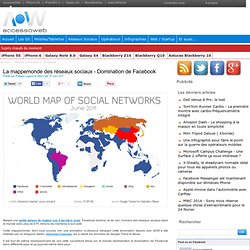
Cependant, les grands marchés de ce continent restent l’apanage d’acteurs locaux. La mappemonde des réseaux sociaux - Domination de Facebook. Malgré une petite baisse de régime ces 2 derniers mois, Facebook domine, et de loin, l'univers des réseaux sociaux dans le monde avec plus de 675 millions de membres à son actif.
Social networks around the world 2010. Social media around the world 2011. La carte du monde des réseaux sociaux. La dernière édition de la carte du monde des réseaux sociaux datait de décembre 2010.
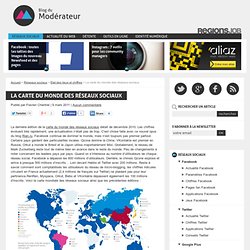
Les chiffres évoluant très rapidement, une actualisation n’était pas de trop. C’est chose faite avec ce nouvel opus du blog Rian.ru. Facebook continue de dominer le monde, mais n’est toujours pas premier partout. Certains pays gardent des particularités locales. Qzone domine la Chine, VKontakte est premier en Russie, Orkut a inondé le Brésil et le Japon utilise majoritairement Mixi. Via. World Map of Social Networks. January 2017: a new edition of my World Map of Social Networks, showing the most popular social networking sites by country, according to Alexa & SimilarWeb traffic data (caveat: it’s hard to understand the impact of Google+ because it is part of Google domain traffic).
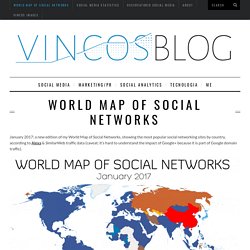
There are a lot of news since last January: Facebook is still the leading social network in 119 out of 149 countries analyzed, but it was stopped in 9 territories by Odnoklassniki, Vkontakte and Linkedin. It’s interesting to see that in some countries, like Botwana, Mozambique, Namibia, Iran e Indonesia, Instagram wins and that some African territories prefer LinkedIn. Overall LinkedIn conquers 9 countries, Instagram 7, meanwhile VKontakte and Odnoklassniki (part of the same group Mail.ru) grow up in Russian territories. In China QZone still dominates the Asian landscape with 632 million users and Japan is the only country where Twitter is the leader.
But what’s going on behind the first place? L'utilisation des médias sociaux dans le monde. Le site SocialBakers est une mine de chiffres concernant l’utilisation des réseaux sociaux.

A l’origine consacré uniquement à Facebook, il intègre désormais Twitter et LinkedIn à ces sites audités, même si la firme de Palo Alto reste son coeur de métier, avec des statistiques très variés et très fines à ce sujet. Les usages des principaux médias sociaux. Comment le monde passe son temps en ligne. Global Audience Spends Two Hours More a Month on Social Networks than Last Year. On average, global web users across 10 countries spent roughly five and a half hours on social networks in February 2010, up more than two hours from the same time last year.
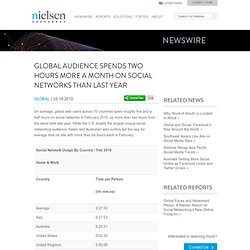
While the U.S. boasts the largest unique social networking audience, Italian and Australian web surfers led the way for average time on site with more than six hours each in February. Overall, the active unique audience to social networks grew nearly 30%, from 244.2M to 314.5M in the last year. In the U.S., the average active unique audience grew to 149.M from 115M in February 2009. Across the 10 countries measured, Facebook drew the largest active unique audience globally and claimed nearly three times the sessions per user of MySpace, the next closest network. Facebook users also spent more time per session, logging nearly six hours per user across the globe. Socialbakers ❶ Social media (Facebook, Twitter…) marketing, statistics & monitoring. Top 5 Social Networking Sites Outside the Big 3 (Part 1 of 5) The world of social networking seems to be at a stable place with Facebook, Twitter and LinkedIn being the titans of the online world.
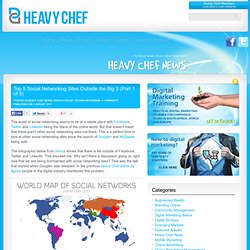
But that doesn’t mean that there aren’t other social networking sites out there. This is a perfect time to look at other social networking sites since the launch of Google+ and MySpace being sold. The infographic below from Vincos shows that there is life outside of Facebook, Twitter and LinkedIn. This shocked me. Top 5 Social Networking Sites Outside the Big 3: Renren (4 of 5) With Facebook being banned from entering the social networking market in China.
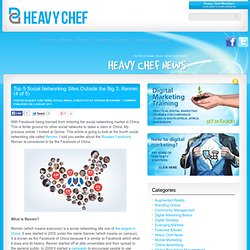
This is fertile ground for other social networks to stake a claim in China. My previous article, I looked at Qzone. Top 5 Social Networks Outside the Big 3 (Part 3 of 5) Top 5 Social Networks Outside the Big 3 (Part 3 of 5) Posted in Heavy Chef News, Concocted by Tatenda Mutsekwa, Published on 4 August 2011 The third article in the series about the top 5 social networking sites outside the big 3 discusses Qzone.

This social network can be found mainly in China. According to their 2009 report more than 200 million people in China were using QZone, leaving behind the leading international players like Facebook and MySpace. Recent statistics have shown this number to have doubled. Unlike V Kontakte, which had English language capabilities helping me to understand what was happening, this network was a bit more difficult to tackle due to the language barriers but we managed to uncover some interesting facts. In addition, a translation of an original QQ press release states that not only are their numbers high but that they also have the most active community in the industry:
Top 5 Social Networks Outside the Big 3 (Part 2 of 5) Top 5 Social Networks Outside the Big 3 (Part 2 of 5) Posted in Heavy Chef News, Videos, Concocted by Tatenda Mutsekwa, In our last article I started the discussion of the top 5 social networking sites outside the big 3.

I started by looking at V Kontakte and its growth. It is amazing how popular VK is to the extent that Facebook is an underdog. I’m so impressed. Top 5 Social Networking Sites Outside the Big 3: Badoo (5 of 5) Top 5 Social Networking Sites Outside the Big 3: Badoo (5 of 5) Posted in Heavy Chef News, Concocted by Tatenda Mutsekwa, 2 comments Published on 8 August 2011 This is the last article in a series looking at other 5 social networks outside the top 3. It has been an interesting ride realizing that there is more to life than Facebook, Twitter and LinkedIn. I am still trying to get people onto Russian network VK so we can have a party there getting our social networking on. So far, no takers.
China's Top 3 Social Network Sites. The leading social networking site in China, renren.com, started out as a blatant Facebook clone - but it now has tens of millions of users. Despite obvious similarities to Facebook, there is one significant difference from the U.S. in how Renren and other Chinese SNS are used. The bread and butter of these sites is social games using virtual items. Attack of the Facebook clones: Russia's Vkontakte. International ripoffs of successful web companies can be found everywhere, from Frazr, the German Twitter clone, to Digg Malaysia, the Malaysian clone of the news-ranking site Digg. Not to be outdone, the Russian social network Vkontakte (or “virtual contact”) has copied Facebook’s look and feel almost exactly — not to mention its growth rate.
See Alexa graph and screenshot gallery, below. Copying Facebook has already turned out to be lucrative in other countries. Pal. Quand la religion lance ses réseaux sociaux. A en croire Karl Marx, « la religion est l'opium du peuple », et avec l’avènement d’Internet, le peuple se tourne davantage vers ses écrans plutôt que ses prières. Faceglat, le Facebook casher des ultraorthodoxes juifs. Internetzensur - Zugriff verboten - Digital. Le design de la visibilité : un essai de typologie du web 2.0. La manière dont est rendue visible l’identité des personnes sur les sites du web 2.0 constitue l’une des variables les plus pertinentes pour apprécier la diversité des plateformes et des activités relationnelles qui y ont cours.
Que montre-t-on de soi aux autres ? Comment sont rendus visibles les liens que l’on a tissés sur les plateformes d’interaction ? The Social Web - Collectivate.net. The Social WebWeb 2.0 What Went Wrong? Course DescriptionIs it feasible to live ethical, meaningful lives in the context of the Social Web today? This course formulates a critique of the Social Web. Based on the rapid growth of participation in social life online and in mobile space-- from social news, referral, social search, media sharing, social bookmarking, tagging, virtual worlds and social networked games, social mapping, IM, social networking, blogging and dating, this class formulates a critical analysis of the international Social Web with regard to privacy, intellectual property, and the utilization of social creation of value through the lens of a small number of case studies in the areas of education, political activism, and art.
Social Network Sites: Definition, History, and Scholarship. Cultures et organisations: Nos ... - Geert Hofstede, Gert Jan Hofstede, Michael Minkov - Google Bücher. Geert Hofstede. Kulturdimensionen nach Hofstede. 1774_chi2011_chenzhao. How Cross-Cultural Differences Impact International Social Media. Many of the social media platforms I use were created by Americans. And I am not American. Although coming from the Bahamas, I can relate to Americans in many ways, I still feel the cultural friction. There are still some very big cultural differences between my cultural background and the American culture. Understanding cultural differences - Edward Twitchell Hall, Mildred Reed Hall - Google Bücher. A Cross-Cultural Analysis of Websites from High-Context Cultures and Low-Context Cultures. Five lessons learned about cross-cultural social networking. Looking for a clear and simple path to a new intranet?
Download our free Intranet Buyers Workbook to learn 10 key steps in evaluating intranet solutions. Social networking theorists like to debate whether and how much cultural differences impact the way people respond to and interact with social networks. . * International Values and Communications Technologies » Using Geert Hofstede Cultural Dimensions to Study Social Media Usage in BRIC Countries. We felt that it will be useful to start our study on the BRIC model of social media by doing a deep dive into the area of cross-cultural communication — how national cultural nuances mediate communication. Geert Hofstede Cultural Dimensions Perhaps the most important model to study cross-cultural communication is the one developed by Prof.
Geert Hofstede 1.