
Classify It! App. You can use this app to help build on your students' understanding of the classification of organisms.
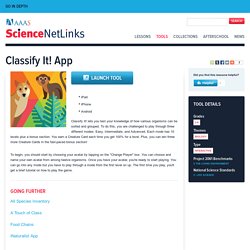
It would be a good way to help students understand that many kinds of organisms can be sorted into groups in many ways using various features to decide which organisms belong to which group. The app also helps demonstrate how classification systems are frameworks used by biologists and demonstrates how living organisms can be classified in a variety of ways.
Since playing through the app can be time consuming, one way to use it would be to divide your students into groups and have each group play through a mode. You could ask your students questions based on the categories and organisms found in a particular mode. You also can make use of the Creature Cards that students can earn while playing the game. Classification 1: Classification Scheme 3-5 | Hands-On Classification 2: A Touch of Class 3-5 | Interactive Classify That! The Scale of the Universe 2. Learn Science at Nature. The Story of the Animal Kingdom. Biologypop- All about Biology. The Secret Lives of Wild Animals. Nature Works Everywhere. Talking Glossary of Genetic Terms. Glossary Home | Text Version Designed to help learners at any level better understand genetic terms Guided by national science standards Explained by scientists at the NIH The National Human Genome Research Institute (NHGRI) created the Talking Glossary of Genetic Terms to help everyone understand the terms and concepts used in genetic research.
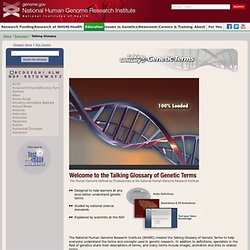
In addition to definitions, specialists in the field of genetics share their descriptions of terms, and many terms include images, animation and links to related terms. Enter a search term or explore the list of terms by selecting a letter from the alphabet on the left and then select from the terms revealed. (A text-only version is available from here.) The Talking Glossary At the bottom of most pages in the Talking Glossary are links to help you get the most out of this glossary. Virtual Frog Dissection. Biology in Motion. Home of CELLS alive!
Darwin, a naturalist's voyage around the world - CNRS sagascience. WHOPOOPED.ORG. Siku Cam 1 - Polar Bears. Catlin Seaview Survey. Ocean Tracks. Nestcams - View Cams. Science Of Gardening: Feed: Plants and people alike, we all have a need to feed. China - Pandas. Biology. Extract Your DNA. Project Noah. Google Earth Tours. Build a Body. Biology - dawnwelch7. Welcome to Ask a Biologist. Discover the world's most endangered species.
Wildscreen's Arkive project was launched in 2003 and grew to become the world's biggest encyclopaedia of life on Earth. With the help of over 7,000 of the world’s best wildlife filmmakers and photographers, conservationists and scientists, Arkive.org featured multi-media fact-files for more than 16,000 endangered species. Freely accessible to everyone, over half a million people every month, from over 200 countries, used Arkive to learn and discover the wonders of the natural world. Since 2013 Wildscreen was unable to raise sufficient funds from trusts, foundations, corporates and individual donors to support the year-round costs of keeping Arkive online. Therefore, the charity had been using its reserves to keep the project online and was unable to fund any dedicated staff to maintain Arkive, let alone future-proof it, for over half a decade. Despite appeals for support, just 85 of our 5.6 million users in 2018 made a donation. Interactive Biology, By Leslie Samuel.
Cell menu. Sheppard Software's Life-Cycles: Learn about different animal life-cycles. Kid's Corner - Main Page on Animal Classification - Mammals, Reptiles, Birds, Amphibians and Fish. Deep Sea Strangers: Fascinating and bizarre creatures from the ocean's depths. A Natural Science Resource for Students and Educators. Indicates a section of the site that is available to subscribing members only.
Not a member? Feel free to click on these links and view the samples we have made available. Then check out the low cost and great benefits to subscribers! Home | Citing this Reference | About Us | Frequently Asked Questions | Contact Us | Privacy ©2005-2015 Sheri Amsel. Website developed by Grayslake Webmasters. UPM - Forest Life. Cameron Park Zoo. San Diego Zoo - Kids.