
400 Free Online Courses from Top Universities. Advertisment Take online courses from the world’s top universities for free.
Top 10 Universities With Free Courses Online. #1 UC Berkeley Ranked as the #1 public school in the United States, Berkeley offers podcasts and webcasts of amazing professors lecturing.
Each course has an RSS feed so you can track each new lecture. For printable assignments and notes you can check the professors homepage, which is usually given in the first lecture or google his name. Online Education Database - Online Colleges and Universities. 100 Incredible Lectures from the World’s Top Scientists. Posted on Thursday June 18, 2009 by Staff Writers By Sarah Russel Unless you’re enrolled at one of the best online colleges or are an elite member of the science and engineering inner circle, you’re probably left out of most of the exciting research explored by the world’s greatest scientists.
But thanks to the Internet and the generosity of many universities and online colleges, you’ve now got access to the cutting edge theories and projects that are changing the world in this list below. If you’re looking for even more amazing lectures, check out our updated list for 2012 with more talks from great minds. General Let the world’s top scientists explain exactly how they do their job when you listen to these lectures. Science and Engineering From materials science to the study of thermodynamics, learn more about the science of engineering here. WTC Lecture – collapse of WTC Buildings: Steven E. Biology and Medicine Chemistry. Online Universities - Accredited Online University Guide. A complete list of free online courses offered by Stanford's Coursera, MIT and Harvard led edX (MITx+HardvardX+BerkeleyX), and Udacity.
OER Commons. Steve Wheeler: Open Educations Wordwide! Chaîne de CollegeBinary. Keeping MOOCs Open. MOOCs — or Massive Open Online Courses — have been getting a lot of attention lately.
Just in the last year or so, there’s been immense interest in the potential for large scale online learning, with significant investments being made in companies (Coursera, Udacity, Udemy), similar non-profit initiatives (edX) and learning management systems (Canvas, Blackboard). The renewed interest in MOOCs was ignited after last year’s Introduction to Artificial Intelligence course offered via Stanford University, when over 160,000 people signed up to take the free online course.
The idea of large-scale, free online education has been around for quite some time. Some examples include David Wiley’s 2007 Introduction to Open Education; Connectivism and Connective Knowledge, led by George Siemens and Stephen Downes in 2008; Open Content Licensing for Educators; and many others. A central component to these earlier iterations of the MOOC was the dual meaning of “open.” OpenLearn - The Open University.
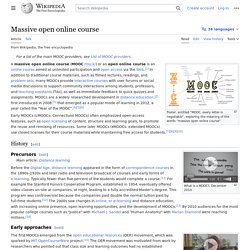
Massive open online course. Poster, entitled "MOOC, every letter is negotiable", exploring the meaning of the words "Massive Open Online Course" A massive open online course (MOOC /muːk/) is an online course aimed at unlimited participation and open access via the web.[1] In addition to traditional course materials such as filmed lectures, readings, and problem sets, many MOOCs provide interactive user forums to support community interactions among students, professors, and teaching assistants (TAs).
MOOCs are a recent and widely researched development in distance education which were first introduced in 2006 and emerged as a popular mode of learning in 2012.[2][3] Early MOOCs often emphasized open-access features, such as open licensing of content, structure and learning goals, to promote the reuse and remixing of resources.
Some later MOOCs use closed licenses for their course materials while maintaining free access for students.[4][5][6][7]
Microsoft PowerPoint - POEMs VUB14 - POEMs VUB14.pdf. Moosphere. Using mLearning and MOOCs to understand chaos, emergence, and complexity in education. Inge deWaard Athabasca University, Canada Sean Abajian Los Angeles Unified School District, USA Michael Sean Gallagher JSTOR, USA Rebecca Hogue University of Ottawa, Canada Nilgün Keskin Anadolu University, Turkey Apostolos Koutropoulos University of Massachusetts, USA Osvaldo C.
Abstract. Khan Academy. OpenCourseWare at the Johns Hopkins Bloomberg School of Public Health. Learn Science at Nature. Chaîne de khanacademy. Open Course Library. Smarthistory: a multimedia web-book about art and art history.
Educational Websites. Coursera. OpenStax College. TeacherTube - Teach the World. Oxford Open. OUP Supports Open Access Oxford University Press (OUP) is mission-driven to facilitate the widest possible dissemination of high-quality research.
We embrace both green and gold open access (OA) publishing to support this mission. A Proven Track Record of Success OUP has been publishing OA content since 2004. Since that time, ‘gold’ OA has grown dramatically and proven effective in some disciplines. Free Online Courses. Advance your College Education & Career. 8,200+ Strong, Researchers Band Together To Force Science Journals To Open Access.
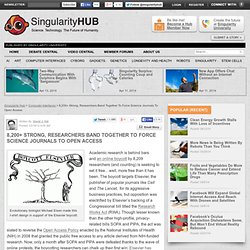
Evolutionary biologist Michael Eisen made this t-shirt design in support of the Elsevier boycott.
Academic research is behind bars and an online boycott by 8,209 researchers (and counting) is seeking to set it free…well, more free than it has been. The boycott targets Elsevier, the publisher of popular journals like Cell and The Lancet, for its aggressive business practices, but opposition was electrified by Elsevier’s backing of a Congressional bill titled the Research Works Act (RWA). Though lesser known than the other high-profile, privacy-related bills SOPA and PIPA, the act was slated to reverse the Open Access Policy enacted by the National Institutes of Health (NIH) in 2008 that granted the public free access to any article derived from NIH-funded research. But the fight for open access is just getting started.
Seem dramatic? Free Online Course Materials. FreeLearning.pdf (application/pdf Object) Commons learning alliance. InTech - Open Science Open Minds. Mary & mac design. Intro to AI - Introduction to Artificial Intelligence - Oct-Dec 2011. Learning for everyone, by everyone, about almost anything. Your Free Online School: Courses, Video Lectures, Documentaries, Images, Books and more. Alsica.pdf - isociety11.pdf. Learning Materials. DNA from the Beginning DNA from the Beginning is an animated tutorial on DNA, genes and heredity.

The science behind each concept is explained using... see more DNA from the Beginning is an animated tutorial on DNA, genes and heredity. Microsoft Word - 211-The MOOC as Distributed Intelligence- Dimensions of a Framework & Evaluation of MOOCs.doc - Framework-for-Design-Evaluation-of-MOOCs-Grover-Franz-Schneider-Pea_final.pdf.
12 Dozen Places To Educate Yourself Online For Free. OCW Consortium. OpenCourseWare. History[edit] The OpenCourseWare movement started in 1999 when the University of Tübingen in Germany published videos of lectures online for its timms initiative (Tübinger Internet Multimedia Server).[1] The OCW movement only took off, however, with the launch of MIT OpenCourseWare at the Massachusetts Institute of Technology (MIT) and the Open Learning Initiative at Carnegie Mellon University[2] in October 2002.
The movement was soon reinforced by the launch of similar projects at Yale, the University of Michigan, and the University of California Berkeley. MIT's reasoning behind OCW was to "enhance human learning worldwide by the availability of a web of knowledge".[3] MIT also stated that it would allow students (including, but not limited to its own) to become better prepared for classes so that they may be more engaged during a class. Serendipity. OpenCourseWare. Un article de Wikipédia, l'encyclopédie libre. OpenCourseWare (OCW) désigne un projet destiné à mettre gratuitement en ligne des cours de niveau universitaire, de la même façon que les logiciels libres le sont.
Généralement, les cours viennent avec une licence de distribution et de modification peu restrictive, souvent une licence Creative Commons[1]. Une application libre de visioconférence conçue pour les profs. À l'ère des MOOC (Massive Online Open Course) et de l'éducation en ligne, posséder une bonne plateforme de visioconférence est essentiel. Il existe déjà des applications gratuites répondant à ces besoins. Par exemple, le « hangout » de Google + fonctionne très bien. Néanmoins, il n'est pas spécifiquement conçu pour l'enseignement à distance comme le logiciel que nous vous présentons aujourd'hui.
BigBlueButton est une application de visioconférence à code ouvert qui se veut simple à utiliser et offre toute la flexibilité nécessaire pour les enseignants et les apprenants. En fait, l'installation constitue le seul élément délicat, dans la mesure où il faut la réaliser sur un serveur capable de supporter le volume de connexions attendu dans votre cours (plusieurs dizaines, centaines, voire milliers de connexions en même temps). Du côté des utilisateurs, BigBlueButton exige 2 Gigaoctets de mémoire vive au minimum et un processeur de 2 GHZ et plus. MOOC completion rates. Connexions - Sharing Knowledge and Building Communities. Welcome to OpenWaldorf.com! School of Open. Learn open practices at School of Open.
Why "open"? Universal access to and participation in research, education, and culture is made possible by openness, but not enough people know what it means or how to take advantage of it. We hear about Open Source Software, Open Educational Resources, and Open Access… But what are these movements, who are their communities, and how do they work? Most importantly—how can they help me? A collaboration with the public. Connectivism. Upload and Search Theses and Dissertations - OpenThesis. Connectivism and MOOCs.