
Operation Deep Sleep: or, dormant robots at the bottom of the sea. [Image: An otherwise unrelated photo of lift bags being used in underwater archaeology; via NOAA].
The Defense Advanced Research Projects Agency, or DARPA, is hoping to implement a global infrastructure for storing mission-critical objects and payloads at the "bottom of the sea"—a kind of stationary, underwater FedEx that will release mission-critical packages for rendezvous with passing U.S. warships and UAVs. It's called the Upward Falling Payloads program. The "concept," according to DARPA, "centers on developing deployable, unmanned, distributed systems that lie on the deep-ocean floor in special containers for years at a time.
These deep-sea nodes would then be woken up remotely when needed and recalled to the surface. In other words, they 'fall upward.'" As Popular Science describes it, it's a sleeping archive of "'upward falling' robots that can hide on the seafloor for years [and] launch on demand. " Satellite Analysis Shows Gulf Oil Spills Typically Underestimated. 30 Jan 2013: Satellite Analysis Shows Gulf Oil Spills Typically Underestimated An analysis of satellite images has revealed that small oil spills that have become common in the Gulf of Mexico are often much larger than reported, U.S. scientists say.

Using technology that calculates the size of oil slicks based on differences in the texture of water surface, as captured in publicly available satellite photos, a team of oceanographers at Florida State University (FSU) estimated that known human-caused spills in the Gulf were typically about 13 times larger than reported to the U.S. Coast Guard’s National Response Center. Oil spills underreported in Gulf of Mexico. Energy Department Launches New Database to Support Sustainable Development of Ocean Energy Resources. New Tethys Database Offers Real-World Data, Guidance for Responsible Ocean Energy Development. Clean Power Published on February 13th, 2013 | by Andrew The US Department of Energy (DOE) has launched an online database containing “results of environmental monitoring and research efforts on wave, tidal, and current energy development worldwide.”

Named after the Greek titaness of the ocean, Tethys “will help industry regulators and enrgy project developers deploy sustainable ocean energy projects in an environmentally responsible manner,” according to a DOE Energy Efficiency & Renewable Energy (EERE) news release. The Arctic: Tequila sunset. David Miliband to head global fight to prevent disaster in the 'lawless oceans' Factory fishing in the Bering Sea: 'We are living as if there are three or four planets instead of one, and you can’t get away with that,' says David Miliband.

Photograph: Natalie Fobes/Corbis An environmental catastrophe with greater economic impact than the global financial crash is occurring on the high seas, according to David Miliband. Bottom trawling resuspends sediment and relea... [Environ Pollut. Tomorrow's life-saving medications may currently be living at the bottom of the sea. OHSU researchers, in partnership with scientists from several other institutions, have published two new research papers that signal how the next class of powerful medications may currently reside at the bottom of the ocean.

In both cases, the researchers were focused on ocean-based mollusks - a category of animal that includes snails, clams and squid and their bacterial companions. Sea life studies aid researchers in several ways, including the development of new medications and biofuels. Because many of these ocean animal species have existed in harmony with their bacteria for millions of years, these benign bacteria have devised molecules that can affect body function without side effects and therefore better fight disease. To generate these discoveries, a research partnership called the Philippine Mollusk Symbiont International Cooperative Biodiversity Group was formed. Salmon steak from GM fish could soon be on your plate.
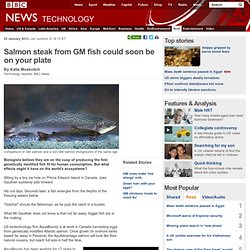
22 January 2013Last updated at 19:15 ET By Katia Moskvitch Technology reporter, BBC News Comparison of GM salmon and a non-GM salmon (foreground) of the same age.
Viruses infect tiny ocean creatures, too. CORNELL (US) — Scientists have found evidence that previously unknown viruses infect marine crustaceans called copepods, which are key to ocean carbon cycling.

While predation by fish and other aquatic creatures accounts for the majority of copepod deaths, up to 35 percent of the zooplankton’s mortalities are unknown. Harmful algae, environmental stressors, parasites, and diseases are likely all involved in copepod mortalities. “This is the first evidence of viruses in marine zooplankton,” says Ian Hewson, assistant professor of microbiology at Cornell University and senior author of the paper published in the Proceedings of the National Academy of Sciences. The finding is important because copepods are critical in oceanic food webs and ocean carbon cycling, a key process for regulating Earth’s climate.
Marine free-floating plants called phytoplankton sequester about half of the carbon dioxide that is pulled from the atmosphere and fixed in plant cells during photosynthesis. For ocean critters, plastic packs double whammy. UC DAVIS (US) — Eating plastic is a threat to marine creatures, but so are the pollutants those plastics have absorbed while floating in the ocean, say researchers.

A new study finds that the most commonly produced plastics also absorbed the most chemicals, and for longer periods of time than previously thought. Products made from the particular plastic used to make water bottles (polyethylene terephthalate, or PET) might have fewer detrimental chemical impacts than products made from other types of plastic, according to the study, published online in Environmental Science & Technology.