
Verbs and Verbals. Auxiliary || gerunds || infinitives || irregular || linking || mood || auxiliary || participles || phrasal || causative || factitive ||sequence || tense There are separate sections on Definitions Verbs carry the idea of being or action in the sentence.
I am a student. The students passed all their courses. As we will see on this page, verbs are classified in many ways. Although you will seldom hear the term, a ditransitive verb — such as cause or give — is one that can take a direct object and an indirect object at the same time: "That horrid music gave me a headache. " Linking_verbs.pdf (application/pdf Objeto) Linking Verbs. A verb indicates the time of an action, event or condition by changing its form.
Through the use of a sequence of tenses in a sentence or in a paragraph, it is possible to indicate the complex temporal relationship of actions, events, and conditions There are many ways of categorising the twelve possible verb tenses. The verb tenses may be categorised according to the time frame: past tenses, present tenses, and future tenses. The Linking Verb. Linking verbs do not express action.
Instead, they connect the subject of the verb to additional information about the subject. Look at the examples below: Keila is a shopaholic. Ising isn't something that Keila can do. Is connects the subject, Keila, to additional information about her, that she will soon have a huge credit card bill to pay. The following verbs are true linking verbs: any form of the verb be [am, is, are, was, were, has been, are being, might have been, etc.], become, and seem. Sylvia tasted the spicy squid eyeball stew.
This substitution will not work for appear. Swooping out of the clear blue sky, the blue jay appeared on the branch. Gerunds and Infinitives. What is a Gerund?
A gerund (often known as an -ing word) is a noun formed from a verb by adding -ing. See also Nouns/Gerund. Not all words formed with -ing are gerunds. You've probably been using them for years. What is the infinitive? An infinitive is to + the verb. The most famous infinitive quote has to be, "To be or not to be. Modal Article – Identifying Modals in Context. Modal Article Identifying Modals In Context The Recording Industry vs.
Music Pirates Text of Article Programs such as Napster and Gnutella allow you to download MP3 files from other people's hard drives without paying a penny to the artist or entertainment industry. The Recording Industry Association of America (RIAA), an industry group that represents major record labels, filed suit against Napster. How does this affect you? It might put Napster out of business, and if you're a devoted Napster user, this is certainly sad news.
Should the recording industry wish to get personal and go after individuals--and you engage in this kind of file trading--it's possible that you'll be taken to task (prosecuted) for your actions. Where will this all lead? Practice Recognizing the Verb Forms in Context. Phrasal Verb Dictionary.
To look up a phrasal verb, click a letter in the menu.
The formats below are used in phrasal verb definitions.separable verbs: (talk * into)inseparable verbs: (run into +)object can be in both positions: (look * up +) 1. A phrasal verb is a verb plus a preposition or adverb which creates a meaning different from the original verb. Example: I ran into my teacher at the movies last night. run + into = meet He ran away when he was 15. run + away = leave home. Two-Part (Phrasal) Verbs (idioms) Verbs Followed by Infinitives. Irregular Verb Page.
Englishpage.com's Irregular Verb Dictionary for English learners contains over 370 irregular verbs used in modern English as well as flashcards and exercises to practice those forms.
To view our Extended Irregular Verb Dictionary, which contains over 470 verbs including rare and antiquated forms, Click Here. List of Irregular Verbs Irregular Verb Flashcards and Drills If you want to learn irregular verbs, you need to practice, practice, practice. Below we have created five sets of flashcards as well as simple irregular verb drills to help English learners learn the 100 most common irregular verbs in English. English Irregular Verb Flashcards - Englishpage.com. Modal Verbs - Glossary Definition. Verbs Followed by Gerunds. Modal Verbs. Modal Summary. Grammar-Quizzes › Verb Phrases › Verb Groups › Modals Summary of Practices Modal Diagnostic: identify specific points that need review Quiz 1: beginning – intermediate Quiz 2: intermediate – advanced Will / Might: express varying degrees of certainty Beg—Inter.
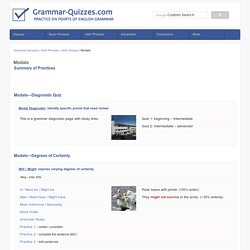
Polar bears will perish. (100% certain) They might not survive in the arctic. (< 50% certainty) Will / Would: express attitudes of determination, unwillingness or failure I will win this singing contest! The judges won't let me sing another song. I would have done better, but my voice cracked. Be going / Will: express immediate vs scheduled future events I am going to text Brad the news. I will call Jill tomorrow to see how she is. We are going to go to the movies. We are going to come home.
Will be -ing: express future activities with focus on the flow of time Beg–Adv ESL. Perfect Modals Ppt Presentation. Slide 1: Used to give possible reasons why something happened or didn’t happen in the past.

Perfect Modals may have... might have... could have... must have...