
Dog Evolution. Undermining biology, one class at a time. We know full well that teachers bring their personal opinions into the classroom even though they’re not really supposed to do that.
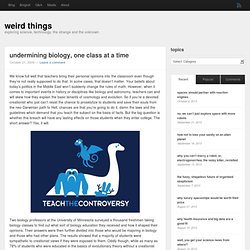
In some cases, that doesn’t matter. Your beliefs about today’s politics in the Middle East won’t suddenly change the rules of math. However, when it comes to important events in history or disciplines like biology and astronomy, teachers can and will skew how they explain the basic tenants of cosmology and evolution. So if you’re a devoted creationist who just can’t resist the chance to proselytize to students and save their souls from the neo-Darwinian path to Hell, chances are that you’re going to do it, damn the laws and the guidelines which demand that you teach the subject on the basis of facts.
But the big question is whether this breach will have any lasting effects on those students when they enter college. Memo to the genius who wrote this. Survey data: Moore, R., & Cotner, S. (2009) . [ again, as per tradition, illustration by Controversy Wear ] How Evolution Works" The theory of evolution is one of the best-known scientific theories around.

Try to make it through a day without using or hearing the word "evolution" and you'll see just how widespread this theory is. Evolution is fascinating because it attempts to answer one of the most basic human questions: Where did life, and human beings, come from? Resources For The Classroom. Do blue eyes stem from the Black Sea 8,000 years ago? (Photo by Andrés Nieto Porras/Flickr) Treehouse students will often ask me which mockup tool I use to prototype websites, and my response is almost always the same: pencil and paper.

I feel like when I give this answer, there's a small sigh of disappointment. I think it's because people are hoping for a better way to simplify the complexities of creative problem-solving. Even though my answer might not be very flashy, building a website with a prototype is often much faster than skipping the prototype phase. Even for a very simple website, a five-minute sketch could save hours of trial and error in the late stages.
It's tempting to open Photoshop or begin coding right away because these digital tools put a cap on the level of naivety and ignorance we can display. Teaching of Evolution in Schools - NSTA Position Statements. Introduction The National Science Teachers Association (NSTA) strongly supports the position that evolution is a major unifying concept in science and should be emphasized in K–12 science education frameworks and curricula.
Furthermore, if evolution is not taught, students will not achieve the level of scientific literacy needed to be well-informed citizens and prepared for college and STEM careers. National Center for Science Education - Defending the Teaching of Evolution & Climate Science. Www.nabt.org/websites/institution/index.php?p=110.
Teaching Evolution. This summary was compiled by Karin Kirk, SERC, and is drawn from the sources referenced below.
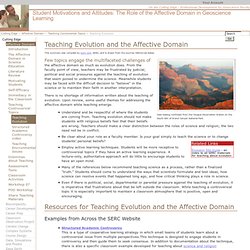
View looking northeast from the Yavapai Observation Station on the South Rim of Grand Canyon National Park. Teaching Evolution. On Evolution, Biology Teachers Stray From Lesson Plan. A suggested project-based evolution unit for high school: teaching content through application. In Search of..... - TV.com www.tv.com/shows/in-search-of Narrarated by Leonard Nimoy, In search of was a 30 minute syndicated show that covered a wide range of paranormal topics.
It pioneered a lot of the methodology that ... Search Engine - Download.com download.cnet.com/s/search-engine search engine free download - GSA Search Engine Ranker, Nomao - The personalized search engine, Zoom Search Engine, and many more programs. Understanding Evolution For Teachers. Text only version. K-12 Resources. A Suggested Project-Based Evolution Unit for High School: Teaching Content Through Application. American Society of Naturalists. (1997).
The challenges and opportunities facing the science of evolution. Proceedings from the Working Committee Meetings of the American Society of Naturalists. Retrieved March 22, 2008, from . Anderson, R. ( 2007 ). Teaching the theory of evolution in social, intellectual, and pedagogical context. Blumenfeld, P. Demastes, S. Donnelly, L. & Boone, W. ( 2007 ). Teaching About Evolution and the Nature of Science. Teaching materials. Teaching materials Evolution is essential to our curriculum and to scientific literacy.
Imagine teaching social science without teaching history; students would lack perspective on events going on today. Similarly, to understand the big picture of biology, students need to understand life on Earth in terms of its history and its future — the changing life forms and ecosystems that have arisen and changed over billions of years, as well as the mechanisms that have brought about those changes. Evolution. Peppered Moth Simulation. Name:______________________________________________ Objective: Simulate changes in moth population due to pollution and predation, and observe how species can change over time.
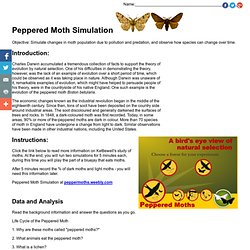
Introduction: Charles Darwin accumulated a tremendous collection of facts to support the theory of evolution by natural selection. One of his difficulties in demonstrating the theory, however, was the lack of an example of evolution over a short period of time, which could be observed as it was taking place in nature. Peppered moth simulation. What is the evidence? Creation SuperLibrary™ at ChristianAnswers. Understanding Evolution.