
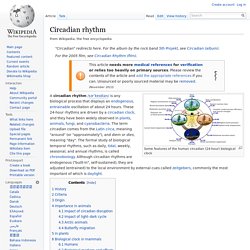
Patricia Burchat sheds light on dark matter. Craig Venter is on the verge of creating synthetic life. Circadian rhythm. Some features of the human circadian (24-hour) biological clock History[edit] The earliest recorded account of a circadian process dates from the 4th century B.C.E., when Androsthenes, a ship captain serving under Alexander the Great, described diurnal leaf movements of the tamarind tree.[1] The observation of a circadian or diurnal process in humans is mentioned in Chinese medical texts dated to around the 13th century, including the Noon and Midnight Manual and the Mnemonic Rhyme to Aid in the Selection of Acu-points According to the Diurnal Cycle, the Day of the Month and the Season of the Year.[2] The first recorded observation of an endogenous circadian oscillation was by the French scientist Jean-Jacques d'Ortous de Mairan in 1729.
The term circadian was coined by Franz Halberg in the 1950s.[10] Criteria[edit] To be called circadian, a biological rhythm must meet these three general criteria:[11] Origin[edit] The simplest known circadian clock is that of the prokaryotic cyanobacteria. Danny Hillis: Understanding cancer through proteomics. Institute for Systems Biology: Home. ExPASy Proteomics Server. Gray, Henry. 1918. Anatomy of the Human Body. InnerSuper.
Anatomy Dissection Videos Video Lecture Course. - StumbleUpon. CosmoLearning Biology - StumbleUpon. Biology Project - site map.
Human Body & Mind - StumbleUpon. The Human Body - A Dissection (Not for Weak Hearted People) From the tiniest veins, arteries and nerves to serial cross-sections of the spinal cord, these incredibly detailed dissections show and label most every part of the human body. The collection is the product of a 17-year collaboration between David L. Bassett, a School of Medicine alumnus and faculty member known for his elegant dissections and love for the human body, and William Gruber, the photographer who invented the View-Master stereoscopic viewing device. The partnership between the two resulted in the production of the Stereoscopic Atlas of Human Anatomy, which began in 1948, but was not not completed until 1962.
It consisted of 221 View-Master reels with 1,554 color stereo views of dissections of every body region. Each stereo view was accompanied by a black-and-white, labeled drawing and explanatory text. A courtesy the Lane Medical Archives (thanks Drew!) The onion-like structure is an eye, seen from above with the bony roof of the eye socket removed. The cervical spinal cord. THE BRAIN FROM TOP TO BOTTOM. Clinical Anatomy. Gary Carlson - Illustration &Animation - Medical &Biological. BioVisions.
Vitamins, Vitamin Table. Deutsch: Gesundheits- und Fitnessrechner Here you can calculate the following informations on health and fitness topics:BMI | Ideal weight | Calorie consumption | Liquid consumption | Walking Index | Nutrition values | Vitamin table | Basic conversion | Body fat (adipose) rate | Optimal training pulse and heart rate | Protein requirement | Fat requirement | Nutrition value need | WHR - Waist to hip ratio | Drink reminder Vitamins Here you can find a detailed table of the most important vitamins.
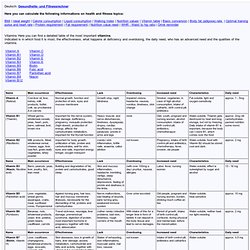
Indicated is in which food it is most, the effectiveness, what happens at deficiency and overdosing, the daily need, who has an advanced need and the qualities of the vitamins. Convert length units and weight units. © Jumk.de Webprojects | Imprint & Privacy No responsibility is taken for the correctness of these informations. <div style="color:#ff0000;font-weight:bold">JavaScript must be activated to be able tu use the calculator. Biology That Makes Us Tick: Free Stanford Course by Robert Sapolsky.
Adductor Pollicis & Musculoskeletal Radiology & UW Radiology. Aditi Shankardass: A second opinion on learning disorders.