
Scientist Prove DNA Can Be Reprogrammed by Words and Frequencies. New neurons help us to remember fear. Fear burns memories into our brain, and new research by University of California, Berkeley, neuroscientists explains how.
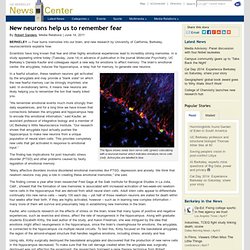
Scientists have long known that fear and other highly emotional experiences lead to incredibly strong memories. In a study appearing online today (Tuesday, June 14) in advance of publication in the journal Molecular Psychiatry, UC Berkeley’s Daniela Kaufer and colleagues report a new way for emotions to affect memory: The brain’s emotional center, the amygdala, induces the hippocampus, a relay hub for memory, to generate new neurons. The figure shows newly born nerve cells (green) colocalizing with a neuronal marker which indicates immature nerve cells (red). Michio Kaku: The Universe in a Nutshell. The World's Smallest Writing.
10 mindblowingly futuristic technologies that will appear by the 2030s. Maverick science.com. Future Of Emerging Technology: An Interactive Infographic Maps The. Top 10 Emerging Technologies That Will Reshape the Future. From super-light cars to smarter drugs, the World Economic Forum’s Global Agenda Council on Emerging Technologies has identified the top 10 emerging technologies of 2014 that could reshape the society of the future.

Comprised of leading thinkers from academia and industry, the Council selected the innovations with input both from experts within the Network and after discussions with industry leaders gathered at the World Economic Forum’s Annual Meeting 2014 in Davos-Klosters. 14 Emerging Digital Technologies That Will Change The World. Policy Horizons Canada worked with futurist and data visualizer Michell Zappa of Envisioning to produce a report called MetaScan 3: Emerging Technologies and accompanying infographics.
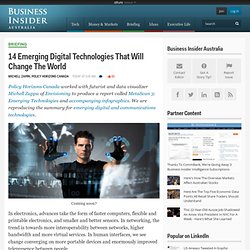
We are reproducing the summary for emerging digital and communications technologies. In electronics, advances take the form of faster computers, flexible and printable electronics, and smaller and better sensors. In networking, the trend is towards more interoperability between networks, higher bandwidth and more virtual services. Only In The Future. Envisioning emerging technology for 2012 and beyond (by Michell Zappa)
Only In The Future. Light pulses control graphene's electrical behavior. Graphene, an ultrathin form of carbon with exceptional electrical, optical, and mechanical properties, has become a focus of research on a variety of potential uses.
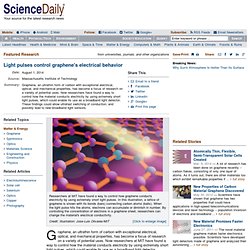
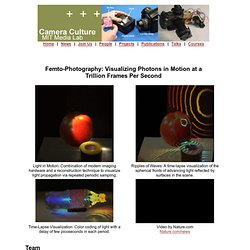
Now researchers at MIT have found a way to control how the material conducts electricity by using extremely short light pulses, which could enable its use as a broadband light detector. 33rd Square. Human Proteome Map. The Electric Universe. Net: Rupert Sheldrake. Planetary Resources – The Asteroid Mining Company. The helical model - our solar system is a vortex. 60,000 miles up: Space elevator could be built by 2035, says new study. Infographic of the Day: The Next 25 Years in Emerging Tech. Visualizing Light at Trillion FPS, Camera Culture, MIT Media Lab. Home | News | Join Us | People | Projects | Publications | Talks | Courses Femto-Photography: Visualizing Photons in Motion at a Trillion Frames Per Second Team.
Computer Scientists Find That Evolution May Not Require Outside Factors. Scientists replicate key evolutionary step in life on earth. (PhysOrg.com) -- More than 500 million years ago, single-celled organisms on Earth's surface began forming multi-cellular clusters that ultimately became plants and animals.
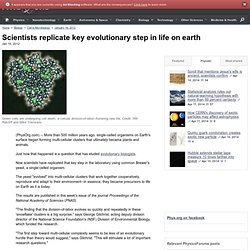
Just how that happened is a question that has eluded evolutionary biologists. Now scientists have replicated that key step in the laboratory using common Brewer's yeast, a single-celled organism. The yeast "evolved" into multi-cellular clusters that work together cooperatively, reproduce and adapt to their environment--in essence, they became precursors to life on Earth as it is today. The results are published in this week's issue of the journal Proceedings of the National Academy of Sciences (PNAS). Skeptical Investigations - Controversies - Cosmology - index. Home > Controversies > Cosmology > index Science Stifled by Dogma.
Nanotechnology - Foresight Institute. Nanotechnology. Nanotechnology. Nanosponge Absorbs 100x Its Weight in Oil, Is Guided With Magnets. Researchers at Rice University have come up with a new technology for oil-absorbing sponges. The sponges are made of carbon nanotubes with a splash of boron . They are elastic, compressible, flexible, lightweight, and they hate water and love oil. When a sponge is placed on the surface of water, it floats across the surface until coming across oil, which it then readily absorbs. Nanosilicon rapidly splits water without light, heat, or electricity. (Phys.org)—Although scientists know that when silicon mixes with water, hydrogen is produced through oxidation, no one expected how quickly silicon nanoparticles might perform this task.
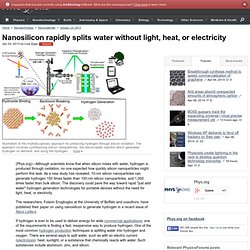
As a new study has revealed, 10-nm silicon nanoparticles can generate hydrogen 150 times faster than 100-nm silicon nanoparticles, and 1,000 times faster than bulk silicon. The discovery could pave the way toward rapid "just add water" hydrogen generation technologies for portable devices without the need for light, heat, or electricity. The researchers, Folarin Erogbogbo at the University of Buffalo and coauthors, have published their paper on using nanosilicon to generate hydrogen in a recent issue of Nano Letters. If hydrogen is ever to be used to deliver energy for wide commercial applications, one of the requirements is finding a fast, inexpensive way to produce hydrogen. One of the most common hydrogen production techniques is splitting water into hydrogen and oxygen. New IBM Microscope Technique Has Resolution 100 Times Smaller Than An Atom.
Une compilation citoyenne de l'actu des nanos : PagePrincipale. Net: the Edge of Science. The Edge of Science This is the edge of science, the edge where research meets real life and where solid cliffs of data meet oceans of unanswered questions.

This is a place where you can examine and talk about some of the newest ideas in science. New Scientist magazine's Planet Science website chose Transaction Net as its Site of the Day for September 4th, 1996. NIKOLA TESLA INSTITUTE - BRASÍLIA - BRAZIL. The Perils Of Technology Prediction. Universal Theory - Introduction. CleanTechnica. The world's largest professional association for the advancement of technology.
Lectures. Robot biologist solves complex problem from scratch. Black holes may have been fundamental building blocks of the early universe. 'Tantalizing' hints of room-temperature superconductivity. Graphene can host exotic new quantum electronic states at its edges. Graphene information, news and resources. Forbidden Knowledge TV. Society for Scientific Exploration. SESTI — Scanning for Emerging Science and Technology Issues. Latest news: International Council for Science — ICSU. Computers Made Out of DNA, Slime and Other Strange Stuff. 11 Emerging Scientific Fields That Everyone Should Know About. Graphene.