Neuroscience Information Framework - Search for Neuroscience Resources. BRAIN ATLAS, BRAIN MAPS, BRAIN STRUCTURE, NEUROINFORMATICS, BRAIN, STEREOTAXIC ATLAS, NEUROSCIENCE. Water Solutions. Aquaporins. Anatomica. Cell biology by the numbers. BioNumbers - The Database of Useful Biological Numbers. Anthony Zador Homepage. Testy. Life Sciences. SCIENCE. Genomics. Botany. Plants. Animalia. Neo Animalia. ORGANICA. Home - Journal of Animal Ecology. Lucidcentral.org > Home. Get Lucid v3.3 for free! We are celebrating the 10th anniversary of Lucid's initial release by providing “Lucid v3.3” free*.

Lucid v3.3, which was released in 2006, operates on Windows98/ME/NT/2000/XP/2003/Vista, OSX, Linux, and Solaris and is capable of producing keys for deployment on CD or the Internet. Lucid v3.3 is compatible with the latest Lucid v3.5 builder, so that any keys developed using Lucid v3.3 can be easily imported to Lucid v3.5. Updated version now available (v3.3.2 07082010 FREE). Enhances backwards compatibility with older v3.0, v3.1 and 3.2 keys. Fixes compatibility issues introduced by the latest Java Runtime Environments (JRE) releases. What's the difference between v3.3 and v3.5. Drawing on Anatomy: Art and Science of the Human Body - Anatomical Drawings and Human Embryology. Prenatal justthefacts.org. Early Flavor Learning and Its Impact on Later Feeding Behavi... : Journal of Pediatric Gastroenterology and Nutrition. Poor nutrition is a leading lifestyle factor related to the development of several noncommunicable diseases.
One strategy for eliminating health disparities and promoting long-term health is to get children to eat and like healthful foods (eg, fruits and vegetables) from an early age (1–4). Health organizations worldwide recommend 5 to 13 servings of fruits and vegetables per day, depending on one's caloric requirement (5,6). Despite such recommendations, adults are not eating enough fruits and vegetables (6) and neither are children (7,8). The 2004 Feeding Infant and Toddlers Study, designed to update knowledge on the feeding patterns of American children, alarmingly revealed that toddlers ate more fruits than vegetables and 1 in 4 did not even consume 1 vegetable on a given day (7,8).
Instead, they were more likely to be eating fatty foods and sweet-tasting snacks and beverages and less likely to be eating vegetables. Taste Olfaction Chemical Irritation Innate Responses. Biology in Motion. The Whole Brain Atlas. BRAIN ATLAS, BRAIN MAPS, BRAIN STRUCTURE, NEUROINFORMATICS, BRAIN, STEREOTAXIC ATLAS, NEUROSCIENCE. (Quantum) neuroscience. The Incredible Human Eye. Dec 23 '07 photography, art The iris, the most visible part of the vertebrate eye, is composed of pigmented bundles of fibrous tissue.
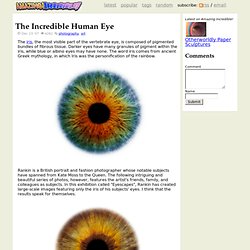
Darker eyes have many granules of pigment within the iris, while blue or albino eyes may have none. The word iris comes from ancient Greek mythology, in which Iris was the personification of the rainbow. Rankin is a British portrait and fashion photographer whose notable subjects have spanned from Kate Moss to the Queen. Vision Sciences Society. Cell. 20 Most Amazing Microscope Shots Pictures !!!! : Green Buzz. These microscope pictures are taken from the book ‘ Microcosmos’, created by Brandon Brill .
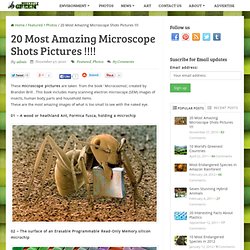
This book includes many scanning electron microscope (SEM) images of insects, human body parts and household items. These are the most amazing images of what is too small to see with the naked eye. The Biology Project. Current Biology. ARCHIVED - NRC Institute for Biodiagnostics - IBD - NRC-CNRC. Information found on this page has been archived and is for reference, research or recordkeeping purposes.
Please visit NRC's new site for the most recent information. Archived Content Information identified as archived on the Web is for reference, research or recordkeeping purposes. It has not been altered or updated after the date of archiving. Web pages that are archived on the Web are not subject to the Government of Canada Web Standards. Synthetic Biology. "Synthetic biology" is an umbrella term that refers to a new set of powerful techniques for manipulating the fundamental molecular structures of life, including genes, genomes, cells and proteins.
Techniques being developed under the "synthetic biology" rubric include the modification of existing bacteria to produce useful substances or perform new functions, the creation of novel artificial organisms from "scratch," and — less noted to date — the modification of animal and human genes. Biological computer created at Stanford. A team of Stanford engineers has made a simple computer inside a living cell, where it could detect disease, warn of toxic threats and, where danger lurked, even self-destruct cells gone rogue.

The startling achievement, unveiled in Friday’s issue of the journal Science, takes us to a new frontier — where nature’s instruction manual is being programmed to deliver information long-concealed within our bodies. A Tissue-Like Printed Material. Living cells communicate and cooperate to produce the emergent properties of tissues.
Synthetic mimics of cells, such as liposomes, are typically incapable of cooperation and therefore cannot readily display sophisticated collective behavior. We printed tens of thousands of picoliter aqueous droplets that become joined by single lipid bilayers to form a cohesive material with cooperating compartments.
Three-dimensional structures can be built with heterologous droplets in software-defined arrangements. The droplet networks can be functionalized with membrane proteins; for example, to allow rapid electrical communication along a specific path. Amplifying Genetic Logic Gates. Organisms must process information encoded via developmental and environmental signals to survive and reproduce.
Researchers have also engineered synthetic genetic logic to realize simpler, independent control of biological processes. We developed a three-terminal device architecture, termed the transcriptor, that uses bacteriophage serine integrases to control the flow of RNA polymerase along DNA. Integrase-mediated inversion or deletion of DNA encoding transcription terminators or a promoter modulates transcription rates. We realized permanent amplifying AND, NAND, OR, XOR, NOR, and XNOR gates actuated across common control signal ranges and sequential logic supporting autonomous cell-cell communication of DNA encoding distinct logic-gate states. The single-layer digital logic architecture developed here enables engineering of amplifying logic gates to control transcription rates within and across diverse organisms.
Main Page. Becoming Human. Institute of Human Origins. Biometrics Research Program. NEW: 29th Pupil Colloquium, Tubingen, Sept. 25-29, 2011 28th Pupil Collqouium, Pittsburgh, August 2009 PersonnelLab Publications (includes downloadable Archives, 1929- present) Related LinksDownloads.
The Journal of Clinical Endocrinology & Metabolism. Special Features Clinical Review: Vitamin D Supplementation and Risk of Toxicity in Pediatrics: A Review of Current Literature April 01, 2014 | Maria G. Preparing a Buffy Coat from Whole Blood. A buffy coat suspension is a concentrated leukocyte suspension. It is not mononuclear as the granulocytes are still present. The following brief protocol demonstrates how to prepare a buffy coat suspension from whole blood. Collect whole blood in a blood collection tube containing anticoagulant.Add 1 part PBS + 2% FBS to 1 part fresh whole blood.Centrifuge the sample at room temperature and 200 x g for 10 minutes with the brake off. NCBI BioSystems Database Overview. Centers for Disease Control and Prevention.
HIV particles infecting a human T cell. NCBI Human Genome Resources. The FASEB Journal. Taxa selector (root) Oxford Journals. Hindawi Publishing Corporation. Theoretical and Computational Biophysics Group. About the Kavli Prize. “The Kavli Prizes recognize three scientific areas we believe are exceptionally exciting in the 21st Century and at the brink of remarkable discoveries – astrophysics, nanoscience and neuroscience. Created to honor, support and recognize scientists whose work have had a profound impact in these areas, through these Prizes we also hope to raise people's awareness of the benefits of basic science in their own lives. Behaviours Extend to Others. PrintTech. Biological Health. HEALTH. Health ReferencEd. Bionica. New Bionica.