
Internet Sacred Text Archive Home. Top 10 Unusual Ancient Weapons. Weird Stuff Mankind always has, and always will, fight wars.
And in order to fight said wars, man needed weapons. Using whatever skills and resources they had, man built tools that would slash, smash, pierce and tear their enemies. Every nation had weapons that made their armies unique. Today when we talk about ancient weapons we immediately think swords, spears, bows and axes. Stone Age Timelines. Human prehistory and the Stone Age… a timeline critique (4th edition - October 2012) by A.O.

Kime for information on 'renting' this article, see Rent-a-Article In the 1820’s, in order to address the prehistory of mankind more clearly, it was thought necessary to divide it into time periods, thus a ‘three-age’ system of the (1) Stone Age, (2) Bronze Age and (3) Iron Age was adopted. While this system is still more-or-less in common use today, refinements were inevitable and the Stone Age, so immensely long, was later subdivided into three major periods as follows: Paleolithic (c 2,000,000 – c 10,000 B.C.) The Big Religion Comparison Chart: Compare World Religions.
Mythology. Paranormal, UFOs, Cryptids and Unexplained Phenomena. I came across several interesting stories recently while reading about Jewish mysticism and rituals.

I decided to look further and discovered references to the 'Dybbuk'. To my surprise, much of what is described in Judaism and the Kabbalah in relation to spirits and possession correlates directly and more precise to the spirit rescue work that I have recently undertaken. I would like to share some of this with you... A dybbuk (pronounced "dih-buk") is the term for a wandering soul that attaches itself to a living person and controls that person's behavior to accomplish a task. Library of Ashurbanipal.
Vaimanika Shastra. Title page of the English translation of Vyamanika Shastra published in 1973 The Vaimānika Shāstra ( वैमानिक शास्त्र, lit.
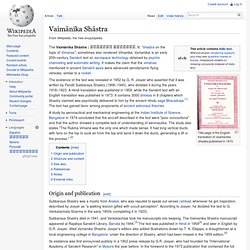
"shastra on the topic of Vimanas"; sometimes also rendered Vimanika, Vymanika) is an early 20th-century Sanskrit text on aerospace technology obtained by psychic channeling and automatic writing. It makes the claim that the vimānas mentioned in ancient Sanskrit epics were advanced aerodynamic flying vehicles, similar to a rocket. Chilam Balam. Copy of the Book of Chilam Balam of Ixil in the National Museum of Anthropology, Mexico The so-called Books of Chilam Balam[pronunciation?]

Are handwritten, chiefly 17th and 18th-centuries Maya miscellanies, named after the small Yucatec towns where they were originally kept, and preserving important traditional knowledge in which indigenous Maya and early Spanish traditions have coalesced. Samarangana Sutradhara. Samarangana Sutradhara is an encyclopedic work on classical Indian architecture (Vastu Shastra) written by Paramara King Bhoja of Dhar (1000–1055 AD).
In 83 chapters, subjects treated are town planning, house architecture, temple architecture and sculptural arts together with Mudras (the different hand poses and the poses of the body as well as the postures of legs), the canons of painting, and a chapter on the art of mechanical contrivances, the yantras (chapter 31). Here are some verses from Samarangana Sutradhara, which describes characteristics a "sthapati" i.e. architect (based on translation by Punya Mishra). Hinduism - Puranas. Sacred-texts home Journal Articles: Hinduism OCRT: Hinduism Buy CD-ROM Buy books about Hinduism Vedas Upanishads Puranas Other Primary Texts Epics Mahabharata Ramayana Bhagavad Gita Vedanta Later texts Modern books The Vedas.
The Riddle of the Dome of the Rock. One of the most fascinating questions about the Temple Mount after the Islamic occupation in 638 CE is connected with the Dome of the Rock.

Important scientific research conducted by Ya'akov Ofir holds that the Dome of the Rock was built in 691CE for the Jews as their “last house” of prayer by their ally Abd el-Malik, the Umayyad ruler of Damascus, who also controlled the land of Israel in those days. The Jews who built the house believed that their redemption had already come. Ofir's conclusion is that the Dome of the Rock is a Jewish building. Abd el-Malik was at war with the Abbasid Arab kingdom which controlled Arabia and Iraq.
According to Ofir and others, Abd el-Malik was actually a follower of the Jewish faith. What did the Knights Templar Do. The Knights Templar were created by the pope to escort and protect "tourists" going to the Holy Land, and to fight Muslims there.

There were originally only a handful, but there were thousands by the time they were disbanded in the 1300's. They were the first bankers. A person could deposit money at one Templar institution, receive a voucher, and turn it in at any other Templar institution. Though charging interest was illiegal at the time, the Templars were permitted to get away with charging a "fee" for the transaction. Some say they were also looking for relics like the holy grail in the holy land, but there is no specific evidence of this. Eventually they became so wealthy, and so many royals owed them so much money, that they became a target.
The Temple Mount - Jerusalem 101. The Time Between 70 AD and 638 AD When the Muslims conquered Jerusalem in 638 there were no buildings on the Temple Mount to destroy.
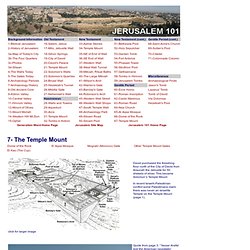
The Christians had left the Temple Mount in ruins, and even used it as a garbage dump. The temple was destroyed in 70 AD by the Romans. 9,000 B.C. - 3,000 B.C. Sacred Texts Timeline. Sacred-textsSacred Time Origins of World Religions This is a timeline which gives the history of sacred texts, as well as a few other relevant events. Of course, not all of the dates in this timeline are accurate; some are entirely conjectural. I have included a few dates, events and documents which are or may be entirely fictional. Links on this page are to resources at this site, not to external sites. In Search of Shambhala, Agharta, Inner Earth , Hollow Earth, subterranean passages and tunnels , aliens, ufos Mary Sutherland, author of Living in the Light, Hollow Earth Theories and the Search for Shambhala. A Timeline of World Civilizations for Mythology. The Book of Enoch and The Secrets of Enoch.
Enoch & the Nephilim - Part III. Enoch & the Nephilim Part III The Evidence Mounts "More and more we are finding that mythology in general though greatly contorted very often has some historic base. And the interesting thing is that one myth which occurs over and over again in many parts of the world is that somewhere a long time ago supernatural beings had sexual intercourse with natural women and produced a special breed of people. " The Dead Sea Scrolls. List of legendary creatures (B) Biblical History of Creation compared to mythology and Science.
List of 39 Famous Greek Philosophers and Statesmen who are known to have lived past the age of 70. HISTORY OF GREEK LITERATURE. Religion of Great Philosophers. Ancient Philosophy Timeline. Plato and his dialogues : home. Famous Greek People: Socrates, Plato, and Aristotle. Digital Dead Sea Scrolls. Why is Jerusalem important to Jews Christians and Muslims. Universal Answers It is so important because it is where their faiths started and it contain holy lands. God also chose Jerusalem as His own. Three religions in the world have chosen Jerusalem to be there holy land these are Muslims, Jews and Christians. Many people go there every year and there are many riots and arguments about people's religions. - Jerusalem.