
Bonsai soil, recommended mixtures. Using the right soil mixture for your Bonsai trees is crucial.

Soil is important to supply your trees with nutrients, but it also needs to drain properly, provide enough aeration and retain water. Though most (online) Bonsai shops sell ready-mixed soils, doing this yourself will save money and enables you to adjust mixtures per tree-species. The quality of soil used directly affects the health and vigor of your tree. It is our experience that unhealthy trees, that lack vigor, are very often planted in a poor (often organic) bonsai soil. Juniper. <p class="noscript"><img src="core/img/noscript.gif" width="26" height="26" alt="!
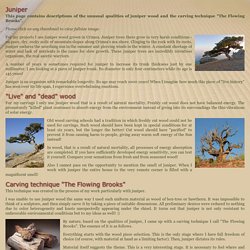
JavaScript is Disabled"> JavaScript may be disabled. If JavaScript is disabled in your browser, please enable it in order to continue. </p> Juniper This page contains descriptions of the unusual qualities of juniper wood and the carving technique "The Flowing Brooks". Please click on any thumbnail to view fullsize image. For my projects I use juniper wood grown in Crimea. A number of years is sometimes required for juniper to increase its trunk thickness just by one millimeter. Juniper is an organism with remarkable longevity. Image Of Juniper Tree. High Resolution Image at FeaturePics.com.
Mountain Soil Types. Mountain ranges vary in their soil types.
Many ranges or individual mountains are rocky and have only small amounts of soil, but many also have plentiful amounts of soil. The United States Department of Agriculture divides soils into 12 orders, each with distinct features. Seven of these occur frequently in mountains. To understand how best to grow plants in mountainous areas, it is important to be able to identify what kind of soil you have and what its various strengths and weaknesses are. Ultisols Soils in the ultisol order occur mainly in the Southeast and contain large amounts of clay. Red maple 'October Glory'/RHS Gardening. Hardiness ratings All ratings refer to the UK growing conditions unless otherwise stated.
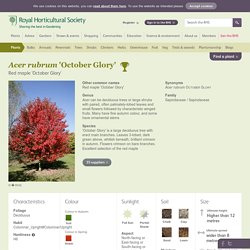
Minimum temperature ranges (in degrees C) are shown in brackets. Silver birch/RHS Gardening. Dwarf mountain pine/RHS Gardening. Stone pine/RHS Gardening. How to Grow A Tree or Shrub From Seed from TreeHelp. Starting trees from seed can be one of the most rewarding gardening activities, but tree seeds often require a little more preparation than many common flower or vegetable seeds.
In most cases, there are two ways to start tree seeds: The natural way, which often includes sowing the seeds in the fall, or through forced or “assisted” germination, which is initially done indoors. The Natural Way to Germinate Tree Seeds Seeds have been sprouting and trees have been growing for an awfully long time without any help from humans. The “natural way” to germinate tree seeds, then, is to allow nature to take its course. Most seeds, when sown in the fall without any pre-treatment, will begin to germinate the following spring. Birch Bonsai Species Guides.
Betula is a genus of about 60 species of deciduous trees and shrubs found in diverse habitats, including woodland, moors, mountains and heathland throughout the Northern hemisphere.
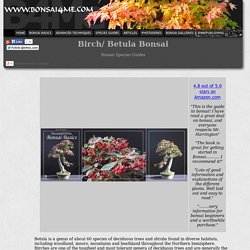
Birches are one of the toughest and most tolerant genera of deciduous trees and are generally the first species to establish themselves on the edges of woodland or on wasteland. Leaves are alternate, toothed, usually ovate and mid- to dark green. Leaves appear shortly after flowering in April or May. Their Autumn colouring varies from bright yellow to orange. Birches are monoecious (i.e. with separate male and female flowers on the same tree) and rely on the wind for pollination.
Birches are commonly favoured for their bark though only two species native to the UK develop white bark, the Silver Birch (Betula pendula, also known as weeping birch) and the Downy Birch (Betula pubescens). BONSAI CULTIVATION NOTES POSITION Full sun. Bonsai Training Guide for Betula pendula by Ma-Ke Bonsai. Silver Birch The lovely silver birch is often planted as a garden or park tree it is a slender and graceful deciduous tree with silvery white bark and double-toothed serrated margins almost triangular leaves.
A native to northern areas that is grown for its beautiful white bark. The tree will grow to 50 feet or more and about 25 feet wide. It has excellent cold tolerance and will grow comfortably in our colder parts too. Styles: Formal upright, Informal Upright, Slanting, Cascade, Semi-cascade, Literate, Broom, Rock-over-root, Clasped-to-rock, Twin-trunk, Clump, Sinuous, Straight Line, Group planting, Saikei Location: Outdoor Position: Birches like a lot of light, although some shade is advisable in the hottest areas or in midsummer. Bonsai- Mugo Pine. Though Pinus mugo has something of a poor reputation as bonsai, with the correct techniques, Mugos are easy to cultivate and style.
Mugo pines (also known as Mountain Pines) are easily available at garden centres and nurseries compared to most pine species. It is recommended that the plain Mugo Pine is used as Mugo varieties tend to be weaker and unresponsive in comparison. Try to find ordinary landscape pines rather than the miniature rock-garden varieties such as P. mugo 'Mops' and 'Valley Cushion' that are known as being particularly touchy to bonsai cultivation. Mugo pine care Mugos like plenty of light and water to achieve their full potential, however they must have a fast draining soil so that their roots don't sit in water. Plant Identification. Vertical Gardening.
Care by species. Identification. Care. Botany. Study Guide to the Science of Botany A Free Online Textbook.
Rhs-level-2-certificate-in-principles-of-plant-propagation.