Videojug - Get Good At Life. The world's best how to videos plus free expert advice and tutorials. 10 Articles That Changed My Life & LifeReboot.com. It’s easy to find a well written article.

It’s not always easy to find a well written article with genuine value. Emergency Bible Numbers. 60 Ways / 100 Days - Improve Your Life. Contrary to popular belief, you don’t have to make drastic changes in order to notice an improvement in the quality of your life.

At the same time, you don’t need to wait a long time in order to see the measurable results that come from taking positive action. All you have to do is take small steps, and take them consistently, for a period of 100 days. Below you’ll find 60 small ways to improve all areas of your life in the next 100 days. 50 Questions to Free Your Mind.
No Thought Suppression. How pushing a thought out of consciousness can bring it back with a vengeance. It sometimes feels like our minds are not on the same team as us. Mental State Called Flow. A number of sources, most recently ProgrammingOutsideTheCube and the RingerTape page, say that many folk find it takes time to get into a state where work flows.
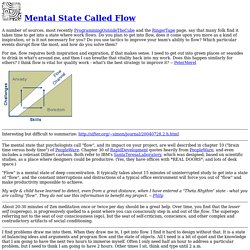
Do you plan to get into flow, does it come upon you more as a kind of inspiration, or is it not necessary for you? Do you use tactics to improve your team's ability to flow? Which particular events disrupt flow the most, and how do you solve them? For me, flow requires both inspiration and expiration, if that makes sense. I need to get out into green places or seasides to drink in what's around me, and then I can breathe that vitality back into my work. Interesting but difficult to summarize: The mental state that psychologists call "flow", and its impact on your project, are well described in chapter 10 ("brain time versus body time") of PeopleWare. About 20-30 minutes of Zen meditation once or twice per day should be a great help. I find problems draw me into them. MicroSoft has a tack on this sort of thing. Try juggling. 10 Life-Enhancing Things You Can Do in Ten Minutes or Less - StumbleUpon.
The Little Book of Procrastination Remedies. Post written by Leo Babauta.

Procrastination is one of those topics that, it seems, I can’t write enough about. There isn’t a person among us who doesn’t procrastinate, and that’s a fact of life. It’s deep within us. We think we’re going to do something later, or read that classic novel later, or learn French later. The Now Habit. In this post, I present a mind map with the full summary of the book The Now Habit: A Strategic Program for Overcoming Procrastination and Enjoying Guilt-Free Play.
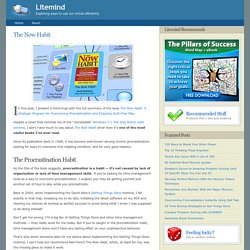
Despite a cover that reminds me of the “remarkable” Windows 3.1 ‘Hot Dog Stand’ color scheme, I don’t have much to say about The Now Habit other than it’s one of the most useful books I’ve ever read. Since its publication back in 1988, it has become well-known among chronic procrastinators looking for ways to overcome this crippling condition, and for very good reasons. The Procrastination Habit As the title of the book suggests, procrastination is a habit — it’s not caused by lack of organization or lack of time management skills. If you’re looking for time management tools as a way to overcome procrastination, I suspect you may be getting yourself just another set of toys to play while you procrastinate.
How to become an early riser. By Leo Babauta I’ve found that waking early has been one of the best things I’ve done as I’ve changed my life recently, and I thought I’d share my tips.
I just posted about my morning routine, and thought you might like to know how I get up at 4:30 a.m. For many years, I was a late riser. I loved to sleep in. Then things changed, because I had to wake up between 6-6:30 a.m. to fix my kids’ lunches and get them ready for school. 8 Things to Stop Doing Right Now - StumbleUpon. The main purpose of this site is to help you be who you want to be and live the life you want to live. I think everyone deserves that at the bare minimum, and I believe that everyone can achieve it. Therefore, a lot of the messages that I share here are positive, inspiring and action orientated. With this post I want to change direction, and not cover the things you should be doing, but the things you shouldn't be doing. I'm not even going to be half-hearted about it and say you should 'probably' stop doing these things or 'you can if you want'.
No; you really should stop, right now. Photo Credit I truly believe that successful implementation, or actually 'de-implementation' of these methods will dramatically improve a number of things. What I mean by improving your awareness is that you actually might 'wake up' to some of the things you've been doing, and understand exactly why I say you need to stop doing these things immediately. The Top 10 Psychology Studies of 2010. The end of 2010 fast approaches, and I'm thrilled to have been asked by the editors of Psychology Today to write about the Top 10 psychology studies of the year. I've focused on studies that I personally feel stand out, not only as examples of great science, but even more importantly, as examples of how the science of psychology can improve our lives. Each study has a clear "take home" message, offering the reader an insight or a simple strategy they can use to reach their goals , strengthen their relationships, make better decisions, or become happier.
If you extract the wisdom from these ten studies and apply them in your own life, 2011 just might be a very good year. 1) How to Break Bad Habits If you are trying to stop smoking , swearing, or chewing your nails, you have probably tried the strategy of distracting yourself - taking your mind off whatever it is you are trying not to do - to break the habit. J. 2) How to Make Everything Seem Easier J. Spirit Vaults : Meditation - Essay. It seems everyone is interested in meditation...talking about the wonderful benefits, recommending classes and discussing the different ways to "do it".
But, for a beginner, just what is "it"? And how do you do "it"? Our busy, hectic, lifestyles may seem to prohibit this peaceful practice, or provide a convenient "excuse" not to begin, or continue, to meditate...but, the happy news is, you CAN successfully benefit even if you practice for short periods. With the simple technique described below, you will begin and incredible journey. There are 100's of styles, traditions and forms of meditation, but this simple practice has always been highly recommended. Start Your Day in 33 Different Ways. Mornings are underrated. I consider them fundamental for the whole diurnal experience. What you do in the very first moments of your morning will fundamentally and inexorably shape your entire day.
Most of the time you spend your mornings by routinely performing some habits, on auto pilot. Hence, your days will routinely unfold towards you, the same way day after day, on auto pilot. Consciously inserting your intentions in these very first moments will have a huge effect. Here are at least 33 ways in which you can transform your days by only spending 5 minutes every morning.
Top five regrets of the dying. There was no mention of more sex or bungee jumps.

A palliative nurse who has counselled the dying in their last days has revealed the most common regrets we have at the end of our lives. And among the top, from men in particular, is 'I wish I hadn't worked so hard'. Bronnie Ware is an Australian nurse who spent several years working in palliative care, caring for patients in the last 12 weeks of their lives.
How to Hack Your Brain - StumbleUpon. Book - 9 insights on&life - StumbleUpon. 8 Things Everybody Ought to Know About Concentrating - StumbleUpon. “Music helps me concentrate,” Mike said to me glancing briefly over his shoulder.

Mike was in his room writing a paper for his U.S. History class. On his desk next to his computer sat crunched Red Bulls, empty Gatorade bottles, some extra pocket change and scattered pieces of paper. In the pocket of his sweat pants rested a blaring iPod with a chord that dangled near the floor, almost touching against his Adidas sandals. On his computer sat even more stray objects than his surrounding environment. Mike made a shift about every thirty seconds between all of the above. Do you know a person like this? The Science Behind Concentration In the above account, Mike’s obviously stuck in a routine that many of us may have found ourselves in, yet in the moment we feel it’s almost an impossible routine to get out of.
The 50 Best Mind Hacks on the Web. Image: JanneM/Flickr Mind hacks.