
Getting Things Done. David Allen. Getting Things Done GTD software, task manager, and to-do list, and project management. Getting Things Done. The GTD method rests on the idea of moving planned tasks and projects out of the mind by recording them externally and then breaking them into actionable work items.
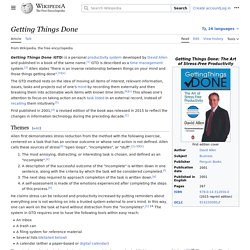
This allows attention to be focused on taking action on tasks, instead of recalling them.[2] First published in 2001, a revised edition of the book was released in 2015 to reflect the changes in information technology during the preceding decade. Themes[edit] Allen first demonstrates stress reduction from the method with the following exercise, centered on a task that has an unclear outcome or whose next action is not defined. Allen calls these sources of stress "open loops", "incompletes", or "stuff".[1]:13. Getting Things Done® (GTD®) Getting Things Done (GTD) is a method for organizing tasks so that you can focus your entire energy and creativity on completing those tasks in a stress free manner.
This method was developed by David Allen in his book, Getting Things Done. The main principle of GTD is that recording your tasks in a reliable way - using a system that you trust - will free your mind from trying to remember and prioritize stuff. This recaptured mental energy can be put towards being more productive and efficient. 12 Lists That Help You Get Things Done. At the center of just about every personal productivity system are lists – GTD has it’s context lists, Pomodoro has it’s action inventory and daily to-do lists, todoodlist has, well, the todoodlist, and so on.
But there are a lot of different kinds of lists besides your task or to-do list that can help you be more productive. Lists in general are powerful tools – open-ended, constantly growing, and effective at extending our memories past the 7 or so things we can keep on our mind at any given time. Some of the lists that can make you more productive or otherwise make life easier include: TiddlyWiki. A standard edit dialog on a tiddler TiddlyWiki is an open-source single page application wiki.
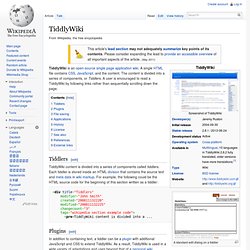
A single HTML file contains CSS, JavaScript, and the content. The content is divided into a series of components, or Tiddlers. The Best Android Apps for Getting Things Done. TiddlyWiki. GTD Cheatsheet: The Workflow. This is the first part in a refresher series on the basics of Getting Things Done.
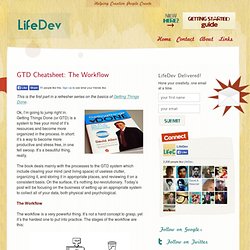
Ok, I’m going to jump right in. Getting Things Done (or GTD) is a system to free your mind of it’s resources and become more organized in the process. In short: it’s a way to become more productive and stress free, in one fell swoop. It’s a beautiful thing, really. The book deals mainly with the processes to the GTD system which include clearing your mind (and living space) of useless clutter, organizing it, and storing it in appropriate places, and reviewing it on a consistent basis. The Workflow The workflow is a very powerful thing. A Primer on Getting Things Done. 12 Free Android Apps to Help Get Things Done (Part 1) With a raft of new devices scheduled to join the lonely T-Mobile G1 in Google’s lineup, the Android operating system looks like it’s not only going to be around for a while but may well give its fellows smartphones from Apple, Blackberry, and Palm a run for their money.
With its Linux-derived core and slick user interface, the Android system is proving to be very adaptable – it will even be available on netbooks pretty soon. I’ve had a chance to play with a 1 for the last few weeks, and more importantly to try out some of the 5,000 apps currently available on the Market, Google’s built-in alternative to the iTunes App Store. Out of this amazing variety of available applications, I’ve found a good dozen free ones that would be perfect for Lifehack’s readers – apps that can help you stay organized, stay effective, and stay productive no matter where you find yourself.
In the interest of space, I’ll post this list over two days: six now, six later, presented in no particular order. 1. 2. Getting Things Done: The Art of Stress-Free Productivity Summary at WikiSummaries, free book summaries. GTD® and Getting Things Done® are the registered trademarks of David Allen Company.
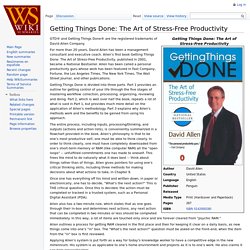
For more than 20 years, David Allen has been a management consultant and executive coach. Allen’s first book Getting Things Done: The Art of Stress-Free Productivity, published in 2001, became a National Bestseller. Allen has been called a personal productivity guru whose work has been featured in Fast Company, Fortune, the Los Angeles Times, The New York Times, The Wall Street Journal, and other publications. Getting Things Done® (GTD®) Getting Things Done: Step 2/3 - Processing & Organizing - CBS MoneyWatch.com. This article is part three of a seven part series on Getting Things Done ? (GTD ? ) -- the time and productivity management system by David Allen. Before You Create a To-Do List. For several years now, I have profited from using a “Master Task List.”
This is a way to group your work-related activities so that you do what you were hired to do and keep from getting side-tracked by “trivial pursuits.” It is something you should develop before you start throwing together a to-do list. Photo courtesy of ©iStockphoto.com/SparkleArt I first learned this technique from Todd Duncan, whose book, Time Traps, published by Thomas Nelson, is a must read. It is subtitled, “Proven Strategies for Swamped Salespeople” but don’t let this put you off. “Master Tasking” is the process of identifying your five to seven most productive, most important work-related tasks. Here are some characteristics of master tasks: They are usually important but not urgent.They spell the difference between success and failure.You have a hard time getting to them.
Master Tasking will enable you to become more productive, more successful, more confident, less frustrated, and less stressed. Turn Gmail Into Your Ultimate GTD Inbox. Getting started with "Getting Things Done". This article was originally posted during the first week of 43 Folders' existence, and, pound for pound, it remains our most popular page on the site.
Please be sure to also visit related pages, browse our GTD topic area, plus, of course you can search on GTD across our family of sites. GTD em 20 minutos Wise Action. The Simplicity Post. Building a Smarter To-Do List, Part I. Since new folks visit 43F each day, I thought it might be valuable to return to one of our most popular evergreen topics to review some "best practices" for keeping a good to-do list.
While a lot of this might be old hat to some of you, it's a good chance to review the habits and patterns behind one of the most powerful tools in the shed. Part 2 appears tomorrow (Update: now available). (N.B.: links to previous posts related to these topics are provided inline) Why bother? In my own experience wrangling life's entropic challenges, some of my best gains have come from maintaining a smart, actionable, and updated accounting of all the things I've committed myself to doing.
While you can argue for the flavor and approach to task management that best suits your style (and your personal suck), it's hard to disparage the benefits that come from getting task commitments out of your brain and into a consistent location. Getting started with "Getting Things Done" New GTD resources page. Getting started with "Getting Things Done" :zenhabits. » Mind Like Water. Post written by Leo Babauta.
As I just posted about my GTD implementation, I started thinking about what appeals to me most about GTD. Of course, there is its total organization and complete capture of everything in your life. There is the clean desk and inbox acheived by this system. I love all that. » Mind Like Water. Massive GTD Resource List. Massive GTD Resource List. 118 GTD Software Apps - Researched Comparison.
118 GTD Software Apps - Researched Comparison. GTD Software Comparison. GTD: You need a daily action plan. The alarm sounds. A long day ahead to enjoy, but also many things to do. Do you feel relaxed or overwhelmed by everything you have to do? Do you have a plan for your day? The truth is that there is a difference when you start your days knowing what you’re going to find.
But beware! Do you have a system to comfortably control your day to day? GTD: You need a daily action plan. Why working with priorities often doesn't work? By Francisco Sáez • January 10, 2011 “There is a regular tension between things that are urgent and things that are important — and far too often, the urgent wins” ~ Charles E. Hummel, “Tyranny of the Urgent”, 1967 Traditional management systems, both personal and corporate, are based on the prioritization of every project and task to perform. It’s so common that we all are used to working that way to some degree. The problem is that, normally, we assign priorities to tasks according to their urgency instead of their importance.
To break the cycle, you need to stop and look at all your projects, whether they are in progress or pending. In GTD, the “priority” of things is defined by your self commitment to accomplish them. GTD Toolbox: 100+ Resources for Getting Things Done. Getting Things Done, also abbreviated as GTD, is a popular time management productivity method created by David Allen. The method is just as popular today as it was back in 2007 when we ran our GTD Ninja post featuring more than 50 apps to help you be more productive and organized. But there are a host of new applications out there to help you be even more productive this year.
Below are more than 100 of them. GTD Toolbox: 100+ Resources for Getting Things Done. GTD Toolbox: 100+ Resources for Getting Things Done. 11 Simple Tips To Effective Email Management. Is Your Personality Right For Getting Things Done? Is there such a thing as a sustainable todo system? It was summer of 2006 and we had just moved to San Francisco, sans jobs. I spent the summer job-hunting and doing a little freelance work, but mostly hacking on some side projects. I felt tremendously busy, but looking back, it was mostly self-imposed busyness stemming from boredom and the restlessness that comes from not having a job for months.
As the items on my todo list grew, I became more and more stressed out. Effecient team communication, reduce e-mail traffic. En historia om dålig kommunikation. Inatt kom jag över en rolig och lärorik historia på WN. Tycker den är värd en återpublicering här. Detta är berättelsen om fyra arbetskamrater som hette Alla, Någon, Vemsomhelst och Ingen. Det fanns ett viktigt jobb som måste göras och Alla var säker på att Någon skulle göra det. Vemsomhelst kunde ju ha gjort det, men Ingen gjorde det. Någon blev arg eftersom det var Allas jobb. Rating: 0.0/10 (0 votes cast) Kristoffer Wedholm Jag började intressera mig för SEO 2008, men har varit aktiv på webben sedan 1997. Achieving “mind like water” through Getting Things Done. Tiddlyspot. The Best Android GTD (Getting Things Done) App is: [Droid vs. Droid] Yes, I am officially the token GTD guy at Androinica. 9 Reasons Why Getting Things Done Sucks! Blasthemy! I hope the productivians don’t strike me down ;) Here is my list of issues with GTD that I have picked out.
These are a mix of my own and other’s experiences that were shared in a previous post asking the readers what they disliked. Getting Things Done in Evernote with one or two notebooks. With the arrival of 2010 coinciding with the end of my Year of Nothing, I found myself with an unusually large pile of new projects to launch, and a bunch of old projects to re-launch. On top of that, my head is bursting with a million ideas for possible business ventures, books I want to read, skills I want to learn, articles I want to write, character traits I want to develop, movies I’d like to watch, countries I want to visit…
Achieving “mind like water” through Getting Things Done. The GTD Resource Motherload: 100+ Links. The Top Five GTD Resources for Windows Vista. Search all GTD resources at once! Getting Things Done. Getting Things Done. Sylvia's Getting Things Done (GTD) Resource List. The Mindjet Blog - Part 3. 8 Reasons You Aren’t Getting Things Done. RTM vs Nozbe vs Nirvana. The best GTD Solution? « pakos.me. Using My First BlackBerry. Get Everything Done. » Simplifying David Allen’s Complicated GTD Setup. Get Everything Done. Get Everything Done. A very simple way to customize outlook to make it GTD friendly ! My method to keep my inbox empty. A very simple way to customize outlook to make it GTD friendly !
50 Great GTD Resources.