
Working towards change in the global electronics sector. MakeITfair works hard to promote substantial improvements in the production chain of consumer electronics; ranging from mining in Africa to manufacturing in Asia and Eastern Europe, and to the dumping of electronic waste in Africa.
Here is a short overview of its most recent activities, including a campaign involving multinational Apple, and an update of the educational tool, Webquest. Furthermore, makeITfair and GoodElectronics have plans for the future. On 9 and 10 May they are organising a Round Table, which will bring together representatives of the electronics industry and civil society organisations from around the globe. The Apple campaign Playful protests of the makeITfair’s campaign It’s time to bite into a fair Apple. Round Table GoodElectronics and makeITfair are organising a Round Table on 9 and 10 May 2012 in Amsterdam, bringing together representatives of the electronics industry and civil society organisations from all over the globe. Webquest update. — Good Electronics. Guide to Greener Electronics. Sacom. 2011-05-06_foxconn-and-apple-fail-to-fulfill-promises1. Apple, America and a Squeezed Middle Class.
But as of spoke, interrupted with an inquiry of his own: what would it take to make iPhones in the United States?
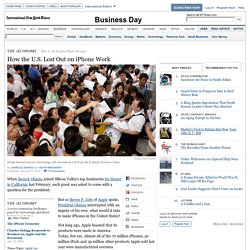
Not long ago, Apple boasted that its products were made in America. Today, few are. Almost all of the 70 million iPhones, 30 million iPads and 59 million other products Apple sold last year were manufactured overseas. Why can’t that work come home? Mr. Mr. The president’s question touched upon a central conviction at Apple. Apple has become one of the best-known, most admired and most imitated companies on earth, in part through an unrelenting mastery of global operations. However, what has vexed Mr. Apple employs 43,000 people in the United States and 20,000 overseas, a small fraction of the over 400,000 American workers at General Motors in the 1950s, or the hundreds of thousands at General Electric in the 1980s.
“If it’s the pinnacle of capitalism, we should be worried.” Apple executives say that going overseas, at this point, is their only option. ‘I Want a Glass Screen’ Apple’s iPad and the Human Costs for Workers in China. Conflict Minerals Company Rankings. Story of Electronics. Free buyers' guide to Mobile Handsets, from Ethical Consumer. Accept This website uses cookies to ensure you get the best experience on our website Read More Cookie Consent plugin for the EU cookie law Mobile phones Ethical shopping guide to Mobile Phone Handsets, from Ethical Consumer This is a product guide from Ethical Consumer, the UK's leading alternative consumer organisation.
The complex ethics involved in choosing a mobile phone This guide includes: Ethical and environmental ratings for 19 brands of mobile phone Best Buy recommendations Mobile phones and conflict minerals This guide is part of our Electronics Report. Score table Rollover an abbreviation for more information More Detail Ethical ratings for brands and products, updated live from our research database Customise your scorecard ratings How important to you? Less More Click the + icon to expand categories Help How the Sliders work Key to expanded Score table Best Buys as of Nov/Dec 2016 You can buy one outright or get a contract from Best Buy mobile network operator, Phone Co-op.
Special Report.