
Ubiquitous computing. Ubiquitous computing (ubicomp) is a concept in software engineering and computer science where computing is made to appear everywhere and anywhere.
Reality. Not to be confused with Realty.
Philosophers, mathematicians, and other ancient and modern thinkers, such as Aristotle, Plato, Frege, Wittgenstein, and Russell, have made a distinction between thought corresponding to reality, coherent abstractions (thoughts of things that are imaginable but not real), and that which cannot even be rationally thought. By contrast existence is often restricted solely to that which has physical existence or has a direct basis in it in the way that thoughts do in the brain. Computer-mediated reality. Art installation illustrating the mediated reality concept.
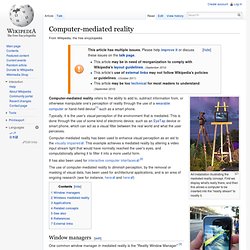
First we display what's really there, and then this allows a computer to be inserted into the "reality stream" to modify it. Mediated Reality application running on Apple iPhone Computer-mediated reality refers to the ability to add to, subtract information from, or otherwise manipulate one's perception of reality through the use of a wearable computer or hand-held device[1] such as a smart phone. Typically, it is the user's visual perception of the environment that is mediated.
This is done through the use of some kind of electronic device, such as an EyeTap device or smart phone, which can act as a visual filter between the real world and what the user perceives. Computer-mediated reality has been used to enhance visual perception as an aid to the visually impaired. It has also been used for interactive computer interfaces.[2] Window managers[edit] Category of being. Categorical distinctions[edit] The common or dominant ways to view categories as of the end of the 20th century. via bundle theory as bundles of properties – categories reflect differences in thesevia peer-to-peer comparisons or dialectics – categories are formed by conflict/debatevia value theory as leading to specific ends – categories are formed by choosing endsvia conceptual metaphors as arising from characteristics of human cognition itself – categories are found via cognitive science and other study of that biological system Any of these ways can be criticized for...
In process philosophy, this last is the only possibility, but historically philosophers have been loath to conclude that nothing exists but process. Categorization of existence[edit] As bundles of properties[edit] For example, if we take the concept of a black square, bundle theory would suggest that all that can be said to exist are the properties of a black square. Hyperreality. In semiotics and postmodernism, hyperreality is an inability of consciousness to distinguish reality from a simulation of reality, especially in technologically advanced postmodern societies.
Hyperreality is seen as a condition in which what is real and what is fiction are seamlessly blended together so that there is no clear distinction between where one ends and the other begins.[1] It allows the co-mingling of physical reality with virtual reality (VR) and human intelligence with artificial intelligence (AI).[2] Individuals may find themselves for different reasons, more in tune or involved with the hyperreal world and less with the physical real world.
Some famous theorists of hyperreality/hyperrealism include Jean Baudrillard, Albert Borgmann, Daniel J. Simulated reality. Simulated reality is the hypothesis that reality could be simulated—for example by computer simulation—to a degree indistinguishable from "true" reality.
It could contain conscious minds which may or may not be fully aware that they are living inside a simulation. This is quite different from the current, technologically achievable concept of virtual reality. Virtual reality is easily distinguished from the experience of actuality; participants are never in doubt about the nature of what they experience. Simulated reality, by contrast, would be hard or impossible to separate from "true" reality. There has been much debate over this topic, ranging from philosophical discourse to practical applications in computing. Cyberspace. Cyberspace is "the notional environment in which communication over computer networks occurs.
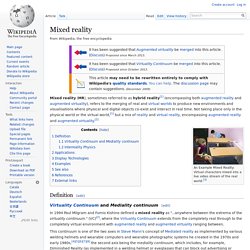
"[1] The word became popular in the 1990s when the uses of the internet, networking, and digital communication were all growing dramatically and the term "cyberspace" was able to represent the many new ideas and phenomena that were emerging.[2] The parent term of cyberspace is "cybernetics", derived from the Ancient Greek κυβερνήτης (kybernētēs, steersman, governor, pilot, or rudder), a word introduced by Norbert Wiener for his pioneering work in electronic communication and control science. Mixed reality. Mixed reality (MR), sometimes referred to as hybrid reality[1] (encompassing both augmented reality and augmented virtuality), refers to the merging of real and virtual worlds to produce new environments and visualisations where physical and digital objects co-exist and interact in real time.
Virtuality Continuum. Reality-Virtuality Continuum.
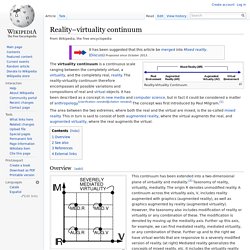
The virtuality continuum is a continuous scale ranging between the completely virtual, a virtuality, and the completely real, reality. The reality-virtuality continuum therefore encompasses all possible variations and compositions of real and virtual objects. It has been described as a concept in new media and computer science, but in fact it could be considered a matter of anthropology. [clarification needed][citation needed] The concept was first introduced by Paul Milgram.[1] The area between the two extremes, where both the real and the virtual are mixed, is the so-called mixed reality. Overview[edit] Consensus reality. Consensus reality[1][2] is that which is generally agreed to be reality, based on a consensus view.
The difficulty with the question stems from the concern that human beings do not in fact fully understand or agree upon the nature of knowledge or ontology, and therefore it is not possible to be certain beyond doubt what is real.[3][4] Accordingly, this line of logic concludes, we cannot in fact be sure beyond doubt about the nature of reality. We can, however, seek to obtain some form of consensus, with others, of what is real. We can use this consensus as a pragmatic guide, either on the assumption that it seems to approximate some kind of valid reality, or simply because it is more "practical" than perceived alternatives.
Throughout history this has also raised a social question: "What shall we make of those who do not agree with consensus realities of others, or of the society they live in? " General discussion[edit]