
Organized Crime - world, body, time, Traditional Organized Crime, Nontraditional Organized Crime, Organized Crime and the Media. Organized Crime - History, The International Context, Ethnic Succession And Organized Crime, Structure, Activities, Controlling Organized Crime - Criminal, Criminals, Category, Relationships, Social, and Kinds. As with several terms in criminology, organized crime has been defined in a variety of ways and there is surprisingly little consensus regarding its meaning. In part this is because, unlike in the case of homicide or robbery or many other types of offenses, organized crime is a conceptual rather than a legal category. The issue of definition is an important one, however, since how we define organized crime has very important implications for how we attempt to explain it and for the steps we take as a society to prevent or control it.
Of course, all crime is organized to some degree. The criminal acts of juvenile delinquents, a small group of minor thieves, or a three-person team of con artists suggest at least minimal levels of social organization. Yet we do not usually intend the term "organized crime" to include such activities or groups. Major Issues Relating to Organized Crime : within the Context of Economic Relationships. Major Issues Relating to Organized Crime : within the Context of Economic Relationships Nathanson Centre for the study of organized crime and corruption Margaret E. Beare and R.T. NaylorLAW COMMISSION OF CANADAApril 14, 1999 This paper was prepared for the LAW COMMISSION OF CANADA. Ce document a été préparé pour la COMMISSION DU DROIT DU CANADA. Introduction. Assessing Vulnerable and Strategic Positions in a Criminal Network.
This study focuses on individual positioning within an illegal drug distribution network surrounding a reputed criminal organization (the Quebec Hells Angels). The aim is to distinguish between participants who were positioned vulnerably and/or strategically during a period when the network was targeted by an intensive law-enforcement investigation. Two centrality measures are used throughout the analysis. Degree centrality accounts for the number of direct contacts surrounding a participant.
Betweenness centrality accounts for a participant’s brokerage leverage by measuring the scope of indirect relationships that s/he mediates. Oeuvres d'art. Giovanni Falcone. Giovanni Falcone (on the left) and Paolo Borsellino.
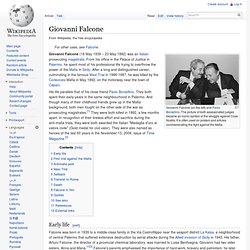
The picture of both assassinated judges became an iconic symbol of the struggle against Cosa Nostra. It is often used on posters and articles commemorating the fight against the Mafia. Giovanni Falcone (18 May 1939 – 23 May 1992) was an Italian prosecuting magistrate. Transparency International. The Empire of Crime. Were Hollywood to update its mafia geography, Al Capone's Chicago would disappear from the map.
New Records 'Vault' Comes Online. The Vault, our new electronic reading room, makes it easier to access and search FBI records.
Last April, we launched a complete overhaul of our FBI Records/Freedom of Information and Privacy Act website, including a new electronic form for submitting requests. Now, we are announcing a revamping of our electronic reading room—renamed “The Vault”—which contains more than two thousand documents that have been scanned from paper into digital copies so you can read them in the comfort of your own home or office. Included here are more than 25 new files that have been released to the public but never added to this website; dozens of records previously posted on our site but removed as requests diminished over time; and files carried over from our previous electronic reading room.
The Vault includes several new tools and resources for your convenience: We’ll be adding more files to the Vault each month, so check back often. Autopsies in the U.S.A. By Krista Kjellman Schmidt, Al Shaw and Jennifer LaFleur, ProPublica, Jan. 31, 2011 Death investigations in the U.S. are often carried out in settings that bear little resemblance to the glitzy, high-tech morgues shown on television.

Nathanson Centre Publications. Ungood Fellas. Romancing The Mob. March 05, 1997|By Teresa Wiltz, Tribune Staff Writer.
In Hollywood's hands, mob kingpin Joey "Doves" Aiuppa's last days would have looked something like this: The Don of Chicago Dons meets his maker while tending his garden. Suddenly, he clutches his chest, the music swelling as he falls to the ground. Or maybe he's gunned down in a mistress' bed. Romancing the Mob > The History Channel Club. It was one of the 20th century’s great law-enforcement conflicts. In the red corner was Scarface, Al Capone, a killer of unprecedented brutality, the father of organized crime as we know it, and the virtual owner of the Chicago police force of his day. In the blue corner were Eliot Ness and his Untouchables, a band of intrepid lawmen, incorruptible by money or favors and willing to give their lives to set Chicago free. Even at the time, the mythic quality of the Ness vs. Capone saga was apparent, and newspapers nationwide were quick to cast the conflict as a good vs. evil passion play.
The Wiseguy and the Wetlands - Page 1 - News - New York - Villag. This is the one New York story about a Mafia soldier and a marshy Brooklyn wetland that does not include any of the following: a .38 caliber Smith & Wesson, duct tape, an area rug, or misplaced appendages.
Instead, this is the saga of one felon's continuing fight with the government over the construction of his waterfront dream home with a stunning view of Mill Basin (not to mention easy access to the Belt Parkway and the Kings Plaza shopping center!). It is the story of what happens when a careless gangster gets caught in the act--the Tidal Wetlands Act, to be precise.
Now, more than eight years after environmental inspectors first cited mob figure John Rosatti, the 54-year-old multimillionaire and state officials are finally close to settling their protracted, snail-paced litigation. Related Stories More About. Amid Baghdad's gridlock, auto dealer is on easy str. BAGHDAD, Iraq — Once a month, Salman Abdul Hussain crosses into Amman, Jordan, to buy used cars for export back home.
He prefers Daewoo and Hyundai, utilitarian models that are hot sellers in a city undergoing an epic expansion in individual mobility. Hussain is one of a thousand entrepreneurs cashing in on Baghdad's cultural boom in these heady economic days following the ouster of this nation's former dictator. Some salesmen take to the streets, hawking their cars one at a time to passers-by. The 39-year-old Hussain is more established, having sold cars for more than a decade. He works in the Adnan Market, which he shares with several other car dealers. Car sales have been spurred by the elimination of heavy taxes and import restrictions, Hussain said. "Now, it is much cheaper, and people want to buy them," Hussain said. A Rich Lindberg Article.
The Mob in America The Mafia in America: Traditional Organized Crime in TransitionAn Overview of Current Conditions By Richard C. Lindberg Copyright © 2002. Mafia bust: How do mobsters make a living in the 21st century? - By Stayton Bonner. Mafia cash in on lucrative EU wind farm handouts - especially in Sicily. Lawyers, Guns & Money. The enormous mortgage-bond scandal. You thought the foreclosure mess was bad?

You’re right about that. But it gets so much worse once you start adding in a whole bunch of parallel messes in the world of mortgage bonds. For instance, as Tracy Alloway says, mortgage-bond documentation generally says that if more than a minuscule proportion of notes in a mortgage pool weren’t properly transferred, then the trustee for the bondholders can force the investment bank who put the deal together to repurchase the mortgages. And it’s looking very much as though none of the notes were properly transferred. But that’s not even the biggest potential problem facing the investment banks who put these deals together. I mentioned this back in September, and I’ve been doing a bit more digging since then. Here’s how it would work: Mortgage Lender Misconduct. Mortgage Fraud Report 2006. May 2007 This house was used in a Mortgage Fraud Scheme Key Findings Top Areas for Mortgage Fraud.
Www.diploweb.com presente: Le crime organise en Suisse. Abstract : Criminal organizations in Switzerland. Overview of criminal network structures, by Nicolas Giannakopoulos. The fact that Switzerland is extensively used by criminal networks to complete theire actions is not a secret any more. The American Mafia - Underworld Slang. The American Mafia has a unique lexicon.
Its collection of slang has been building for more than a century. Many of its words have entered mainstream language.