
HackerThings - Materials. Electronic Components Distributor. OSH Park ~ Welcome. CircuitHub. Microcontrollers/MiniPC/Etc | Platforms/Hardware/Etc. Circuit Simulator. Great Scott Gadgets HackRF. Freehand 3D Computer Interaction Without Gloves. Digits. Digits is a wrist-worn sensor that recovers the full 3D pose of the user's hand.
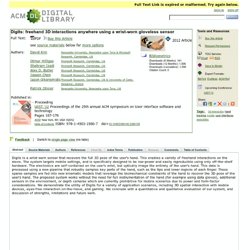
This enables a variety of freehand interactions on the move. The system targets mobile settings, and is specifically designed to be low-power and easily reproducible using only off-the-shelf hardware. The electronics are self-contained on the user's wrist, but optically image the entirety of the user's hand. This data is processed using a new pipeline that robustly samples key parts of the hand, such as the tips and lower regions of each finger. These sparse samples are fed into new kinematic models that leverage the biomechanical constraints of the hand to recover the 3D pose of the user's hand. Wiring. LED WATCHES & LCD WATCHES : Tokyoflash Japan. Tech materials of the future (and how you can make them yourself) Flexible screens, wearable computers, conductive ink, wires that move like muscles: These are the materials that will make up the gadgets of the future, and they’re being dreamed up and developed in do-it-yourself hacker labs and garages all around the world.
Sure, large manufacturers are working on these kinds of materials, too, but openMaterials co-founder Catarina Mota says the real innovation is coming from the bottom up as makers, hackers, and DIY enthusiasts figure out how to do “the future” for themselves in their own home labs. Smart materials have one or more properties that can be changed by external stimuli, such as temperature, moisture, a magnetic field, or an electric current. And these kinds of materials are changing how we think about hardware and what hardware is able to do. So, Mota concluded, she’d have to make the materials she wanted by herself. “The only way to go about this was trial and error,” she said.
Hardware Materials of the Future Art meets fashion meets tech. DIY smart materials. Projects. HiJack is a hardware/software platform for creating cubic-inch sensor peripherals for the mobile phone.
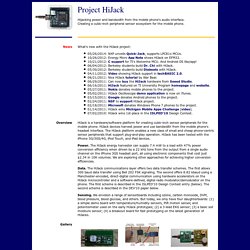
HiJack devices harvest power and use bandwidth from the mobile phone's headset interface. The HiJack platform enables a new class of small and cheap phone-centric sensor peripherals that support plug-and-play operation. HiJack has been tested with the iPhone 3G/3GS/4G, iPod Touch, and iPad devices. Power. The HiJack energy harvester can supply 7.4 mW to a load with 47% power conversion efficiency when driven by a 22 kHz tone from the output from a single audio channel on the iPhone 3GS headset port, all using electronic components that cost just $2.34 in 10K volumes. Data. Sensing. Welcome! - tindie. Build A TENS Machine to Remove Pain. A Tens machine is used to provide a drug free way of removing pain from your body ( TENS stands for Transcutaneous Electrical Nerve Stimulation ) .Here I will show you how to build your own Tens machine and reduce the amount of pills you use to stop pain .To Build this Tens unit, you will first need to buy a 555 timer IC .
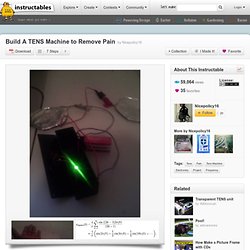
The 555 timer is very small about a quarter of the size of your finger nail .You can purchase one for about 25p from Maplins or Radio Shack etc . There are 2 types of Tens machine. High Frequency Tens uses frequencies in the range of 80 to 100 Hz. This blocks the pain impulses going to the brain . Low frequency Tens uses frequencies from 2 to 4 Hz . Seeeduino Google Android Open ADK Main Board (Arduino Mega 2560 + USB Host) Introducing the next big thing in tech-world: Android Arduino open accessory development kits.
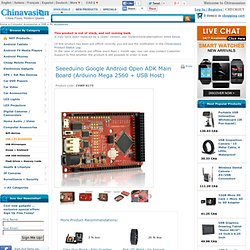
Do you have a great idea for an Android accessory? Then this Seeeduino Android ADK main board is the go-to choice for DIY’ers everywhere. Using the Seeeduino, you’ll be prototyping your custom designed product in mere hours. Just search online for “Arduino tutorials” and you’ll find limitless resources teaching you how to program things like robots, washing machine controllers, automated desk lamps, fish feeders and even 3D printers. Whatever gadget you want to build, it’s possible using the Arduino ADK board! What is the Android Open Accessory Development Kit? On top of that, Mega2560 is the latest release of the Arduino Mega series and includes an upgraded chip set with 256k flash memory (double the original mega board's memory).
Electronic Components Distributor. Allied Electronics – Electronic Parts and Components Distributor. TI Microsites. Breakout – Connect your Arduino sensors and actuators to javascript. Reverse engineering a Nokia LCD. Print your own Supercaps. DIY Solid State Tesla Coil. Graphene supercapacitors are 20 times as powerful, can be made with a DVD burner. A team of international researchers have created graphene supercapacitors using a LightScribe DVD burner.

These capacitors are both highly flexible (pictured below) and have energy and power densities far beyond existing electrochemical capacitors, possibly within reach of conventional lithium-ion and nickel metal hydride batteries. The team, which was led by Richard Kaner of UCLA, started by smearing graphite oxide — a cheap and very easily produced material — films on blank DVDs. These discs are then placed in a LightScribe drive (a consumer-oriented piece of gear that costs less than $50), where a 780nm infrared laser reduces the graphite oxide to pure graphene.
The laser-scribed graphene (LSG) is peeled off and placed on a flexible substrate, and then cut into slices to become the electrodes. Sketch, simulate, and share your circuits. Powering the next generation of electric vehicles. All About Circuits : Free Electric Circuits Textbooks.
Electronic and Electrical Components. Premier Farnell - Our Company. Where to Begin with Arduino » g33ktalk. Hijack. Seeed Studio Bazaar, Boost ideas, extend the reach. Open source electronic projects. Projects [brmlab] USB-Powered Massager Can Knead to the Beat of Your Tunes. OLED panel could switch between sunroof and light source.
A sample of the OLED roof panel material, that can switch between being transparent and emitting light Image Gallery (2 images) What if your car had roof panels that let you see the sky during the day, but that lit the interior of the vehicle at night?
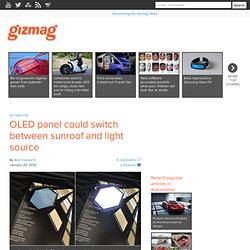
This is now a distinct possibility, thanks to work being done by BASF and Philips. Adafruit Industries. Social Making: Hardware design tools for the web - Upverter. Maker Shed. EVA Film for Photovoltaic Panel “EVASKY” Introduction of EVA FILM - XINOLOGY. As architectural design becomes more and more sophisticated, glass is playing significant role in building construction and decoration.

It leads to a diversified demand in laminated glass, not only in safety and security purposes, but also aesthetics, design, art and view control etc. One of the most popular bonding interlayer films, nowadays, used for glass lamination is PVB. Despite PVB is expansive, PVB is delicate to handle. Online Electronic Resources and Support Homepage. Hosting/Servers/Domains/PaaS/Backend/Etc | Tech Topics. Rasberry Pi. Web/Internet of Things | Technology Topics. Apple/OSX/iPhone/iPod/etc | Platforms. Head Mounted Screen/Glasses/Goggles.
Pretty Hardware/Products/To Buy(?) Screen/Monitor/Display. Touchscreen/Touch Panel. 3D Modeling/3D Scanning/3D Printing/Etc | Tech Topics. Wearable Electronics | Hardware/Electronics/etc. Suppliers/Stores/Manufacturers/Etc.