
A Fair(y) Use Tale. About The Licenses. Our public copyright licenses incorporate a unique and innovative “three-layer” design.
Each license begins as a traditional legal tool, in the kind of language and text formats that most lawyers know and love. We call this the Legal Code layer of each license. Creative Commons license. This video explains how Creative Commons licenses can be used in conjunction with commercial licensing arrangements.

Creative Commons licenses are explained in many languages and used around the world, such as pictured here in Cambodia. A Creative Commons (CC) license is one of several public copyright licenses that enable the free distribution of an otherwise copyrighted work. Creative Commons images and you: a quick guide for image users. Here at Ars we're big fans of Creative Commons, both the idea behind it and the work that gets produced.
As publishers, we benefit from Creative Commons in a number of ways—we look things up in Creative Commons-licensed Wikipedia (used with caution, of course), the Creative Commons-related policy issues that we cover give us a steady stream of great news content, and we make use of Creative Commons-licensed images in our news stories. Will I Use Creative Commons Licenses? (Activity 9: H817OPEN. Licenses/NC - Definition of Free Cultural Works. When the Creative Commons project published its first licenses in December 2002, it finally brought a sense of unity to the free culture movement.
Instead of having to choose from many scattered licenses, authors now have the option to pick the right license for their work using a simple tool. They only have to answer basic questions like: “Allow commercial uses? Allow modifications?” The tool then recommends one of the licenses developed by the Creative Commons team. They are legally sane, simple documents, specially adapted for various jurisdictions.
One particular licensing option, however, is a growing problem for the free culture community. Fair Use. Copyright Fair Use and How it Works for Online Images. You’ve heard the adage that a picture is worth a thousand words, but when that picture is protected by copyright, the picture is only worth three words: cease and desist.
OK, that’s kind of a lawyer joke. But it illustrates how protective people are about finding their images used online without permission. Copyright laws were established not to give the author the right to deny their work to other people, but instead to encourage its creation. Article I, Section 8, clause 8, of the United States Constitution states the purpose of copyright laws is “to promote the Progress of Science and useful Arts, by securing for limited times to Authors and Inventors the exclusive Right to their respective Writings and Discoveries.” In General (FAQ) 10 Big Myths about copyright explained. See EFF notes on fair use and links from it for a detailed answer, but bear the following in mind: The "fair use" exemption to (U.S.) copyright law was created to allow things such as commentary, parody, news reporting, research and education about copyrighted works without the permission of the author.
That's vital so that copyright law doesn't block your freedom to express your own works -- only the ability to appropriate other people's. Tips For Making Sure Your Copyright Registration Application Is Accepted. Circ07d.pdf (application/pdf Object) Copyright_Graphic_Article.pdf (application/pdf Object) YouTube. If You Cannot Find the Owner. The situation is common: You want to use a copyrighted work beyond the limits of fair use or other copyright exception.
You tracked down a likely copyright owner and have attempted to seek permission, but the effort simply has produced no conclusion. Worse, perhaps you did receive permission, but with burdensome conditions or a high price. Perhaps you wrote for permission, and the permission was flatly denied. In some situations, you might have little choice but to absorb the bad news and change your plans. Much more complex and frustrating, however, is when you exert an honest effort, but you simply cannot find a copyright owner or your efforts go unanswered. Problems 1. The work itself does not have a name, and you have searched through various different catalogs, databases, and other sources, according to the title or description of the work. 2. 3. Possible Solutions 1. 2. MyFreeCopyright.com: FREE Copyright Protection. Public domain in the United States.
Works are in the public domain if they are not covered by intellectual property rights, such as copyright, at all, or if the intellectual property rights to the works has expired.[1] Public domain in copyrighted works in the United States[edit] Congress has restored expired copyrights several times: "After World War I and after World War II, there were special amendments to the Copyright Act to permit for a limited time and under certain conditions the recapture of works that might have fallen into the public domain, principally by aliens of countries with which we had been at war.
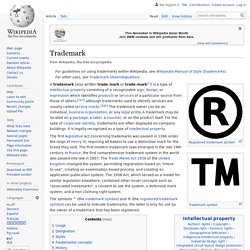
(Re-)Defining the Public Domain : Carl Malamud. Fighting for your digital rights in Washington. Society: Law: Legal Information: Intellectual Property: Copyrights. Survey_private_registries-final_draft-2011_09_14-clean 2.doc. Trademark. Trade identifier of products or services.
How to Register a Trademark for a Company Name - Small Business. Registering a trademark for a company name is pretty straightforward.
Many businesses can file an application online in less than 90 minutes, without a lawyer’s help. The simplest way to register is on the U.S. Patent and Trademark Office’s Web site, www.uspto.gov. Trademarks Home.
Plagiarism, Creativity & The Remix. Creative Commons.