
Office Bliss (An Infographic on Work-Life Happiness) Click for full size Key Take Aways 1.

Happiness with work environment has decreased consecutively the last 4 years. This is a sad trend to see. Each year happiness has dropped by a few percentage points, but lower happiness leads to less productivity, which leads to weak economic growth. 2. Each point represents the percentage of employees whose work exhibits these characteristics and feel they are happy with their work. Secure jobs 63%Benefits 60%Compensation/pay 57%Opportunities to use skills and abilities 55%Feeling safe in the work environment 54%Relationship with supervisor 52%The work itself 50%Independence 47%Work-Life balance 46%Corporate Culture 45% Matthieu Ricard: Habits of happiness. TEDxBloomington - Shawn Achor - "The Happiness Advantage: Linking Positive Brains to Performance".
The Century of Self Happiness Machines Video. Srikumar Rao: Plug into your hard-wired happiness. Talks about happiness. 20 Amazing Facts About Happiness - Family Health Guide. About Raising Happiness. This blog is mostly science-based parenting advice.
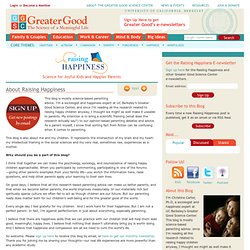
I’m a sociologist and happiness expert at UC Berkeley’s Greater Good Science Center, and since I’m reading all the research related to raising happy children anyway, I thought we might as well make it useable to parents. My intention is to bring a scientific framing (what does the research actually say?) To our opinion-based parenting debates and advice. As a parent myself, I know that sorting fact from fiction can be confusing when it comes to parenting. The 3 R’s To Total Happiness. You wake up in the morning and determine to be happy, but your happiness can be short- lived because of other factors not within your control and they are sending negative signals to disturb your peace of mind.

To be totally happy you have to handle the three components of happiness well. The three components are resolution, reaction and relation. Let’s take a look at each and every one in detail. This is at a personal level. Things are within your control. Choice: You decide and you make a choice. The Difference between False Happiness and Real Happiness.
It seems we are all striving for happiness; but, what do we actually mean by happiness?
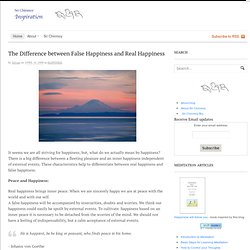
There is a big difference between a fleeting pleasure and an inner happiness independent of external events. These characteristics help to differentiate between real happiness and false happiness. Peace and Happiness: Real happiness brings inner peace. When we are sincerely happy we are at peace with the world and with our self. The Nine Rooms of Happiness - Love, Purpose, and Life's Little Imperfections.
Happiness 101. The Secret of Happiness ? Happiness is a Choice You Make « The Art of Loving Yourself. <a href=" Our Poll</a> If you are not a happy person that is a choice you are making.
Our Message on Happiness. Keep Smiling: 80 Beautiful Photographs Reflecting Happiness. Serotonin-and-dopamine.gif (GIF Image, 620×398 pixels) Daily Schedule for Happiness. Spread Some Random Happiness. Daily affirmations and inspirational messages may look cheesy but they work.
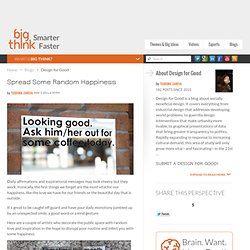
Ironically, the first things we forget are the most vital for our happiness, like the love we have for our friends or the beautiful day that is outside. It's great to be caught off guard and have your daily monotony jumbled up by an unexpected smile, a good word or a kind gesture. Here are a couple of artists who decorate the public space with random love and inspiration in the hope to disrupt your routine and infect you with some happiness.
Akin Bilgic is currently raising money on kickstarter to be able to purchase as many mirrors as possible, inscribe them with inspirational messages and then install them around the city overnight. On the next day, after busy San Franciscans catch their reflections under messages like "Looking good. How to Trick Your Brain for Happiness. This month, we feature videos of a Greater Good presentation by Rick Hanson, the best-selling author and trailblazing psychologist.
In this excerpt from his talk, Dr. Empathy. Empathy is the capacity to understand what another person is experiencing from within the other person's frame of reference, i.e., the capacity to place oneself in another's shoes.[1] Etymology[edit] The English word is derived from the Ancient Greek word ἐμπάθεια (empatheia), "physical affection, passion, partiality" which comes from ἐν (en), "in, at" and πάθος (pathos), "passion" or "suffering".[2] The term was adapted by Hermann Lotze and Robert Vischer to create the German word Einfühlung ("feeling into"), which was translated by Edward B.
Titchener into the English term empathy.[3][4] Alexithymia (the word comes from the Ancient Greek words λέξις (lexis, "diction", "word") and θυμός (thumos, "soul, as the seat of emotion, feeling, and thought") modified by an alpha-privative, literally meaning "without words for emotions"), is a term to describe a state of deficiency in understanding, processing, or describing emotions in oneself.[5] Definition[edit] Philosophy of happiness. Greek philosophers (Socrates, Antisthenes, Chrysippus, Epicurus).
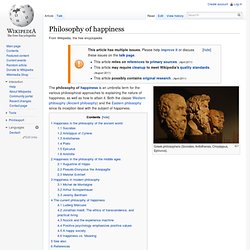
The philosophy of happiness is an umbrella term for the various philosophical approaches to explaining the nature of happiness, as well as how to attain it. Both the classic Western philosophy (Ancient philosophy) and the Eastern philosophy since its inception deal with the subject of happiness. Happiness in the philosophy of the ancient world[edit] Diogenes with a lamp. Socrates[edit] Socrates (* 469 BC in Athens, † 399 BC) is fundamental in Western thinking. Abraham Maslow. American psychologist Abraham Harold Maslow (; April 1, 1908 – June 8, 1970) was an American psychologist who was best known for creating Maslow's hierarchy of needs, a theory of psychological health predicated on fulfilling innate human needs in priority, culminating in self-actualization.[2] Maslow was a psychology professor at Brandeis University, Brooklyn College, New School for Social Research, and Columbia University.
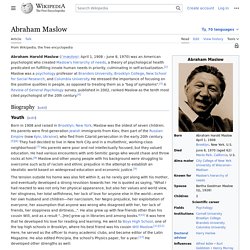
He stressed the importance of focusing on the positive qualities in people, as opposed to treating them as a "bag of symptoms".[3] A Review of General Psychology survey, published in 2002, ranked Maslow as the tenth most cited psychologist of the 20th century.[4] Biography[edit] An introduction to Maslow's Hierarchy of needs. Abraham Maslow. Dr. C. George Boeree. Carl Rogers. Carl Ransom Rogers (January 8, 1902 – February 4, 1987) was an influential American psychologist and among the founders of the humanistic approach (or client-centered approach) to psychology. Rogers is widely considered to be one of the founding fathers of psychotherapy research and was honored for his pioneering research with the Award for Distinguished Scientific Contributions by the American Psychological Association (APA) in 1956.
The person-centered approach, his own unique approach to understanding personality and human relationships, found wide application in various domains such as psychotherapy and counseling (client-centered therapy), education (student-centered learning), organizations, and other group settings. For his professional work he was bestowed the Award for Distinguished Professional Contributions to Psychology by the APA in 1972.
Biography[edit] Rogers was born on January 8, 1902, in Oak Park, Illinois, a suburb of Chicago. Theory[edit] Carl Rogers - Streaming Audio. Personality & Consciousness - - Carl Rogers' Theory of Personality. By Dagmar Pescitelli Since the study of personality began, personality theories have offered a wide variety of explanations for behavior and what constitutes the person. This essay offers a closer look at the humanistic personality theory of Carl Rogers. 40 Photo-Illustrated Questions to Refocus Your Mind. Asking the right questions is the answer… It’s not the answers you get from others that will help you, but the questions you ask of yourself.
Here are 40 thought-provoking questions to help you refresh and refocus your thinking: Please share your thoughts with us in the comments section below. Also, check out our sister site, Thought Questions, for more photo-illustrated questions like these; and check out The Book of Questions if you’re interested in reading even more inspiring, thought-provoking questions.Title photo by: Helga Weber For all other photo credits please refer to ThoughtQuestions.com Related. Self-actualization. Self-actualization is a term that has been used in various psychology theories, often in slightly different ways. The term was originally introduced by the organismic theorist Kurt Goldstein for the motive to realize one's full potential. Expressing one's creativity, quest for spiritual enlightenment, pursuit of knowledge, and the desire to give to society are examples of self-actualization.
In Goldstein's view, it is the organism's master motive, the only real motive: "the tendency to actualize itself as fully as possible is the basic drive... the drive of self-actualization. Self Actualization. Quotes to Inspire Teachers & Learners of English. Inspirational Quotes for Teachers and Learners.