
Police are going to wield the full force of the surveillance state to monitor these protests. It’s critical that if you are attending, you follow these basic steps so you can protect yourself. What depressed robots can teach us about mental health. Manifesto for teaching online. This page contains the text of the revised (2016) manifesto.

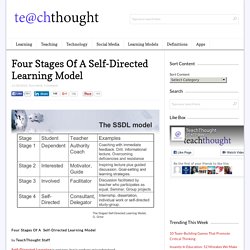
To read the 2011 manifesto, visit the 2011 page. The PDF Download the manifesto in PDF format. The video. Call me a CALL Expert: Mapping the Structure of Knowledge in the Field - Kelly J. Cunningham. Two Contrasting Views of Educational Technology by @nikpeachey - UKEdChat.com. The Four Stages Of The Self-Directed Learning Model. Four Stages Of A Self-Directed Learning Model by TeachThought Staff Self-Directed Learning is not new, but is perhaps misunderstood.
Comprehensive new study provides foundation for future of digital higher education. A new, comprehensive metastudy of the role technology plays in higher education urges universities of tomorrow to capitalize on technologies that effectively support student learning, to embrace blended learning environments, and to customize degree programs to serve the needs of students in a digital age.
George Siemens, executive director of The University of Texas at Arlington's Learning Innovation and Networked Knowledge Lab, is the lead author of "Preparing for the Digital University: A Review of the History and Current State of Distance, Blended, and Online Learning. " The international study offers strategies and important implications for higher education institutions preparing for the digital wave. Technology Manifesto. Politicians and policymakers must put technology front and centre of their thinking for the 2015 general election.

Policy Exchange's Technology Manifesto, written in association with Google and EMC as part of our Road to 2015 series of work, sets out a vision for how Britain can maximise technology's positive contribution for individuals, businesses and government. As a country we are well positioned to be a world leader in using technology for positive ends, but success will require the proactive attention of – and continuity of support from – successive governments.
The manifesto sets out three principal goals: to build the world's most connected and digitally skilled society; to make Britain the most attractive place outside of Silicon Valley for technology entrepreneurs to start and grow a business; and to make our government the smartest in the world. What’s the “problem” with MOOCs? « EdTechDev. In case the quotes didn’t clue you in, this post doesn’t argue against massive open online courses (MOOCs) such as the ones offered by Udacity, Coursera, and edX.
I think they are very worthy ventures and will serve to progress our system of higher education. I do however agree with some criticisms of these courses, and that there is room for much more progress. I propose an alternative model for such massive open online learning experiences, or MOOLEs, that focuses on solving “problems,” but first, here’s a sampling of some of the criticisms of MOOCs. Criticisms of MOOCs. The UK Media-Enhanced Learning Special Interest Group. Educational Research Made Easy for Busy Teachers. Doug Engelbart 1968 Demo. Why big IT projects always go wrong. In 1975, a computer scientist named Fred Brooks published one of the seminal texts in the literature of computing.
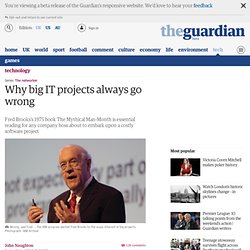
It had the intriguing title of The Mythical Man-Month and it consisted simply of a set of essays on the art of managing large software projects. Between its covers is distilled more wisdom about computing than is contained in any other volume, which is why it has never been out of print. And every government minister, civil servant and chief executive thinking about embarking on a large IT project should be obliged to read it – and answer a multiple-choice quiz afterwards. How come? What is Transliteracy? What is Transliteracy?
Transliteracy is the ability to read, write and interact across a range of platforms, tools and media from signing and orality through handwriting, print, TV, radio and film, to digital social networks. – www.transliteracy.com What does it have to do with libraries? Longer definition of transliteracy in relation to libraries (originally published at Librarian by Day) Donald Clark Plan B. I've already given a general critique of why tablets should not be used in schools in Too cool for school: why tablets should NOT be used in education, but there is one issue that gets to the heart of the matter.

Typing, text and data manipulation is important in learning. Many learners will be expected to write, edit and input data, not only while they learn but also when using computers at work or at home for leisure. Given the increased use of tablets in schools and universities, we must also ask whether typing is better on touchscreens or keyboards. Are we missing the fact that touchscreens may inhibit or even damage learning? Community of Inquiry. An educational community of inquiry is a group of individuals who collaboratively engage in purposeful critical discourse and reflection to construct personal meaning and confirm mutual understanding. The Community of Inquiry theoretical framework represents a process of creating a deep and meaningful (collaborative-constructivist) learning experience through the development of three interdependent elements - social, cognitive and teaching presence.
Social presence is “the ability of participants to identify with the community (e.g., course of study), communicate purposefully in a trusting environment, and develop inter-personal relationships by way of projecting their individual personalities.” (Garrison, 2009) Typologie des réseaux sociaux et usages pédagogiques des réseaux sociaux. Which type of communicator are you? Ofcom research sorts the ‘always on’ from the ‘detached’ communicators New analysis of the UK’s communication habits has found that people can be categorised into five different groups of communicators, ranging from the ‘always on’ to the ‘detached’.
Earlier this year, Ofcom’s Communication Market Report revealed that the UK is now texting more that talking. Further analysis of the research, published today, looks at the methods and frequency of communication, as well people’s attitudes towards it. The study classifies adults into one of five groups, divided by the ways they choose to communicate and how often: ‘Always on’ (22% of adults) The youngest group, with half (50%) aged under 35, they communicate a lot, especially with their friends and family. Researchers tell the difference between a male and female tweet. How do you tell male speech from female speech?

University researchers David Bamman, Jacob Eisenstein, and Tyler Schnoebelen took up the challenge of replicating and reciprocating previous research, which used Twitter, to point out that identifying gender differences in speech is a lot more complicated than the conclusions previous studies came to. The latest study cites the work of researchers Burger, Henderson, Kim, and Zarrella 2011, that measured 184,000 “authors,” or Twitter users, which was able to obtain 75.5 percent accuracy for identifying the gender of the speaker, granted that their algorithm had multiple tweets per author to work with. 67.8 accuracy was obtained from single messages per author.
Using Facebook to Explore Boundary Issues for Social Workers in a Networked Society: Students' Perceptions of Learning. Tarsem Singh Cooner* + Author Affiliations ↵*Correspondence to Tarsem Singh Cooner, Institute of Applied Social Studies, Muirhead Tower, University of Birmingham, Edgbaston, Birmingham, B15 2TT, UK. E-mail: t.s.cooner@bham.ac.uk Accepted November 2012. Abstract. Recent contributions to the theory of distance education - Open Learning: The Journal of Open, Distance and e-Learning - Volume 5, Issue 3. Abstract. Research Article Working together online to enhance learner autonomy: Analysis of learners’ perceptions of their online learning experience* Jérôme Eneaua1 and Christine Develottea2 a1 Université de Haute Bretagne, Place du Recteur Le Moal, 35000 Rennes, France (email: jerome.eneau@univ-rennes2.fr) a2 Institut National de Recherche Pédagogique, Allée de Fontenay, 69007 Lyon, France (email: christine.develotte@inrp.fr)
Editorial: Three types of interaction - American Journal of Distance Education - Volume 3, Issue 2. Editorial, What Does Research Say About the Learners Using Computer-Mediated Communication in Distance Learning? - American Journal of Distance Education - Volume 16, Issue 2. OER Synthesis and Evaluation / OER Synthesis and Evaluation Project. Welcome to the JISC/HE Academy OER Programme Synthesis and Evaluation Project Wiki This project provided objective, ongoing evaluation and synthesis of the HEFCE funded pilot programme which was run in collaboration between the Higher Education Academy and JISC through three linked activities: A framework tool provided a strong foundation and common language for collating data from projects.
The framework allows us to structure our interventions with projects, and was also used a means of evaluating the 'openness' of their outcomes. The framework was developed in collaboration with both projects and the support teams during the pilot phase of the programme. Resources to support projects The team have produced a range of guidance documents to support projects as well as links to useful sources available elsewhere.
UK University Twitter Accounts. Google's Chrome Browser Now Contains A Disruptive New Communications Framework. JISC Digital Media. DiAL-e Framework. Heuristic Evaluation: How-To. Chickering and Gamson's 7 principles. University of Brighton Repository - I saw this: bringing learned language into the classroom via mobile phones. Pemberton, L. and Winter, M. (2011) I saw this: bringing learned language into the classroom via mobile phones In: Presentation at Asian Conference on Language Learning, 10-12 June, 2011, Osaka, Japan. Full text not available from this repository.
Critical Review of Connectivism: A Learning Theory for the Digital Age. In his 2005 article Connectivism: A Learning Theory for the Digital Age, Siemens outlined a new way of thinking about learning based on the recent advances in information technology. He argues that this new theory, connectivism, supersedes previous learning theories, including behaviourism, cognitivism, and contructivism. In this post, I am seeking to further my understanding of this new theory, examine its limitations, and consider its relevance to both classroom teaching as well as knowledge management practices within organizations. Defining Connectivism In the article, Siemens outlines the fundamental principles of connectivism: For Siemens, connectivism is a significant departure from previous learning theories because it sees learning occurring outside of the individual, within the network: For connectivists, the starting point is always the individual learner (Siemens, 2005).
Applications in the Classroom. Four educational theories applied to learning to build a fire. Four educational theories applied to learning to build a fire. Welcome // Variety of Language. Introduction: The growth of the Internet has fostered hopes that it will promote active democracies around the world. These hopes are based on the multiple sources of information available to users on the Internet, which is believed to lead to better political choices, and the freedom to express one’s views online, regardless of social status differences.
IdeaLearning Group » Blog Archive » The Rise of Social Learning at Work. A tidal wave of social learning is reshaping the way we experience new information. As businesses become more globalized, people are discovering more flexible, engaging ways to make connections with each other. We’re now able to cast a net into the ebbs and flows of relevant information that surrounds us. And the results are pretty amazing. Facebook. The Digital Age, Memory and Learning. I remember plenty of seven-digit numbers from my youth — the Gabrielli’s home phone, the Young’s, and the Bardo’s among them. An Apple for the teacher: are iPads the future in class? 10 Real-World BYOD Classrooms (And Whether It’s Worked Or Not)
Journal of Computer-Mediated Communication. Envisioning the Post-LMS Era: The Open Learning Network (EDUCAUSE Quarterly. Visitors and Residents: What Motivates Engagement with the Digital Information Environment? Apple’s App Discovery Lead On Google Is Shrinking, But Mobile Publishers Shouldn’t Be Too Worried.
Open University research explodes myth of 'digital native' (Critical) history of ICT in education – and where we are heading? Is Facebook Making Us Lonely? - Magazine. Online social networks as formal learning environments: Learner experiences and activities. Using Twitter to Talk About Teaching - Do Your Job Better. CCK12 #LAK12 From Information Attention, Abundance to Engagement. The Failure of One Laptop Per Child. Stephen Downes’ overview of e-learning: and a little history lesson. Journal of Learning Development in Higher Education. Txttools limited » case studies. Will technology harm or help young people’s brains? A highly nuanced debate.
How Do You Cite a Tweet in an Academic Paper? - Atlantic Mobile. Curation. How schools and colleges are using Social Media in Education? CCK12 #LAK12 Facebook or Twitter. Tweeting To Their Teachers Could Help Shy Students. Baladodiffusion (diffusion pour baladeur, podcasting) et enseignement. Computer-Supported Collaborative Learning: Best Practices and Principles for Instructors. Digital opportuities for Christians in 2012. Pedagogy and Space: Empirical Research on New Learning Environments (EDUCAUSE Quarterly. Technology Integration Matrix. Technology Integration Matrix. Ce qu’un message sur Twitter peut cacher comme informations. SocialnetImporter for NodeXL: Import your Facebook ego-networks. SocialnetImporter for NodeXL: Import your Facebook ego-networks. Crowdsourcing to predict the future of computing.
Quick Guide to Social Network Analysis « SplinterNet. Facebook's Secret to High Emotional Engagement? Faces [STUDY] Alt-metrics: a manifesto – altmetrics.org. 7 Stories From Educators About Teaching In The Flipped Classroom. ASIST Twitter presentation. People Are More Likley to Lie When Communicating Online. Comprendre les réseaux sociaux numériques : un enjeu pour l’enseignement (dossier) The Internet of Things – this is where we're going. Ademic knowledge in the digital era: 5 podcasts. Is Twitter an Individual Mass Communication Medium? Things I grab, motley collection. Ten ways schools are using social media effectively.
Why do men and women talk differently? 60seconds.jpg (JPEG Image, 1191x842 pixels) - Scaled (76%) Reconsidering Teachers’ Roles (III). Douglas Thomas: Cultivating the imagination for a world of constant change. Emergent Learning and Learning Ecologies in Web 2.0. The educational value of creative disobedience. The Principled Approach 2. Tech-savvy students want real-life lecturers too, study finds. Taxonomy of Technology Integration.