
ESO. The Hubble Heritage Project Website. Hubble 25 Anniversary. HubbleSite - Out of the ordinary...out of this world. Supernova in Messier 82 discovered by UCL students. Updated 23 Jan 2014 - 9:30am Students and staff at UCL’s teaching observatory, the University of London Observatory, have spotted one of the closest supernova to Earth in recent decades.

At 19:20 GMT on 21 January, a team of students – Ben Cooke, Tom Wright, Matthew Wilde and Guy Pollack – assisted by Dr Steve Fossey, spotted the exploding star in nearby galaxy Messier 82 (the Cigar Galaxy). The discovery was a fluke – a 10 minute telescope workshop for undergraduate students that led to a global scramble to acquire confirming images and spectra of a supernova in one of the most unusual and interesting of our near-neighbour galaxies. Hubble telescope takes stunning new nebula photo for 23rd birthday. This new Hubble image, captured and released to celebrate the telescopeâ ESA, and the Hubble Heritage Team (AURA/STScI),NASA NASA's Hubble Space Telescope has snapped a spectacular new image of an iconic nebula to celebrate its 23 years of peering deep into the heavens.
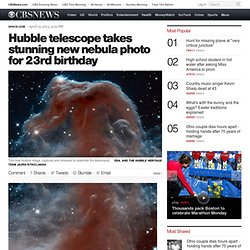
The Hubble observatory, which launched on April 24, 1990, captured the Horsehead Nebula in infrared light, peering through obscuring veils of dust to reveal the object's hidden features. The Milky Way Project. Photojournal: NASA's Image Access Home Page. Images. Voyager - The Interstellar Mission. Realtime Image Gallery. Picture of the Week.
In this new Hubble image, we can see an almost face-on view of the galaxy NGC 1084.
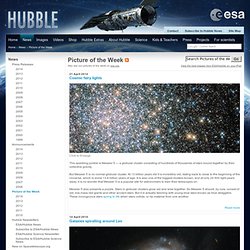
At first glance, this galaxy is pretty unoriginal. Like the majority of galaxies that we observe it is a spiral galaxy, and, as with about half of all spirals, it has no bar running through its loosely wound arms. However, although it may seem unremarkable on paper, NGC 1084 is actually a near-perfect example of this type of galaxy — and Hubble has a near-perfect view of it. NGC 1084 has hosted several violent events known as supernovae — explosions that occur when massive stars, many times more massive than the Sun, approach their twilight years.
As the fusion processes in their cores run out of fuel and come to an end, these stellar giants collapse, blowing off their outer layers in a violent explosion. Astronomers have noted five supernova explosions within NGC 1084 over the past half century.
Astronomy Photographer of the Year Award Winners: Photos. Royal Observatory : Places. Stellarium. How to... photo guides : Astronomy Photographer of the Year : Exhibitions : What's on. Universal Big Questions ? Universe Today — Space and astronomy news. RedOrbit - Science, Space, Technology, Health News and Information. NASA finds extra-terrestrial amino-acids in Sudan meteorites. Earlier this month, NASA announced the discovery of bacteria living in arsenic in a California lake.
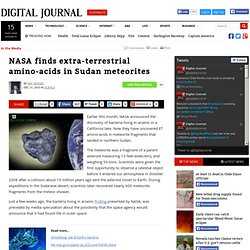
Now they have uncovered ET amino-acids in meteorite fragments that landed in northern Sudan. The meteorite was a fragment of a parent asteroid measuring 13-feet-wide (4m), and weighing 59-tons. Scientists were given the first opportunity to observe a celestial object before it entered our atmosphere in October 2008 after a collision about 15 million years ago sent the asteroid closer to Earth.
During expeditions in the Sudanese desert, scientists later recovered nearly 600 meteorite fragments from the meteor shower. Just a few weeks ago, the bacteria living in arsenic finding presented by NASA, was preceded by media speculation about the possibility that the space agency would announce that it had found life in outer space.
Read more... Astrophysical Journal Letters. Astronomy & Astrophysics (A&A) The Planet's Most Powerful Digital Camera Captures Its First Images of the Universe - Megan Garber. The device could help astronomers figure out why the expansion of the universe is accelerating.

Zoomed-in image from the Dark Energy Camera of the center of the globular star cluster 47 Tucanae, which lies about 17,000 light years from Earth (Dark Energy Survey Collaboration) The Dark Energy Camera is the world's most powerful digital camera. About the size of a phone booth and boasting 570 megapixels, the device took eight years to construct -- by astronomers, technicians, and engineers collaborating across three continents -- and is currently mounted to the Blanco telescope in Chile. From that perch, it is able to observe light from over 100,000 galaxies.
Galaxies that are up to 8 billion light years away. Again: 8 billion light years away. That light isn't just mind-bogglingly ancient. Experiment. Supersymmetry, Extra Dimensions and the Origin of Mass. The Universe is Alive. “Night, when words fade and things come alive.
When the destructive analysis of day is done, and all that is truly important becomes whole and sound again.” Speed of the Milky Way in Space. As we all know, a galaxy is a massive ensemble of hundreds of millions of stars.
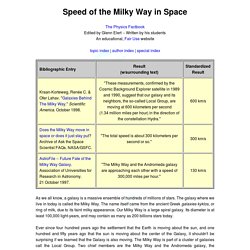
The galaxy where we live in today is called the Milky Way. The name itself came from the ancient Greek galaxies kyklos, or ring of milk, due to its faint milky appearance. Our Milky Way is a large spiral galaxy. Its diameter is at least 100,000 light-years, and may contain as many as 200 billions stars today. How fast is our galaxy moving through space. Astronomy. Astronomy. The Universe. Universe. Extraterrestrial life. Physics. Welcome to Explorations in Science with Dr. Michio Kaku. Scale of Universe - Interactive Scale of the Universe Tool. The Elegant Universe: Series ...
The Elegant Universe: Part 3 PBS Airdate: November 4, 2003. Hubble Space Telescope Picture Gallery - Photo Gallery - Images. Cosmic Journeys. VideoFromSpace's Channel When Will Time End? Is the Universe Infinite? The Largest Black Holes in the Universe. How Large is the Universe? Interactive panoramic photo: Inside the Large Hadron Collider.