
Ancient Archeological Sites That Were Destroyed By Stupid Humans. Such a tragedy.
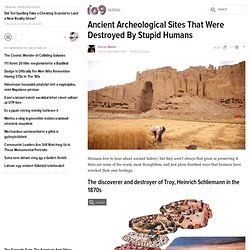
The Ikea and Taliban destruction is sickening. And it certainly seems like these archaeological sites have more cultural and historical value than the short- term political and economic greed that hastened their demise. Armenia – An Ancient land of Culture. Armenia is an ancient land of culture and it offers a little something for every traveler .

Armenia is full of historical churches, monasteries, monuments, and magnificent masonry, this country that was the first to adopt Christianity and proclaim it as its state religion in 301 AD is a unique treasure for those interested in great events. EMPIRE17. Holocaust Timeline. Jump to: 1938 1939 1940 1941 1942 1943 1944 1945 1933 January 30, 1933 - Adolf Hitler is appointed Chancellor of Germany a nation with a Jewish population of 566,000.
February 22, 1933 - 40,000 SA and SS men are sworn in as auxiliary police. February 27, 1933 - Nazis burn Reichstag building to create crisis atmosphere. February 28, 1933 - Emergency powers granted to Hitler as a result of the Reichstag fire. March 22, 1933 - Nazis open Dachau concentration camp near Munich, to be followed by Buchenwald near Weimar in central Germany, Sachsenhausen near Berlin in northern Germany, and Ravensbrück for women. March 24, 1933 - German Parliament passes Enabling Act giving Hitler dictatorial powers. Terms of use: Private home/school non-commercial, non-Internet re-usage only is allowed of any text, graphics, photos, audio clips, other electronic files or materials from The History Place.
Tales of the Middle Ages. Voynich manuscript. The Voynich manuscript is an illustrated codex hand-written in an unknown writing system.
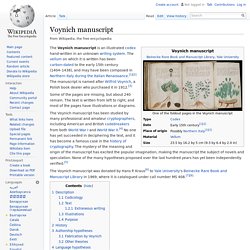
The vellum on which it is written has been carbon-dated to the early 15th century (1404–1438), and may have been composed in Northern Italy during the Italian Renaissance.[1][2] The manuscript is named after Wilfrid Voynich, a Polish book dealer who purchased it in 1912.[3] Some of the pages are missing, but about 240 remain. The text is written from left to right, and most of the pages have illustrations or diagrams. The Voynich manuscript has been studied by many professional and amateur cryptographers, including American and British codebreakers from both World War I and World War II.[4] No one has yet succeeded in deciphering the text, and it has become a famous case in the history of cryptography. Knight armour and Fantasy armor for sale. Mysterious book that contains many UNDECIFERED secrets!!
Erectile dysfunction in the Middle Ages – historian examines medieval impotence cases. Like today, the problem of male impotence in the Middle Ages was often serious, and had important consequences for marriages and families.
A recent article deals with the issue, explaining how it showed up in court cases in 14th century York. ‘Privates on Parade: Impotence Cases as Evidence for Medieval Gender’, by Frederick Pederson, a senior lecturer at the University of Aberdeen, analyses two cases where wives attempted to annul their marriages because they claimed their husbands were impotent. They are among six cases from the city’s records that deal with impotence that survive from the Middle Ages. These cases were adjudicated in ecclesiastical courts, also known as consistory courts, where decisions were based on canon law. Kuntz-Kamera of St. Petersburg. Posted on June 27, 2007 by “Kuntzkamera” it’s a museum in St.

Petersburg. It’s a really strange place, was founded by Russian Tsar Peter the First. He collected different weird stuff all over the Russia to this museum: freaky people and animals preserved in alcohol, torture instruments, strange paintings and much more. Middle Ages. Pyramid Discoveries Will Force History to be Re-Written. The world’s largest and oldest pyramid has been discovered in Bosnia A pyramid has been discovered in Bosnia-Herzegovina that is larger, older and more perfectly oriented than Egypt’s Great Pyramid of Giza.

Located near the city of Visoko, not only is it the first pyramid to be discovered in Europe, but it is also the largest valley of pyramids in the world. Dr. What Vikings really looked like. The fine decoration of the Oseberg ship in Norway, which was buried in the year 834, provides clues to what Vikings looked like.
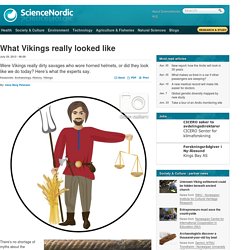
Inside the ship were two women and the archaeologists believe the ship has served as a sarcophagus. (Photo: Annie Dalbéra) Project Avalon - Klaus Dona: The Hidden History of the Human Race. Click here for the PDF version of this interview (20 pages) Click here for the video presentation March 2010 **Ed note: Some transcripts contain words or phrases that are inaudible or difficult to hear and are, therefore, designated in square brackets.** BILL RYAN (BR): This is Bill Ryan here from Project Camelot and Project Avalon.

Europe’s Top 25 Castles – The Best Castles in Europe. There is something about castles that inspires awe and at the same time touches a gentler, more romantic side in each of us.

And if you want to visit and tour some of the best castles in the world, then Europe should be your destination as this continent certainly has more than its share. Here are the top 25 castles in Europe, in no particular order. 1. Castle Neuschwanstein in Germany Neuschwanstein Castle. Roman Life. ARCHAEOLOGY - Roman sarcophagus found after 20 years. ISTANBUL - Hürriyet Daily News This file photo shows two guards waiting in front of Roman sarcophagus in Rome. According to Britain-based The Art Newspaper, an ancient Roman alabaster sarcophagus that had been stolen more than 20 years ago from a church south of Rome was returned to Italy July 18. It came from a London-based collection of antiquities and was flown back to Rome on a cargo flight in a container reportedly displaying the official seal of the Italian Embassy in London. A special team from the cultural heritage protection division of Italy’s police force, the Guardia di Finanza, gruppo Tutela Patrimonio Archeologico, lead by Massimo Rossi, conducted the repatriation operation, reported The Art Newspaper.
Archaeologists unearth 5,000-year-old 'third-gender' caveman. Archaeologists investigating a 5,000-year-old Copper Age grave in the Czech Republic believe they may have unearthed the first known remains of a gay or transvestite caveman, reports the Telegraph. The man was apparently buried as if he were a woman, an aberrant practice for an ancient culture known for its strict burial procedures. Since the grave dates to between 2900 and 2500 BC, the man would have been a member of the Corded Ware culture, a late Stone Age and Copper Age people named after the unique kind of pottery they produced. Men in this culture were traditionally buried lying on their right side with their heads pointing west, but this man was instead buried on his left side with his head pointing east, which is how women were typically buried.
"From history and ethnology, we know that people from this period took funeral rites very seriously so it is highly unlikely that this positioning was a mistake," said lead archaeologist Kamila Remisova Vesinova. Top 100 of medieval castles. Archaeologists Excavate a Lost Kingdom Buried Beneath Volcanic Ash. Like Pompeii, evidence shows a human settlement frozen in time by volcanic pyroclastic flows. Turkey to create world's largest museum of civilizations.
Turkey exhibits an unprecedented activity in the area of the restitution of cultural property removed from the country. The country has an excuse - the creation of the world's largest museum of civilizations. The Turks not only want to return the heritage of their ancestors, Seljuks, but also ancient artifacts of Greeks, Romans, Byzantines, Hittites - the cultures and peoples who once lived here.
The Museum of Civilizations will be built in Ankara on the area of 25,000 square meters. Completion of the construction of the ambitious project is scheduled for 2023 - the 100th year anniversary of the Republic of Turkey. 15 Fascinating Facts About Ancient Egypt. History Ever since my childhood I have been fascinated with all things relating to Ancient Egypt. I have tried for a long time to come up with a good idea for a list relating to it and this is the first (of what I hope will be many!)
These facts should serve as a good introduction to Ancient Egyptian culture and society – and hopefully many will be things you did not know. 1. A Pharaoh never let his hair be seen – he would always wear a crown or a headdress called a nemes (the striped cloth headdress made famous by Tutankhamen’s golden mask (pictured above). Funny Historical Facts on Life from the Brobdingnagian Bards. New Discovery of the oldest civilization ever existed on the face of earth in IRAN (Persia)
Colossal statue of Neo-Hittite warrior king found. The Tayinat Archaeological Project in southeastern Turkey continues to prove itself a bonanza of Bronze and Iron Age archaeological wonders. Ancient underwater cities being found that are 10,000 years old. Lost city 'could rewrite history' How Could An Ancient City Survive In The Desert? Welcome to Catalhoyuk. Pubes in Ancient Athens. The Shapes of Medieval Swords.
Sex, Society, and Medieval Women. Atlantis : the evidence. Stone Age Poison Pushes Back Dawn Of Ancient Civilization 20,000 Years. By: Stephanie Pappas, LiveScience Senior Writer Published: 07/30/2012 03:08 PM EDT on LiveScience The late Stone Age may have had an earlier start in Africa than previously thought — by some 20,000 years. Medieval Castle History, Design of Medieval Castles, Haunted Castles: www.medieval-castle.com. Center for History and New Media » Teaching + Learning. Sea of Liberty Providing interactive tools for teaching, exploring, and sharing the power of Jefferson’s ideas across cultures and borders.
Learn More | Visit the Site 100 Leaders Encouraging exploration of leadership and legacy in world history through voting, classroom activities, and teaching resources. Minoan Culture and its Women. RWAAG Home, Minoan Culture--> Minoan Culture. Photolog: British Museum. Royal Lion Hunt bas-relief details, Mesopotamian Collection. Medieval Times & Castles. Smarthistory: a multimedia web-book about art and art history. 8000 years older than pyramids ! Gobekli Tepe, Human's First yet Known Temple in Northern Kurdistan. Roman Entertainment. The History of Costume - Index #1. Unexplained Mystical Structures HC/HD. History: Romans. EAWC: Ancient Rome. Visualising Giza. Lost Pyramids and Other Hidden Ancient Artifacts. Home - Ancient-Warfare.com, the online home of Ancient Warfare magazine - Ancient-Warfare.com, the online home of Ancient Warfare magazine.
Lost city 'could rewrite history' Broadcast Yourself. 500 year old map of ‘America’ discovered in Munich. Medieval Codex Calixtinus recovered; four arrested. UK citizenship test: Could you pass on British history? Canaanite. British history quiz results: Could you be a UK citizen? Ancient 'Cow Woman' Skeleton Called Bizarre. Excavations at Ancient Galilean Synagogue Expose Samson Mosaic. Star of David? How about Star of Baal! The Ivy League of Ancient Roman Gladiator Schools.
Jordan Times. YouTube. How did the ancient city of Palmyra support such a large population? Gobekli Tepe: The underground theory. Underwater and Oceanic Oddities : WebUrbanist. UNDERWATER PYRAMIDS: JAPAN. Best of History Web Sites. Sex In The Middle Ages: 10 Titillating Facts You Wanted To Know But Were Afraid to Ask. Absolutely INCREDIBLE DISCOVERY.