
Sense-making with PKM. Latest version: PKM in 2010 We may learn on our own but usually not by ourselves.
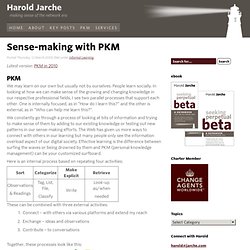
People learn socially. In looking at how we can make sense of the growing and changing knowledge in our respective professional fields, I see two parallel processes that support each other. One is internally focused, as in “How do I learn this?” Overwhelmed? Welcome the Age of Curation. Forrester Research analyst Sarah Rotman Epps coined a phrase Friday for something many have been talking about since Apple launched the iPad about six weeks ago.
“Curated computing” refers to the way Apple staff examines each piece of software written for iPhone OS devices before allowing it into (or blocking it from) the App Store. Epps is almost certainly not among the first 10,000 people on the planet to observe that the iPhone OS does not allow users to install whatever programs they wish, unless the devices are jailbroken. For that reason, it’s tempting to write off her coinage as an attention-grabbing rehash of a well-worn meme — especially because she plans to take this show on the road at conferences to talk about this observation.
That knowledge itself is anything but revelatory to anyone who has been paying even slight attention to what has already been said about the iPhone OS over the past few years. However, Epps is onto something with this word, curated. Professional Online Publishing: New Media Trends, Communication Skills, Online Marketing - Robin Good's MasterNewMedia. Exploring Curation as a core competency in digital and media literacy education. Abstract: In today's hypermedia landscape, youth and young adults are increasingly using social media platforms, online aggregators and mobile applications for daily information use.
Communication educators, armed with a host of free, easy-to-use online tools, have the ability to create dynamic approaches to teaching and learning about information and communication flow online. In this paper we explore the concept of curation as a student- and creation-driven pedagogical tool to enhance digital and media literacy education. We present a theoretical justification for curation and present six key ways that curation can be used to teach about critical thinking, analysis and expression online. How to distill content curation for real impact. Curation - Howard Rheingold on Diigo. Real-Time News Curation, Newsmastering And Newsradars - The Complete Guide Part 1: Why We Need It. The time it takes to follow and go through multiple web sites and blogs takes tangible time, and since most sources publish or give coverage to more than one topic, one gets to browse and scan through lots of useless content just for the sake of finding what is relevant to his specific interest.

Even in the case of power-users utilizing RSS feed readers, aggregators and filters, the amount of junk we have to sift through daily is nothing but impressive, so much so, that those who have enough time and skills to pick the gems from that ocean of tweets, social media posts and blog posts, enjoy a fast increasing reputation and visibility online. The Seven Needs of Real-Time Curators. I keep hearing people throw around the word “curation” at various conferences, most recently at SXSW.

The thing is most of the time when I dig into what they are saying they usually have no clue about what curation really is or how it could be applied to the real-time world. So, over the past few months I’ve been talking to tons of entrepreneurs about the tools that curators actually need and I’ve identified seven things. First, who does curation? Bloggers, of course, but blogging is curation for Web 1.0. Look at this post here, I can link to Tweets, and point out good ones, right? But NONE of the real time tools/systems like Google Buzz, Facebook, Twitter, YouTube, Flickr, give curators the tools that they need to do their work efficiently. Manifesto For The Content Curator: The Next Big Social Media Job Of The Future ?
Every hour thousands of new videos are uploaded online.
Blog posts are written and published. Millions of tweets and other short messages are shared. To say there is a flood of content being created online now seems like a serious understatement. Until now, the interesting thing is that there are relatively few technologies or tools that have been adopted in a widespread way to manage this deluge. We pretty much just have algorithmic search, with Google (and other search engines) as the most obvious example. The real question is whether solutions like these will be enough.
The 5 Models Of Content Curation. Curation has always been an underrated form of creation.
The Getty Center in Los Angeles is one of the most frequently visited museums in America – and started as a private art collection from one man (J. Paul Getty) who had a passion for art. Aside from a few well known examples like this one, however, the term curation has rarely been used outside of the world of art … until now. One of the hottest trends in social media right now is content curation – thanks in no small part to the leading efforts of several thought leaders actively promoting the idea. Joe Pulizzi is a “content marketing evangelist” who speaks and writes often about content marketing publishes a list of the best content marketing blogs across the web.