
The Art of Memetics by Wes Unruh, Edward Wilson. Memetic governance in theory and practice. Memetic governance in theory and practice Developing a theory and a replicable method for governance of social systems.
Øyvind Vada Abstract. Journal of Memetics - Evolutionary Models of Information Transmission. Memes « etiologue. Memes are a unit of cultural information, such as a cultural practice or idea, that is transmitted verbally or by repeated action from one mind to another.
Coined by Richard Dawkins in The Selfish Gene and popularised by Daniel Dannett, meme is a concept for explaining the spread of ideas and cultural phenomena via application of evolutionary principles. Memes evolve by natural selection, like that of biological evolution and they show self-replication, variation, mutation, competition, and inheritance, each of which influences a meme’s reproductive success. Memes are thus analogous to genes. Examples of memes include thoughts, ideas, theories, practices, habits, songs, dances, melodies, catch-phrases, fashion and moods and terms such as race, culture and ethnicity.
Memes spread through the behaviors that they generate in their hosts. The field of study called memetics arose in the 1990s. Memetics is a subject out of scope for a single blog entry. References not linked above: Information Cycles of Culture. The Selfish Gene. The Selfish Gene is a book on evolution by Richard Dawkins, published in 1976.
It builds upon the principal theory of George C. The Selfish Gene. The Selfish Gene?
GeneticsGenes and EnvironmentIntelligence and GenesIQ TestingEugenicsCrime and GeneticsRacism and GeneticsThe Selfish GeneThe Future of GeneticsNotes Part Three It was not until the late 1930s that Darwin’s mechanism for evolution—natural selection—obtained widespread acceptance. At this time, leading scientific figures like Fisher, Haldane, and Wright became the founding fathers of neo-Darwinism, which fused natural selection with Mendelian genetics.
The theory of heredity was essential for the connection between the theory of evolution and cell theory. The Meme Hustler. Tim O’Reilly’s crazy talk.

Memetics. Memetic Lexicon. The "New Age" memetic process.
MemeTracker: tracking news phrases over the web. Memes. Traducido por Stacco Troncoso, editado por Arianne Sved - Guerrilla Translation!
Los memes nos encantan y nos parecen una de las herramientas de difusión más útiles y originales de la era red. Hace unos meses, nos topamos con la obra de Hieronimo Morfejev, remezclador de imágenes y palabras que da salida a sus creaciones a través de las páginas de Facebook de Avantgardens y Planet Reboot. Cuando entramos en contacto con él se mostró muy ilusionado de que quisiéramos traducir sus memes al español y nos pusimos manos a las obra. Hemos presentado algunas de estas imágenes a lo largo de los últimos meses en nuestras propias redes, pero también creemos que merecen un lugar aparte donde tenerlos recopilados a modo de exposición. Memes as mental frames and cognitive templates. Øyvind Vada (Memetor, ECCO) Abstract:
What we learned from 5 million books. Algorithm Distinguishes Memes from Ordinary Information — The Physics arXiv Blog. Memes are the cultural equivalent of genes: units that transfer ideas or practices from one human to another by means of imitation.
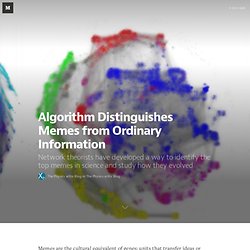
In recent years, network scientists have become increasingly interested in how memes spread. This kind of work has led to important insights into the nature of news cycles, into information avalanches on social networks and into the role that networks themselves play in this spreading process. AN INQUIRY INTO THE DIFFUSION OF SMITH'S -THE WEALTH OF NATIONS- Susan Blackmore on memes and "temes" On vMemes and the yellow leading edge. History of ideas. The Lovejoy approach[edit] The historian Arthur O.
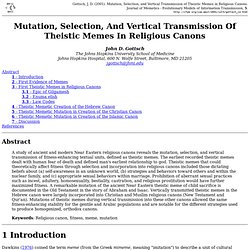
Lovejoy (1873–1962) coined the phrase history of ideas and initiated its systematic study[1] in the early decades of the 20th century. Memetic strategies. Plug n' play. Content —> Form (structure) —> Aesthetics —> Meaning —> Intention alignment —> Action potential —> Self-organizing intention realization —> rinse. repeat. rinse. repeat. Memetic Computing covers the general aspects of population-based problem-solving methods that are enhanced with some form of cultural-analog mechanism. For instance, Memetic Computing involves also software ecology. That is, studies of the enormous number of software projects are shedding light on how software development takes place and the many social and technical issues related to this fundamental XXI century activity. Diane Benscoter on how cults rewire the brain. Mutation, Selection, and Vertical Transmission of Theistic Memes in Religious Canons. Gottsch, J.
Cargo. Meme Hacking. At PivotCon 2010, Douglas Rushkoff made some extremely cogent arguments about why brands cannot go viral on social networks — even when there’s plenty of activity on companies’ websites and Facebook pages — and why it’s pointless to try to push brand concepts (such as mascots) around as memes in the expectation of driving actual product sales.
This talk is exceptionally amusing both for its venue — he’s at a branding conference talking about social media — and for the fact that he opens the talk by saying, essentially, “you think you’re talking about what’s happening, but you’re not.” He managed to rankle more than a few career marketeers who oversimplified his message to mean “marketing is evil”; the mild antagonism to this particular audience inherent in his message did not go unnoticed by PivotCon organizer Chris Shipley who made no bones about the reason they decided to schedule his talk dead last.
Graphing the history of philosophy « Drunks&Lampposts. A close up of ancient and medieval philosophy ending at Descartes and Leibniz If you are interested in this data set you might like my latest post where I use it to make book recommendations. This one came about because I was searching for a data set on horror films (don’t ask) and ended up with one describing the links between philosophers. MemeHacking.
Infocology thinkstate. Wired 2.10: Meme, Counter-meme. Meme, Counter-meme By Mike Godwin It was back in 1990 that I set out on a project in memetic engineering. The Nazi-comparison meme, I'd decided, had gotten out of hand - in countless Usenet newsgroups, in many conferences on the Well, and on every BBS that I frequented, the labeling of posters or their ideas as "similar to the Nazis" or "Hitler-like" was a recurrent and often predictable event. Memetic engineering. Meme Machine. The Meme Machine. The idea of memes, and the word itself, were originally speculated by Richard Dawkins in his book The Selfish Gene although similar, or analogous, concepts had been in currency for a while before its publishing.
In the book she examines the difficulties associated with the meme including its definition and how to spot one as well as the difficulties which arise from seeing it as being like the gene. She sees the meme in terms of being a universal replicator, of which the gene is but an example, rather than being like the gene itself. Memetic engineering. Memetic engineering is a term developed and coined by Leveious Rolando, John Sokol, and Gibran Burchett while they researched and observed the behavior of people after being purposely exposed (knowingly and unknowingly) to certain memetic themes. The term is based on Richard Dawkins' theory of memes. The process of developing memes, through meme-splicing and memetic synthesis, with the intent of altering the behavior of others in society or humanity.The process of creating and developing theories or ideologies based on an analytical study of societies, cultures, their ways of thinking and the evolution of their minds.The process of modifying human beliefs, thought patterns, etc.
Definition[edit] According to the above theory, typical memetic engineers include scientists, engineers, industrial designers, ad-men, artists, publicists, political activists, and religious missionaries. Origins of memetic engineering[edit] Applied memetic engineering[edit] Examples[edit] See also[edit] Memetic Engineering. Be an Information DJ - Matthew Lieberman. By Matthew Lieberman | 1:02 PM November 27, 2012. Competition among memes in a world with limited attention : Scientific Reports. Emerging Memetic Singularity in the Global Knowledge Society. 30 April 2009 | Draft.
Seb's Open Research: How to Become a Culture Hacker (in 5 min.) Are Memes & Internet Culture Creating a Singularity? Adam Feuer » Blog Archive » Culture Hacking. Some culture hackers work on methods that can be shared between teams; others work on the culture for specific companies.
Dan Dennett on dangerous memes. On genes, memes, bemes, and conscious things. Building the Future of Work and Culture: Announcing CultureCon 2012! The Memetic Web & The "Internet of Products" #search #semantics #commerce #location #LBS #Junto. Meme. A meme (/ˈmiːm/ meem)[1] is "an idea, behavior, or style that spreads from person to person within a culture. Memetics. This article is related to the study of self-replicating units of culture, not to be confused with Mimesis. Meme selection. Meme pool. MemePix - Memes, Funny Pictures, Rage Comics and Videos.
Introduction to Memetics: What is a Meme? Birth of a Meme: The Rise of Culture Tech. I've Seen the Worst Memes of My Generation Destroyed by Madness.