
Consciosness. Concsciousness. Scientists Confirm That Reality is an Illusion - Our 3D Universe Is A Hologram. Facing Up to the Problem of Consciousness. David J.
Chalmers. MetAMORphosis: Conscious Evolution Newsletter. Astrology and Free Will by Sujatha Sridhara Many people believe that astrology is a fatalistic art that leaves no room for human free will.
In this view, a person’s horoscope reveals their inflexible destiny, which they are bound to accept, for good or ill, with no choice in the matter. However, a deeper understanding of astrology reveals that it reinforces the concept of free will by giving us the tools to make intelligent choices, rather than blindly following the path of least resistance. When we voluntarily choose to control our actions and reactions, we can change the nature of our lives and become the masters of our own destinies.
What is astrology? According to popular astrology writer Linda Goodman, “Astrology is the study of man in relation to celestial bodies, or to be precise, the planets. To understand astrology, we must discuss karma, because karma is a major foundation of astrology. Evolution - Conscious Evolution. Conscious Evolution Evolution is happening right now in and around us.
It is influenced by all that we do and don't do, and all that we are and are not. Whether we are aware of it or not, we have a lot to do with how evolution unfolds, especially right here on Earth. Recent offspring in life's 13.7 billion years of cosmic, planetary, biological and social evolution, we are on the leading edge of the evolutionary process. We share that emergent edge with everything else in the universe. Evolution has given us a special kind of consciousness, one that creates -- and is thoroughly conditioned by -- our languages, cultures, stories, and built environments.
Consciousness, Wisdom, and Self-Realization. Www.quantumconsciousness.org/penrose-hameroff/cajal.pdf. Institute of Higher Consciousness.
Spirituality and Conciousness. Consciousness. Consciousness. Consciousness. Www.quantumconsciousness.org/penrose-hameroff/cajal.pdf. Electromagnetic theories of consciousness. The electromagnetic theories of consciousness propose that consciousness can be understood as an electromagnetic phenomenon.
Overview[edit] Theorists differ in how they relate consciousness to electromagnetism. Electromagnetic field theories (or "EM field theories") of consciousness propose that consciousness results when a brain produces an electromagnetic field with specific characteristics. Susan Pockett[1] [2]and Johnjoe McFadden[3][4][5] have proposed EM field theories; William Uttal[6] has criticized McFadden's and other field theories. Neural correlates of consciousness. Figure 1: The Neuronal Correlates of Consciousness (NCC) are the minimal set of neural events and structures – here synchronized action potentials in neocortical pyramidal neurons – sufficient for a specific conscious percept or a conscious (explicit) memory.
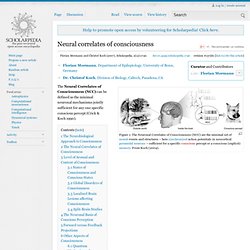
From Koch (2004). The Neural Correlates of Consciousness (NCC) can be defined as the minimal neuronal mechanisms jointly sufficient for any one specific conscious percept (Crick & Koch 1990). The Neurobiological Approach to Consciousness Consciousness is a puzzling, state-dependent property of certain types of complex, biological, adaptive, and highly interconnected systems. A science of consciousness must strive to explain the exact relationship between phenomenal, mental states and brain states.
Reality and Consciousness: Electromagnetic theories of consciousness. MindPapers: Contents. Search tips There are two kinds of search you can perform on MindPapers: All fields This mode searches for entries containing the entered words in their title, author, date, comment field, or in any of many other fields showing on MindPapers pages.
Entries are ranked by their relevance as calculated from the informativeness of the words they contain and their numbers. You may search for a literal string composed of several words by putting them in double quotation marks (") Surname This mode searches for entries containing the text string you entered in their author field. Remember: viewing options in the menu above affect the results you get when searching. Note that short and / or common words are ignored by the search engine. Physics, Metaphysics & the Consciousness Connection 1 of 18. ASSC. Infinite Being - Mysticism As A Key To Scientific Breakthroughs. {*style:<b><i> Mysticism As A Key To Scientific Breakthroughs </i></b>*} Mystics are visionaries.
That’s what gives them the edge in scientific research. Newton, Faraday and Einstein were all examples of mystics. Most of their research occurred, not in a laboratory, but within their visionary consciousness. Mysticism is a learned skill, just like learning to ride a bicycle, and it is an exact science. Mysticism is the act of going within. Infinite being. Quantum awakening. Llective unconscious. Hard problem of consciousness. The existence of a "hard problem" is controversial and has been disputed by some philosophers.[4][5] Providing an answer to this question could lie in understanding the roles that physical processes play in creating consciousness and the extent to which these processes create our subjective qualities of experience.[3] Several questions about consciousness must be resolved in order to acquire a full understanding of it.

These questions include, but are not limited to, whether being conscious could be wholly described in physical terms, such as the aggregation of neural processes in the brain. Llective consciousness. Consciousness, group consciousness, mind.
Consciousness. 1.
History of the issue Questions about the nature of conscious awareness have likely been asked for as long as there have been humans. Neolithic burial practices appear to express spiritual beliefs and provide early evidence for at least minimally reflective thought about the nature of human consciousness (Pearson 1999, Clark and Riel-Salvatore 2001). Preliterate cultures have similarly been found invariably to embrace some form of spiritual or at least animist view that indicates a degree of reflection about the nature of conscious awareness. Nonetheless, some have argued that consciousness as we know it today is a relatively recent historical development that arose sometime after the Homeric era (Jaynes 1974). Although the words “conscious” and “conscience” are used quite differently today, it is likely that the Reformation emphasis on the latter as an inner source of truth played some role in the inward turn so characteristic of the modern reflective view of self. 2.
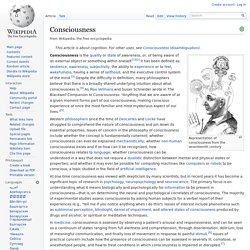
Sentience. Consciousness. Representation of consciousness from the seventeenth century At one time consciousness was viewed with skepticism by many scientists, but in recent years it has become a significant topic of research in psychology, neuropsychology and neuroscience.
Dennett - Consciousness Explained. Online papers on consciousness. Search tips There are three kinds of search you can perform: All fields This mode searches for entries containing all the entered words in their title, author, date, comment field, or in any of many other fields showing on OPC pages. Surname This mode searches for entries containing the text string you entered in their author field.
Advanced This mode differs from the all fields mode in two respects. The Brain: The Mystery of Consciousness. The young women had survived the car crash, after a fashion. In the five months since parts of her brain had been crushed, she could open her eyes but didn't respond to sights, sounds or jabs. In the jargon of neurology, she was judged to be in a persistent vegetative state. In crueler everyday language, she was a vegetable. Neural correlates of consciousness. The Neuronal Correlates of Consciousness (NCC) constitute the smallest set of neural events and structures sufficient for a given conscious percept or explicit memory. This case involves synchronized action potentials in neocortical pyramidal neurons.[1] Neurobiological approach to consciousness[edit] A science of consciousness must explain the exact relationship between subjective mental states and brain states, the nature of the relationship between the conscious mind and the electro-chemical interactions in the body.
Progress in neurophilosophy has come from focusing on the body rather than the mind. In this context the neuronal correlates of consciousness may be viewed as its causes, and consciousness may be thought of as a state-dependent property of some undefined complex, adaptive, and highly interconnected biological system.[4] What characterizes the NCC? Home. Consciousness. Consciosness.