
Artificial OR artificielle intelligence. Anonymous - The Singularity Project 2013 - (Project Mayhem Has Begun) Aiimg3.jpg (Image JPEG, 465x525 pixels) Expert system. An expert system is divided into two sub-systems: the inference engine and the knowledge base.
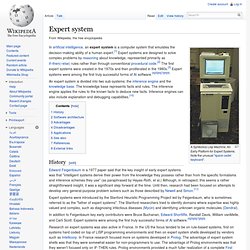
The knowledge base represents facts and rules. The inference engine applies the rules to the known facts to deduce new facts. Inference engines can also include explanation and debugging capabilities.[10] History[edit] Edward Feigenbaum in a 1977 paper said that the key insight of early expert systems was that "intelligent systems derive their power from the knowledge they possess rather than from the specific formalisms and inference schemes they use" (as paraphrased by Hayes-Roth, et al.) Expert systems were introduced by the Stanford Heuristic Programming Project led by Feigenbaum, who is sometimes referred to as the "father of expert systems". In addition to Feigenbaum key early contributors were Bruce Buchanan, Edward Shortliffe, Randall Davis, William vanMelle, and Carli Scott. In the 1980s, expert systems proliferated. Software architecture[edit] R1: Man(x) => Mortal(x)
Système expert. Artificial intelligence. AI research is highly technical and specialized, and is deeply divided into subfields that often fail to communicate with each other.[5] Some of the division is due to social and cultural factors: subfields have grown up around particular institutions and the work of individual researchers.

AI research is also divided by several technical issues. Some subfields focus on the solution of specific problems. Intelligence artificielle. Un article de Wikipédia, l'encyclopédie libre.
Définition[modifier | modifier le code] Philosophy of artificial intelligence. The philosophy of artificial intelligence attempts to answer such questions as:[1] Can a machine act intelligently?
Can it solve any problem that a person would solve by thinking? Are human intelligence and machine intelligence the same? Is the human brain essentially a computer? Can a machine have a mind, mental states and consciousness in the same sense humans do? These three questions reflect the divergent interests of AI researchers, cognitive scientists and philosophers respectively.
Important propositions in the philosophy of AI include: Outline of artificial intelligence. The following outline is provided as an overview of and topical guide to artificial intelligence: Artificial intelligence (AI) – branch of computer science that deals with intelligent behavior, learning, and adaptation in machines. Research in AI is concerned with producing machines to automate tasks requiring intelligent behavior. Inference engine. Moteur d'inférence. Un article de Wikipédia, l'encyclopédie libre.
Un moteur d'inférence (du verbe « inférer » qui signifie « déduire ») est un logiciel correspondant à un algorithme de simulation des raisonnements déductifs. Base de connaissance. Un article de Wikipédia, l'encyclopédie libre.
Une base de connaissance regroupe des connaissances spécifiques à un domaine spécialisé donné, sous une forme exploitable par un ordinateur. Elle peut contenir des règles (dans ce cas, on parle de base de règles), des faits ou d'autres représentations[1]. Si elle contient des règles, un moteur d'inférence - simulant les raisonnements déductifs logiques - peut être utilisé pour déduire de nouveaux faits. Une base de connaissance sert à rassembler - de manière centralisée - l'expertise d'un domaine généralement formalisée de manière déclarative. A ne pas confondre avec : Exemples[modifier | modifier le code] Knowledge representation and reasoning. Knowledge representation and reasoning (KR) is the field of artificial intelligence (AI) devoted to representing information about the world in a form that a computer system can utilize to solve complex tasks such as diagnosing a medical condition or having a dialog in a natural language.

Knowledge representation incorporates findings from psychology about how humans solve problems and represent knowledge in order to design formalisms that will make complex systems easier to design and build. Knowledge representation and reasoning also incorporates findings from logic to automate various kinds of reasoning, such as the application of rules or the relations of sets and subsets. Examples of knowledge representation formalisms include semantic nets, Frames, Rules, and ontologies. Examples of automated reasoning engines include inference engines, theorem provers, and classifiers. Overview[edit] What is a Knowledge Representation? Randall Davis MIT AI Lab Howard Shrobe MIT AI Lab and Symbolics, Inc.

Peter Szolovits MIT Lab for Computer Science This paper appeared as R. Davis, H. Shrobe, and P. History of artificial intelligence. The history of artificial intelligence (AI) began in antiquity, with myths, stories and rumors of artificial beings endowed with intelligence or consciousness by master craftsmen; as Pamela McCorduck writes, AI began with "an ancient wish to forge the gods.
" The seeds of modern AI were planted by classical philosophers who attempted to describe the process of human thinking as the mechanical manipulation of symbols. This work culminated in the invention of the programmable digital computer in the 1940s, a machine based on the abstract essence of mathematical reasoning. This device and the ideas behind it inspired a handful of scientists to begin seriously discussing the possibility of building an electronic brain. Timeline of artificial intelligence. Topic:Artificial intelligence. Artificial Intelligence Part of the School of Computer Science Four approaches summarize past attempts to define the field: The study of systems that think like humans.The study of systems that think rationally.The study of systems that act like humans.The study of systems that act rationally.
Of these approaches, the former two are considered to be "white-box" approaches because they require our analysis of intelligence to be based on the rationale for the behaviour rather than the behaviour itself. The latter two are considered "black-box" approaches because they operationalize intelligence by measuring performance over a task domain. Although the third approach, (known as cognitive modelling), is of great importance to cognitive scientists, we concern ourselves with the fourth approach.
This approach motivates us to provide a model for our intelligent systems known as the intelligent agent. WHAT IS ARTIFICIAL INTELLIGENCE? Artificial Intelligence Books. Artificial intelligence. "A.I. " redirects here. For the Steven Spielberg film see A.I. Artificial Intelligence. Toyota Partner Robot: The walking type playing the trumpet. Portal:Artificial intelligence. Artificial Intelligence. Welcome to the Wikibook about Artificial Intelligence. The following is a first proposal for a basic layout. This is not yet complete, ideas are welcome. Discuss on the talk page or just add them here. The book is laid out into 5 sections, with increasing detail and complexity. Each section contains a number of chapters. AIspace. These tools are for learning and exploring concepts in artificial intelligence.
They were developed at the Laboratory for Computational Intelligence at the University of British Columbia under direction of Alan Mackworth and David Poole. They are part of the online resources for Artificial Intelligence: Foundations of Computational Agents. If you are teaching or learning about AI, you may use these tools under the terms of use. Feedback is welcome. Site Map: These tools were designed and written by Saleema Amershi, Nicole Arksey, Mike Cline, Wesley Coelho, André Gagné, Byron Knoll, Janine Li, Kevin O'Neill, Mike Pavlin, Kyle Porter, Joseph Roy Santos, Shinjiro Sueda, Leslie Tung, Audrey Yap, and Regan Yuen, under the guidance of Giuseppe Carenini, Cristina Conati, Peter Gorniak, Holger Hoos, Jacek Kisyński, Alan Mackworth, and David Poole. Copyright © 1999 - 2010 S. Category:Artificial intelligence. From Wikipedia, the free encyclopedia Subcategories This category has the following 32 subcategories, out of 32 total. Pages in category "Artificial intelligence" The following 200 pages are in this category, out of 256 total.
This list may not reflect recent changes (learn more). (previous 200) (next 200)(previous 200) (next 200) AITopics / HomePage. Alain.colmerauer.free. Category:Philosophy of artificial intelligence. Artificial Intelligence: How To Build A Robot. Free Online Artificial Intelligence Books. Artificial Intelligence. Defining Artificial Intelligence The phrase “Artificial Intelligence” was first coined by John McCarthy four decades ago. One representative definition is pivoted around comparing intelligent machines with human beings.