
Psychoactive Vaults. Future Computer by Jakub Záhoř & Yanko Design - StumbleUpon. Future Touch Tech This concept computer-of-the-future by designer Jakub Záhoř allows the user to operate the device anywhere they can find a glass surface.

The user simply attaches the central unit to any glass surface like a window or coffee table, switches on the power, and watches their system light up before their eyes. The display appears as an interactive hologram on the glass that the user merely has to touch to operate. It also makes for an easy, take-anywhere way to project photos and presentations or stream movies. Windex not included. Does the Color Pink Exist? Scientists Arent Sure. In a blog post, Robert Krulwich of the public radio show Radiolab noted that there is no pink in the colors of the rainbow.
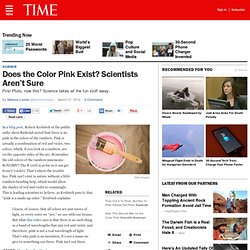
Pink is actually a combination of red and violet, two colors, which, if you look at a rainbow, are on the opposite sides of the arc. Remember the old colors of the rainbow mnemonic ROYGBIV? The R (red) is as far as it can get from V (violet). That’s where the trouble lies. Pink can’t exist in nature without a little rainbow-bending help, which would allow the shades of red and violet to commingle. I know, of course, that all colors are just waves of light, so every color we “see,” we see with our brains. (MORE: Hues You Can Use) So there you have it. We will leave the debate over the color pink to the experts, because we know one Pink who definitely still exists. PHOTOS: Color My Dog! Human Evolution & Archaeology. Darwin Pond. The Scale of the Universe 2 - StumbleUpon.
- StumbleUpon. Scientist creates lifelike cells out of metal. Scientists trying to create artificial life generally work under the assumption that life must be carbon-based, but what if a living thing could be made from another element?
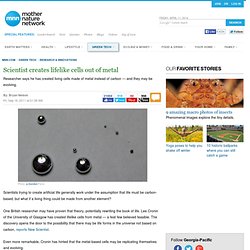
One British researcher may have proven that theory, potentially rewriting the book of life. Lee Cronin of the University of Glasgow has created lifelike cells from metal — a feat few believed feasible. The discovery opens the door to the possibility that there may be life forms in the universe not based on carbon, reports New Scientist. Even more remarkable, Cronin has hinted that the metal-based cells may be replicating themselves and evolving.
"I am 100 percent positive that we can get evolution to work outside organic biology," he said. The high-functioning "cells" that Cronin has built are constructed from large polyoxometalates derived from a range of metal atoms, like tungsten. The metallic bubbles are certainly cell-like, but are they actually alive? The early results have been encouraging. DISCOVER Magazine - StumbleUpon. 5 Ways To Hack Your Brain Into Awesomeness. Much of the brain is still mysterious to modern science, possibly because modern science itself is using brains to analyze it.

There are probably secrets the brain simply doesn't want us to know. But by no means should that stop us from tinkering around in there, using somewhat questionable and possibly dangerous techniques to make our brains do what we want. We can't vouch for any of these, either their effectiveness or safety. All we can say is that they sound awesome, since apparently you can make your brain... #5. So you just picked up the night shift at your local McDonald's, you have class every morning at 8am and you have no idea how you're going to make it through the day without looking like a guy straight out of Dawn of the Dead, minus the blood... hopefully.
"SLEEEEEEEEEP... uh... What if we told you there was a way to sleep for little more than two hours a day, and still feel more refreshed than taking a 12-hour siesta on a bed made entirely out of baby kitten fur? Holy Shit! What would happen if I drilled a tunnel through the center of th& - StumbleUpon. Want to really get away from it all?
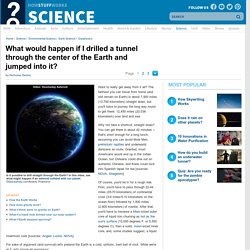
The farthest you can travel from home (and still remain on Earth) is about 7,900 miles (12,700 kilometers) straight down, but you'll have to journey the long way round to get there: 12,450 miles (20,036 kilometers) over land and sea. Why not take a shortcut, straight down? You can get there in about 42 minutes -- that's short enough for a long lunch, assuming you can avoid Mole Men, prehistoric reptiles and underworld denizens en route.
Granted, most Americans would end up in the Indian Ocean, but Chileans could dine out on authentic Chinese, and Kiwis could tuck into Spanish tapas for tea [sources: NOVA; Shegelski]. Of course, you'd be in for a rough ride. For sake of argument (and survival) let's pretend the Earth is a cold, uniform, inert ball of rock. At the Earth's surface, gravity pulls on us at 32 feet (9.8 meters) per second squared. You're still moving at a heck of a clip, though, so don't expect to stop there.