
Curation. Robert Scoble Interview. “A curator is an information chemist.
He or she mixes atoms together in a way to build an info-molecule. Then adds value to that molecule” – Robert Scoble Master curator and Microsoft evangelist Robert Scoble gave an interview to Howard Rheingold on how to be a good curator (see below) and gave away some great advice on mastering the art and science of content curation using social media and other digital technologies. Here is a collection of my favorite quotes from Scoble’s interview with Rheingold. I’ll provide some context around Scoble’s quotes from the interview as well as my personal interpretation. Aperçu - La veille collaborative, les diverses avenues à explorer. Ce laboratoire se déroulera en formule hybride (présence et distance) avec une équipe du Cégep de La Pocatière.
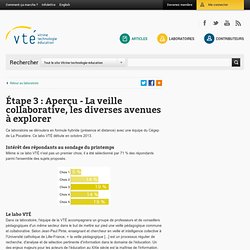
Ce labo VTÉ débute en octobre 2013. Intérêt des répondants au sondage du printemps Même si ce labo VTÉ n'est pas un premier choix, il a été sélectionné par 71 % des répondants parmi l'ensemble des sujets proposés. Le labo VTÉ Dans ce laboratoire, l'équipe de la VTÉ accompagnera un groupe de professeurs et de conseillers pédagogiques d'un même secteur dans le but de mettre sur pied une veille pédagogique commune et collaborative.
Un aperçu Pour en savoir plus sur la veille pédagogique, nous vous conseillons de lire l'article de Jean-Paul Pinte paru dans Pédagogie collégiale, Vol. 18, no. 3, « La relation au savoir et les outils de la veille pédagogique ». Building Thought Leadership through Content Curation. Veille et curation. To Get the Most Out of Tablets, Use Smart Curation. By Justin Reich and Beth Holland The Someday/Monday dichotomy captures one of the core challenges in teacher professional development around education technology.
On the one hand, deep integration of new learning technologies into classrooms requires substantially rethinking pedagogy, curriculum, assessment, and teacher practice (someday), because for technology to make a real difference in student learning, it can’t just be an add-on. Digital Curation Resource Guide. DuckDuckGo, le petit moteur de recherche qui monte. Le Monde.fr | • Mis à jour le | Par Damien Leloup Le cap est avant tout symbolique, mais il traduit une accélération récente : le moteur de recherche DuckDuckGo a dépassé pour la première fois, le 13 février, le million de recherches par jour.
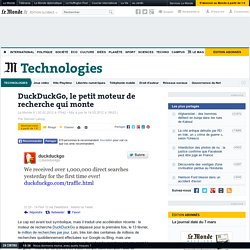
Loin, très loin des centaines de millions de recherches quotidiennement effectuées sur Google ou Bing, mais une performance appréciable pour un moteur de recherche maintenu par une poignée de gens – moins de dix personnes à plein temps, sans compter l'aide de bénévoles. Si DuckDuckGo est une entreprise, son projet et sa philosophie vont à l'encontre des pratiques habituelles des moteurs de recherche. Tout d'abord, le service ne se contente pas d'indexer les pages Web pour élaborer ses pages de résultats. Il intègre aussi les résultats de la plupart de ses concurrents, ainsi que ceux de l'encyclopédie en ligne Wikipedia et de dizaines d'autres sites de référence. ON CURATING—A new web-based publication focusing on curatorial practice and theory, by Dorothee Richter. ON CURATING—A new web-based publication focusing on curatorial practice and theoryPublisher: Dorothee Richter The interest of all those involved in the journal, whether curators, lecturers, researchers or participants of curating programs is to create a platform for presentation, discussion and research about this growing area of knowledge.
To expand the pool of those involved we aim to cooperate with different institutions and people for every new issue. Twitchimp.com - The ultimate Twitter List Curation Tool. 8 must-reads detail how to verify information in real-time, from social media, users. Over the past couple of years, I’ve been trying to collect every good piece of writing and advice about verifying social media content and other types of information that flow across networks.
This form of verification involves some new tools and techniques, and requires a basic understanding of the way networks operate and how people use them. It also requires many of the so-called old school values and techniques that have been around for a while: being skeptical, asking questions, tracking down high quality sources, exercising restraint, collaborating and communicating with team members. Brocooli.com : Blog d’expression et de curation. What is curation? Pearltrees. PEARLTREES, et si c'était l'outil de curation par excellence ? Curation Startup Says It Captures 10,000 Links a Day. French startup Pearltrees offers a very unique interface for organizing and sharing collections of links from around the web.
Tomorrow the company will release a new, faster version of its application and announce that it has passed 2 million links curated in 7 months since going live. That means an average of 10,000 links have been bookmarked in Pearltrees every day since launch, and presumably many more now that the site has grown. Last month the company announced that it raised $1.6 million in venture funding. I love what Pearltrees is trying to do, most people I talk to love the idea, and it's good to hear the service is getting so much traction. I'm waiting until the promised iPad version comes out before getting too excited about it. Pearltrees. Pearltrees Brings Your Interest Graph' to the iPad.
One of the more buzzword-y buzzwords in Silicon Valley right now is the "interest graph," which is supposed to connect people and the topics that they're interested in.
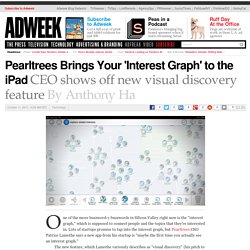
Lots of startups promise to tap into the interest graph, but Pearltrees CEO Patrice Lamothe says a new app from his startup is "maybe the first time you actually see an interest graph. " The new feature, which Lamothe variously describes as "visual discovery" (his pitch to the tech press) and "related interests" (what it's actually called in the app), is included in the just-launched iPad application from the previously Web-only company.
Scoop.it. Best News Curation Tools for Independent Publishe... News Discovery Tools 2012 by Robin Good. The Power of Passion. Cc flickr photo: by pirate_renee If you think you can make a difference – you can.
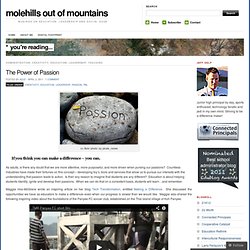
As adults, is there any doubt that we are more attentive, more purposeful, and more driven when pursing our passions? Countless industries have made their fortunes on this concept – developing toy’s, tools and services that allow us to pursue our interests with the understanding that passion leads to action. Clay Shirky: How cognitive surplus will change the world. Facebook and the Epiphanator: An End to Endings? I do not enjoy Facebook — I find it cloying and impossible — but I am there every day.
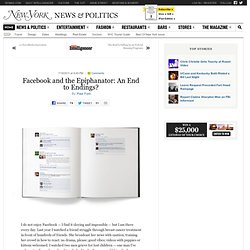
Last year I watched a friend struggle through breast cancer treatment in front of hundreds of friends. She broadcast her news with caution, training her crowd in how to react: no drama, please; good vibes; videos with puppies or kittens welcomed. I watched two men grieve for lost children — one man I've only met online, whose daughter choked to death; one an old friend, whose infant son and daughter, and his wife and mother-in-law, died in an auto accident.
I watched in real time as these people reconstructed themselves in the wake of events — altering their avatars, committing to new causes, liking and linking, boiling over in anger at dumb comments, eventually posting jokes again, or uploading new photos. Learning to take the measure of the world with new eyes. How Insight Labs Gets Smart People To Brainstorm Solutions To The World's Problems. Insight Labs' pro bono attempts to solve the world's problems started innocently enough. Two years ago, Jeff Leitner, a Chicago-based digital strategist and former journalist, wanted to gather together a group of smart people to brainstorm the solution to a seemingly insurmountable problem. So, he scheduled a three-hour-long discussion in Detroit and asked friends, colleagues, and family to recommend people who would volunteer their time to talk through a problem. Some major smarty pants from companies such as Blue Cross and Blue Shield of Michigan, Deloitte, Quicken Loans, and Ford agreed to participate.
On a January day in 2009, the executives tackled the question: How best to revive the Detroit economy and create jobs? Leitner has since orchestrated 23 panels for Insight Labs, a pro bono group funded by a Chicago interactive consultancy called Manifest Digital. Case in point: One of the lab’s most successful panels involved the Ann & Robert H. Collective intelligence 2.0. Designing for learning – a case for understanding collaboration. What I present in the ensuing section seeks to make a claim for aspects of this culture of collaboration within education.
Thinking Social at the University of Florida. Advanced Search. New Social Media Plugin Pearltrees Offers a New Take on Web Favorites. Robin Good on curation. There Is A Big Difference. Posted by Tom Foremski - November 2, 2010 Curation is becoming an increasingly important term and for good reason: the online world is increasingly messy, muddled and full of blind alleys.
Search used to be the best way to navigate online but today it is only one part of an Internet user's dashboard. Finding things is fine if you know what to look for, but search is increasingly less effective in judging the quality of links, or putting those links into a context. Blekko, the recently launched search engine tries to provide a context for search terms but it's still not curation but aggregation. Content Curation Vs Content Aggregation. Two posts brought to my attention the discussion starting to take root about the worlds of content aggregation versus content curation. A post on the Poynter blog back in early October points to the work of journalists engaging in curation via Twitter as a way of “filtering the signal from the noise.” The phrase used was “curation is the new aggregation.” A more recent post on the Simple-talk.com blog by Roger Hart delves more into the world of content curation in a broader sense, stating that it is a bit of a flavor-of-the-month.
I would disagree with that sentiment, having discussed this for years. Why Curation is here to stay. Why Curation. What Makes A Great Curator Great? How To Distinguish High-Value Curation From Generic Republishing. Today content curation is "sold", promoted and marketed as the latest and trendiest approach to content production, SEO visibility, reputation and traffic building. Beth Kanter's Blog. Content Curation, Social Media and Beyond. Search & Social Media. Understand collective curation in under 90 seconds. Real-Time News Curation - The Complete Guide Part 2: Aggregation Is Not Curation. We are no longer just consumers of content, we have become curators of it too. Real-Time News Curation, Newsmastering And Newsradars - The Complete Guide Part 1: Why We Need It. The time it takes to follow and go through multiple web sites and blogs takes tangible time, and since most sources publish or give coverage to more than one topic, one gets to browse and scan through lots of useless content just for the sake of finding what is relevant to his specific interest.
Even in the case of power-users utilizing RSS feed readers, aggregators and filters, the amount of junk we have to sift through daily is nothing but impressive, so much so, that those who have enough time and skills to pick the gems from that ocean of tweets, social media posts and blog posts, enjoy a fast increasing reputation and visibility online. Online Content Curation: The Key To Building Visibility, Authority And Value. Robert Scoble On Online Curation. Curated Content Delivery Formats: Beyond News Portals and Magazines. Professional Online Publishing: New Media Trends, Communication Skills, Online Marketing - Robin Good's MasterNewMedia.
Content Curation by people not Ai « PrePrint. CurationSoft works on Google Plus. Why Curation? Utilisation des TIC par les individus.