
15 Fascinating Facts on Human Attraction. How To Be Brilliant. Blog & Depth Perception.
Social Psychology. Neuropsychology. Learning. Intelligence. Disorders. Parenting tips from neuroscience. Linda Geddes, reporter How to Persuade Your Toddler to Eat Spinach might have been a catchier title for this book, which tackles the fascinating subject of child brain development from infancy through to adolescence.
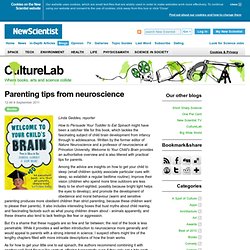
Written by the former editor of Nature Neuroscience and a professor of neuroscience at Princeton University, Welcome to Your Child's Brain provides an authoritative overview and is also littered with practical tips for parents. Among the advice are insights on how to get your child to sleep (small children quickly associate particular cues with sleep, so establish a regular bedtime routine); improve their vision (children who spend more time outdoors are less likely to be short-sighted, possibly because bright light helps the eyes to develop); and promote the development of obedience and moral behaviour (warm and sensitive parenting produces more obedient children than strict parenting, because these children want to please their parents).
Top 10 Mysteries of the Mind. By Jeanna Bryner, Live Science Managing Editor | October 09, 2007 01:25pm ET Credit: NIH, NIDA Much of what we don't understand about being human is simply in our heads.
The brain is a befuddling organ, as are the very questions of life and death, consciousness, sleep, and much more. Here's a heads-up on what's known and what's not understood about your noggin. Author Bio. Improve your Brain Health. How Does the Brain Retain Info? The Consumer Paradox: Scientists Find that Low Self-Esteem and Materialism Goes Hand in Hand. “Advertising has us chasing cars and clothes, working jobs we hate so we can buy shit we don't need.”

~From the movie Fight Club, based on the novel by Chuck Palahniuk Researchers have found that low self-esteem and materialism are not just a correlation, but also a causal relationship where low self esteem increases materialism, and materialism can also create low self-esteem. The also found that as self esteem increases, materialism decreases. The study primarily focused on how this relationship affects children and adolescents. Your Brain Knows a Lot More Than You Realize. Meanwhile, a similar story was unfolding oceans away.
During World War II, under constant threat of bombings, the British had a great need to distinguish incoming aircraft quickly and accurately. Which aircraft were British planes coming home and which were German planes coming to bomb? Several airplane enthusiasts had proved to be excellent “spotters,” so the military eagerly employed their services. These spotters were so valuable that the government quickly tried to enlist more spotters—but they turned out to be rare and difficult to find. The government therefore tasked the spotters with training others. Stuttering Reflects Irregularities in Brain Setup. Put on a pair of headphones and turn up the volume so that you can’t even hear yourself speak.
For those who stutter, this is when the magic happens. Without the ability to hear their own voice, people with this speech impediment no longer stumble over their words—as was recently portrayed in the movie The King’s Speech. This simple trick works because of the unusual way the brain of people who stutter is organized—a neural setup that affects other actions besides speech, according to a new study.
Normal speech requires the brain to control movement of the mouth and vocal chords using the sound of the speaker’s own voice as a guide. This integration of movement and hearing typically happens in the brain’s left hemisphere, in a region of the brain known as the premotor cortex. In the new study, published in the September issue of Cortex, researchers found that the unusual neural organization underlying a stutter also includes motor tasks completely unrelated to speech. 47 Mind-Blowing Psychology-Proven Facts You Should Know About Yourself.
I’ve decided to start a series called 100 Things You Should Know about People.

As in: 100 things you should know if you are going to design an effective and persuasive website, web application or software application. Or maybe just 100 things that everyone should know about humans! Psychological facts. One of your facts says that if you dream about someone, it was because they though of you, but I beg to differ.
Last night I had a dream of me and Austin Powers. (The Mike Meyers character) soooo. yeah. you fail. attention people of the world: stop saying the word “fail” and thinking you’re superior for using a meme from 2004 I don't understand how you're being called a troll for just posting and reblogging facts. I also do not understand why people are spending so much energy saying mean or rude things to you, when if they don't like what you post, they could be looking at a blog that they actually enjoy, or doing something of production. Haha thats a good idea thanks! I got a lot of hate for simply pointing out the fact that these "facts" aren't true.
Seven Psychological Principles Con Artists Exploit. The Double Life of Women. Step into any bar or party and it won't take you long to spot her. She's the woman with the ringing laugh, the daring clothes, the magnetic appeal that has drawn a circle of admirers around her. Avoid Distractions! Now! How can we more effectively avoid short-term temptations to achieve long-term goals ?
Two leading researchers argue that framing our goals with "width" and "consistency" makes a big difference. Ayelet Fishbach (University of Chicago) and Benjamin Converse (University of Virginia) argue that the necessary first step to overcoming temptation is to identify a conflict between potential temptations and higher-order (often longer-term) goals. Of course, the notion of a temptation is always relative to current goals. Temptation in this regard is a moving target. It's a Small World... Don't Burn Bridges. Because we live in such a small world, it is critically important not to burn bridges - no matter how tempted you might be!

You aren’t going to like everyone and everyone isn’t going to like you, but there’s no need to make enemies. For example, when you look for your next job, it’s quite likely that the person interviewing you will know someone you know. CHILDHOOD BRAIN MODIFICATION: Do This Now. Suck a paperclip up your nose!
This one's from Jim Burrows Get a medium-small rubberband and a paperclip. Put the rubberband around your palm and the back of your hand. Thread the paperclip onto the band, then hold the paperclip between thumb and forefinger. If you let it go, the paperclip should instantly snap back, vanishing from sight. 47 Mind-Blowing Psychology-Proven Facts You Should Know About Yourself - StumbleUpon. Eyes reveal true hypnotic state for the first time. Chelsea Whyte, contributor "Lay back, close your eyes, and count backwards from ten. Does your brain sleep when you do? Answer. In fact, large slow waves show when the brain is in deep sleep. Wide awake. Billions of brain cells fire separately. Awake and thinking, but with your eyes closed.
Dozing off. Your brain's activity starts to change. Scientist Prove DNA Can Be Reprogrammed by Words and Frequencies. By Grazyna Fosar and Franz Bludorf THE HUMAN DNA IS A BIOLOGICAL INTERNET and superior in many aspects to the artificial one. Russian scientific research directly or indirectly explains phenomena such as clairvoyance, intuition, spontaneous and remote acts of healing, self healing, affirmation techniques, unusual light/auras around people (namely spiritual masters), mind’s influence on weather patterns and much more.
In addition, there is evidence for a whole new type of medicine in which DNA can be influenced and reprogrammed by words and frequencies WITHOUT cutting out and replacing single genes. 10 Simple Postures That Boost Performance. Psychological research suggests simple actions can project power, persuade others, increase empathy, boost cognitive performance and more… We tend to think of body language as something that expresses our internal states to the outside world.
But it also works the other way around: the position of our body also influences our mind. As the following psychological research shows, how we move can drive both thoughts and feelings and this can boost performance. 30 Very Funny Books. It’s All In Your Head: How to Take Advantage of Neuroplasticity. A NEW LOOK AT ANXIETY'S MANY FACES. As Sandra Turner described it to her psychiatrist, the severe anxiety attacks she'd been having for the last six months were close to unbearable. ''My chest tightens,'' she said, ''my palms sweat, I have a sense of dread, and it feels like I'm losing control.''
How to live forever….. A few days ago a psychologist named Ulric Neisser died. A brief history of the brain - life - 26 September 2011. Read full article. Field Guide to the Loner: The Real Insiders. Miina Matsuoka lives by herself in New York City. Keep It Simple, Stupid. Digest - Things you didn't know about lies, liars and detecting lies. The Scientist Who Controlled People with Brain Implants. There is one aspect of human research which is usually overlooked: the existence of a moral and social duty to advance scientific knowledge and to improve the welfare of man. That's actually a very agreeable view. Spending was always very low, but nowadays it has hit rock bottom in light of the general apathy of society and politics regarding science.
Why don't we normally hallucinate? Time is More Valuable than Money. Your Inner Voice: A Key To Self-Control? Near-death experiences may be triggered by serotonin - health - 08 September 2011.
Brain Games. Pop. Experiments. Memory. Forensic Psychology. Consciousness. The Brain. Positive Psychology.