
OAuth Community Site. BossaIntro – BOINC. Bossa is an open-source software framework for distributed thinking - the use of volunteers on the Internet to perform tasks that use human cognition, knowledge, or intelligence.

Bossa minimizes the effort of creating and operating a distributed thinking project. It provides a project web site, hosted on your Linux server, where volunteers go to perform tasks and to interact with other volunteers. CI capitalising on the crowd. Serendipity-Sérendipité. Le logiciel libre moteur de recherche. Home - OpenSearch. The RoboEarth Cloud Engine. Start - International Desktop Grid Federation.
APML - Attention Profiling Mark-up Language: The open standard for Attention Metadata. Attention Profiling Mark-up Language. APML (Attention Profiling Mark-up Language) is an XML-based format for expressing a person's interests and dislikes.
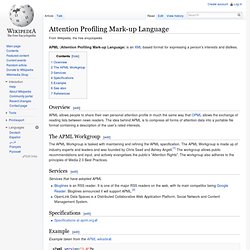
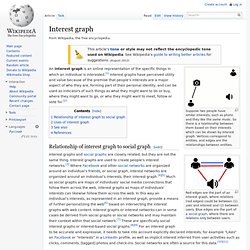
Overview[edit] APML allows people to share their own personal attention profile in much the same way that OPML allows the exchange of reading lists between news readers. The idea behind APML is to compress all forms of attention data into a portable file format containing a description of the user's rated interests. Interest graph. Suppose two people have similar interests, such as photo and they like the same music.
Your data is your interface. By Jarno Mikael Koponen On April 17, 2013 We all view the world differently and on our own terms.
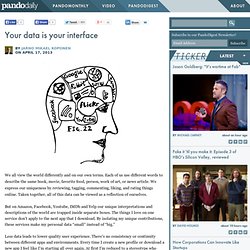
Each of us use different words to describe the same book, movie, favorite food, person, work of art, or news article. We express our uniqueness by reviewing, tagging, commenting, liking, and rating things online. Taken together, all of this data can be viewed as a reflection of ourselves. Technology. Increase Interoperability of Social Data Round 11. Grand Challenges Explorations Round 11March 2013.

RoboEarth [Artificial Intelligence] Knowledge-Exchange between Robots The purpose of the RoboEarth project is to create a giant network through which robots and their programmers can easily share information about actions and the world.
![RoboEarth [Artificial Intelligence]](http://cdn.pearltrees.com/s/pic/th/artificial-intelligence-53159308)
Similar to what the World Wide Web has done for humans, RoboEarth will enable robotic systems to benefit from the experience of other robots in a way that can be easily translated to their own case. Data stored in RoboEarth include software components, environment maps, task knowledge, and object recognition models. The network will provide a key infrastructure for advancing machine cognition and behavior incrementally on a collective level. In addition the RoboEarth Cloud Engine will make powerful computation available to robots. Charity Engine. Bienvenue sur Winiti. Open Hardware. Plug comp Sensors. Twine : Listen to your world, talk to the Internet by Supermechanical.
The Kickstarter is over, but if you missed out on backing us, not to worry.
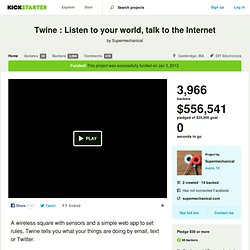
You can still join the thousands of other awesome Twine owners by pre-ordering on Supermechanical. It's the next best thing to being an original backer! Follow us on Facebook or Twitter. Eureqa. Eureqa is a breakthrough technology that uncovers the intrinsic relationships hidden within complex data.

Traditional machine learning techniques like neural networks and regression trees are capable tools for prediction, but become impractical when "solving the problem" involves understanding how you arrive at the answer. Supermechanical : objects that connect us.
Ubiquitous computing. Ubiquitous computing (ubicomp) is a concept in software engineering and computer science where computing is made to appear everywhere and anywhere.
In contrast to desktop computing, ubiquitous computing can occur using any device, in any location, and in any format. SOCIETIES: Combining Pervasive Computing with Social Networks. Feng-GUI - Attention Analysis for Websites and Advertisements. "pervasive computing" OR "ubiquitous computing" Pervasive Computing Methodenseminar - Taxonomy of Bypassers - Institut für Pervasive Computing. Top 7 Benefits of Pervasive Computing in Architecture : Sensing Architecture by Maria Lorena Lehman. Rewire the web.
DataPortability.org - Share and remix data using open standards. ScrapePro Universal Web Scraper Platform. SaaS integration, cloud apps workflows and task automation - tarpipe. Browser Automation. Yahoo Pipes. Let me google that for you. Soovle - Let the web help.
Give me back my GOOGLE™ Google Consciousness. Autopoiesis. Conway's Game of Life. "Conway game" redirects here.
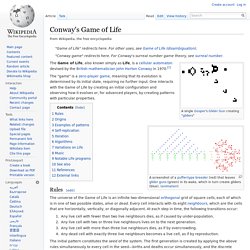
For Conway's surreal number game theory, see surreal number. The Game of Life, also known simply as Life, is a cellular automaton devised by the British mathematician John Horton Conway in 1970.[1] The "game" is a zero-player game, meaning that its evolution is determined by its initial state, requiring no further input. One interacts with the Game of Life by creating an initial configuration and observing how it evolves or, for advanced players, by creating patterns with particular properties. Rules[edit] _LIVESON. To be published in: R. Trappl (ed.) (1996): Cybernetics and Systems '96 (World Science, Singapore?)
Johan Bollen & Francis Heylighen Center "Leo Apostel", Free University of Brussels, Self-organization. Figure 1: Snow Crystal. In the beginning of quantum mechanics and statistical physics it was believed that a crystalline structure can be calculated by determining the minimum of the free energy. This may be true, e.g. for ionic crystals, such as sodium chloride, or metals. In this case, the Schrödinger equation for the ground state or possibly low lying states must be solved. In general, this requires the solution of a many particle problem. Web Mining: Information and Pattern Discovery on the World Wide Web. Pattern recognition. Pattern recognition algorithms generally aim to provide a reasonable answer for all possible inputs and to perform "most likely" matching of the inputs, taking into account their statistical variation. This is opposed to pattern matching algorithms, which look for exact matches in the input with pre-existing patterns.
A common example of a pattern-matching algorithm is regular expression matching, which looks for patterns of a given sort in textual data and is included in the search capabilities of many text editors and word processors. In contrast to pattern recognition, pattern matching is generally not considered a type of machine learning, although pattern-matching algorithms (especially with fairly general, carefully tailored patterns) can sometimes succeed in providing similar-quality output to the sort provided by pattern-recognition algorithms. Overview[edit] Probabilistic classifiers[edit] They output a confidence value associated with their choice. .