
Online community manager. The online community manager role is a growing and developing profession.
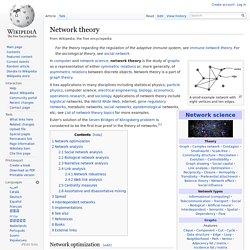
People in this position work to build, grow and manage online communities around a brand or cause. History[edit] Network theory. A small example network with eight vertices and ten edges.
It has applications in many disciplines including statistical physics, particle physics, computer science, electrical engineering, biology, economics, operations research, and sociology. Applications of network theory include logistical networks, the World Wide Web, Internet, gene regulatory networks, metabolic networks, social networks, epistemological networks, etc; see List of network theory topics for more examples. Euler's solution of the Seven Bridges of Königsberg problem is considered to be the first true proof in the theory of networks.[1] Network optimization[edit] SMO_Periodic_Table.png (2304×1584) Social networks analysis. Social networks and the analysis of them is an inherently interdisciplinary academic field which emerged from social psychology, sociology, statistics, and graph theory.
Georg Simmel authored early structural theories in sociology emphasizing the dynamics of triads and "web of group affiliations. "[2] Jacob Moreno is credited with developing the first sociograms in the 1930s to study interpersonal relationships. These approaches were mathematically formalized in the 1950s and theories and methods of social networks became pervasive in the social and behavioral sciences by the 1980s.[1][3] Social network analysis is now one of the major paradigms in contemporary sociology, and is also employed in a number of other social and formal sciences.
Together with other complex networks, it forms part of the nascent field of network science.[4][5] Dunbar's number. Six degrees of separation. Six degrees of separation.
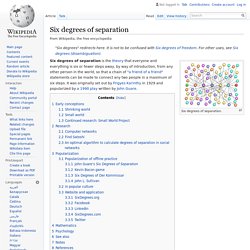
Early conceptions[edit] Shrinking world[edit] Theories on optimal design of cities, city traffic flows, neighborhoods and demographics were in vogue after World War I. These[citation needed] conjectures were expanded in 1929 by Hungarian author Frigyes Karinthy, who published a volume of short stories titled Everything is Different. One of these pieces was titled "Chains," or "Chain-Links.
" As a result of this hypothesis, Karinthy's characters believed that any two individuals could be connected through at most five acquaintances. A fascinating game grew out of this discussion. Social dynamics. Social dynamics can refer to the behavior of groups that results from the interactions of individual group members as well to the study of the relationship between individual interactions and group level behaviors.[1] The field of social dynamics brings together ideas from Economics, Sociology, Social Psychology, and other disciplines, and is a sub-field of complex adaptive systems or complexity science.
The fundamental assumption of the field is that individuals are influenced by one another's behavior. The field is closely related to system dynamics. Like system dynamics, social dynamics is concerned with changes over time and emphasizes the role of feedbacks. Topics[edit] See also[edit] References[edit] Weidlich, W. (1997) "Sociodynamics applied to the evolution of urban and regional structures". Further reading[edit] Easley, David; Klienberg, Jon (2010). External links[edit] Watts, D.J.; Strogatz, S.H. (1998). Forget Dunbar’s Number, Our Future Is in Scoble’s Number. February 16, 2009 by Hutch Carpenter Photo credit: Mark Wallace I probably don’t know about your latest job project.
I don’t know what your kids are up to.
Roles & Functions... Community of interest. A community of interest is a community of people who share a common interest or passion.
These people exchange ideas and thoughts about the given passion, but may know (or care) little about each other outside of this area. Participation in a community of interest can be compelling, entertaining and create a ‘sticky’ community where people return frequently and remain for extended periods. Frequently, they cannot be easily defined by a particular geographical area. In other words, "a community of interest is a gathering of people assembled around a topic of common interest. Its members take part in the community to exchange information, to obtain answers to personal questions or problems, to improve their understanding of a subject, to share common passions or to play. SocialMediaStrategyFrameworkv2.pdf (Objet application/pdf) [1405.1429] How Community Feedback Shapes User Behavior.
Don't Feed the Trolls! How to Manage Negativity in Social Media. Don't Feed the Trolls! How to Manage Negativity in Social Media Halloween is the day made for fantastically mucky creatures like the witch, the ghoul, the black cat and the troll. Virtual community. A virtual community is a social network of individuals who interact through specific social media, potentially crossing geographical and political boundaries in order to pursue mutual interests or goals.
One of the most pervasive types of virtual community operate under social networking services consisting of various online communities. Virtual communities all encourage interaction, sometimes focusing around a particular interest or just to communicate. Some virtual communities do both. Community members are allowed to interact over a shared passion through various means: message boards, chat rooms, social networking sites, or virtual worlds.[1] Introduction[edit]
Reputation. Reputation of a social entity (a person, a social group, an organization) is an opinion about that entity, typically a result of social evaluation on a set of criteria.
It is important in business, education, online communities, and many other fields. Reputation is known to be a ubiquitous, spontaneous, and highly efficient mechanism of social control in natural societies. It is a subject of study in social, management and technological sciences. Its influence ranges from competitive settings, like markets, to cooperative ones, like firms, organisations, institutions and communities. Account planning. Medium to large-sized advertising agencies divide their work into various departments, traditionally splitting functions into interacting with clients and looking out for their interests (account management), buying advertising (media), and creating advertising (creative).
The importance of the voice of the consumer has grown over time. Around the 1980s US ad agencies introduced a new discipline from the UK called account planning which became a primary function in most US ad agencies in the 90s. Responsables médias sociaux, community managers : comment gérer votre temps ? Community Manager...What Else ? Tipping point (sociology) In sociology, a tipping point is a point in time when a group —or a large number of group members— rapidly and dramatically changes its behavior by widely adopting a previously rare practice. The idea was expanded and built upon by Nobel Prize-winner Thomas Schelling in 1972. A similar idea underlies Mark Granovetter's threshold model of collective behavior. Mediabistro.com: jobs, classes, community and news for media professionals. TOP 50 LIST OF COMMUNITY MANAGER ACCOUNTS ON TWITTER.
10 marques de respect à donner à ses clients. Thomas Day Associates - The Ten Step Planning Methodology. Les 10 commandements de l'Expérience Utilisateur. How to Kill A Community in 10 Easy Steps. There has been a lot of buzz lately about the how many empty or failed online communities litter the web. As with any hype-cycle, people run out to get or make the latest thing - in this case a social network or community - and often don't think through what having one will be like. It's kind of like getting a puppy - exciting at first, but hard work thereafter! So, the question at hand is how to keep your community alive and thriving? Or, on the flip side, here are the top 10 ways to (inadvertently) to kill an online community: Digital Reputation Blog. Social Web - Reputation Management Cycles diagram. Community management. Social-intranet-intersection.png (Image PNG, 976x744 pixels)
Community Building Online. The Community Roundtable's Community Maturity Model. We developed the Community Maturity Model™ (CMM) in 2009 to help organizations understand, plan for and assess the performance of community and social business initiatives. In studying communities and organizations for a decade, we now have a much better sense of what each of those milestones looks and feels like and have updated the Community Maturity Model accordingly. Our clients use it both as a community management checklist and as an organizational roadmap. At TheCR, we use it to organize our research, our curated content and our training services so that our clients can easily connect the dots and use our research and content in their strategic planning.
71-72breton. Nétiquette. Community Managment & Social Medias. COMMS corner: 194 social media case studies (and 23 tactics) from 2011. COMMS corner: February 2011. Inside the Mind of a Community Manager. Community-Manager-Infographic-Revised.jpg (Image JPEG, 900x1424 pixels) Community Management. Je tenais à vous signaler absolument cet excellent article du blog Socialmediapro.fr, blog de référence pour les stratégies marketing sur les réseaux sociaux, qui dresse une liste des 40 blogs français référents sur les médias sociaux.
Avec, en fin de l'article d'Olivier, une liste Facebook ainsi qu'une liste Twitter regroupant tous les comptes cités dans l’article. Lire la suite "40 blogs français sur les médias sociaux à suivre absolument" » Facebook est en train de déployer les nouvelles pages et le nouveau newsfeed, il va donc falloir adapter légèrement les formats des images que nous publions sur nos pages Fans. Lire la suite "Pages Facebook : le guide des tailles et formats des images" » Les guidelines de Facebook concernant les Pages de marques sont certes très claires quand on les lit mais elles changent tout le temps. Voici une petite mise au point, à date en ce mois de Février 2014.
Advanced Human Technologies. Social media such as blogs, Twitter, social networks, content sharing and far more give customers a voice and organizations a powerful tool for value creation and competitive differentiation. Advanced Human Technologies has extensive experience helping organizations to understand social media, build effective strategies, and implement these to create value. Social Media Strategy Framework Download our Social Media Strategy Framework to gain insights into the key steps in building an effective social media strategy. Click on the image to download pdf We use our Social Media Strategy Framework primarily to help our clients who are early in the process of engaging with social media to understand what is required to create a social media strategy.
Social media strategy is unique to every organization, so in consulting engagements we always use the approach that is most relevant to the client’s issues and situation. Services. What makes a community manager? « NuSum. I 1 Vote Original post: I am working on a slide describing the high level attributes of an ideal community manager and am wondering what is missing. Any thoughts? Revisions: July 5, 2010 After collecting some comments and some discussion at the first Ottawa Community Managers meetup I have created a revised version of the slide above. Links to other resources: Like this: Like Loading...