
- The Washington Post. Income inequality: The difference between the US and Europe, in one chart. User Data and Cookie Consent. Steven Brill's "Tailspin": How My Generation Broke America. Lately, most Americans, regardless of their political leanings, have been asking themselves some version of the same question: How did we get here?
How did the world’s greatest democracy and economy become a land of crumbling roads, galloping income inequality, bitter polarization and dysfunctional government? As I tried to find the answer over the past two years, I discovered a recurring irony. About five decades ago, the core values that make America great began to bring America down. World – WID – World Wealth & Income Database. Frequently Asked Questions (FAQ) What is WID.world?
For more information on WID.world and its history, click here. For more information on the network of researchers, click here. For more information on methodology, click here. How to read WID.world graphs? Click here for help on how to navigate through WID.world menus and graphs. Our Broken Economy, in One Simple Chart - The New York Times. You're not imagining it: the rich really are hoarding economic growth. If you’ve read an article or two about economic inequality in the United States at any point in the past decade, chances are you’ve come across a chart like this: The left-leaning Economic Policy Institute has been producing that graphic, and ones like it, for years now.
It shows that in the aftermath of World War II through the early 1970s, workers got paid more as the economy grew. Median hourly compensation rose in tandem with productivity (the amount of economic output workers could produce per hour). But something changed in 1973 or thereabouts. A Bigger Economic Pie, but a Smaller Slice for Half of the U.S. - The New York Times. Corporations in the Age of Inequality. Latest Digital Article The future of capitalism depends on fixing it.
On a sunny morning in December 2013, as Google employees boarded the bus that would take them on their daily commute from Oakland to the company’s Mountain View headquarters, protesters moved in. One unfurled a bright blue banner bearing the words “F— Off, Google.” Some handed out pamphlets explaining their anger: “While you guys live fat as hogs with your free 24/7 buffets, everyone else is scraping the bottom of their wallets, barely existing in this expensive world that you and your chums have helped create.” Log In - New York Times. Log In - New York Times. Log In Don't have an account?

Sign up here » Facebook Google or Forgot password? Just 8 men own same wealth as half the world. Eight men own the same wealth as the 3.6 billion people who make up the poorest half of humanity, according to a new report published by Oxfam today to mark the annual meeting of political and business leaders in Davos.
Oxfam’s report, ‘An economy for the 99 percent’, shows that the gap between rich and poor is far greater than had been feared. It details how big business and the super-rich are fuelling the inequality crisis by dodging taxes, driving down wages and using their power to influence politics. It calls for a fundamental change in the way we manage our economies so that they work for all people, and not just a fortunate few. 11 Charts That Show Income Inequality Isn't Getting Better Anytime Soon. It's no secret that the United States has a glaring—and growing—problem with inequality.
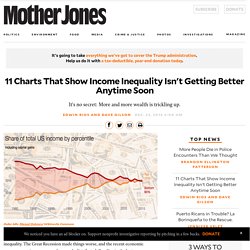
The Great Recession made things worse, and the recent economic recovery remains uneven, and unevenly distributed. Families in the bottom 99 percent of households have recovered just 60 percent of their income losses from the economic slump, according to a recent analysis of tax data by University of California-Berkeley economist Emmanuel Saez. Log In. The resulting research is among the most eye-opening economics work in recent years.
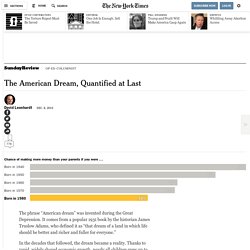
You’ve probably heard some of the findings even if you don’t realize it. They have shown that the odds of escaping poverty vary widely by region, for instance, an insight that has influenced federal housing policy. After the research began appearing, I mentioned to Chetty, a Stanford professor, and his colleagues that I thought they had a chance to do something no one yet had: create an index of the American dream. It took them months of work, using old Census data to estimate long-ago decades, but they have done it. When will Trump voters realize they’ve been had? Hey, Trumpkins — have you worked it out yet?

Is the truth dawning on you, or are you still in the dark? See if you can put it all together from the resumes of those in President-elect Donald Trump’s closest political circle so far: Treasury secretary nominee Steven Mnuchin: Goldman Sachs. Chief strategist Steve Bannon: Goldman Sachs. Transition adviser Anthony Scaramucci: Goldman Sachs. Commerce secretary nominee Wilbur Ross: Rothschild & Co. Amazon, Cyber Monday and the flywheel of doom – Bloomberg Technology – Medium. The annual shopping frenzy known as Cyber Monday has me reflecting today on the relative performance of two of the largest retailers in the U.S.
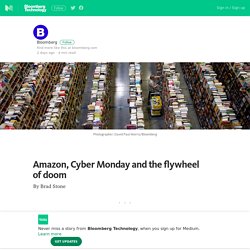
In 2003, the shopping juggernaut Wal-Mart Stores notched $250 billion in net sales for the first time. This year, many analysts believe Amazon.com is likely to approach or achieve the same lofty benchmark. (Amazon doesn’t release the total value of products sold on its site, so analysts estimate it by adding the products sold by Amazon itself with the total sales of merchants on Amazon’s third party marketplace.) So what’s the big deal? In 2003, Wal-Mart was growing at a rate of 12 percent a year. This is unprecedented — we have never seen a retail business at this size growing at this rate.
Amazon, however, is picking up steam. It’s easy to see why. Explicit cookie consent. ON AUGUST 31ST 1910 Theodore Roosevelt delivered a fiery speech in Osawatomie, Kansas. The former president celebrated America’s extraordinary new commercial power but also gave warning that America’s industrial economy had been taken over by a handful of corporate giants that were generating unparalleled wealth for a small number of people and exercising growing control over American politics. Roosevelt cautioned that a country founded on the principle of equality of opportunity was in danger of becoming a land of corporate privilege, and pledged to do whatever he could to bring the new giants under control.
Roosevelt’s speech sounds as fresh today as on the day he made it. A small number of giant companies are once again on the march, tightening their grip on global markets, merging with each other to get even bigger, and enjoying vast profits. As a proportion of GDP, American corporate profits are higher than they have been at any time since 1929. But now size seems to matter again. The Economic Journey of a German Pickle, From the Berlin Wall to TTIP. Globalization has brought foods from around the world to grocery stores near you. And in some cases, it’s also brought contentious food politics. For instance in Germany, the land of pilsners and bratwurst, on this issue consider the gherkin—the pickle, depending on which side of the Atlantic you call home.
Gherkins, in their sweet and sour briny goodness, have been lauded in the German imagination from poetry to popular culture. In the 2003 film Good Bye, Lenin! , the protagonist’s mother requests one almost immediately on waking from a coma. Fairfield County, Connecticut: Inequality's Epicenter. BRIDGEPORT, Conn. —Few places in the country illustrate the divide between the haves and the have-nots more than the county of Fairfield, Connecticut. Drive around the city of Bridgeport and, amid the tracts of middle-class homes, you’ll see burned-out houses, empty factories, and abandoned buildings that line the main street.
Nearby, in the wealthier part of the county, there are towns of mansions with leafy grounds, swimming pools, and big iron gates. Bridgeport, an old manufacturing town all but abandoned by industry, and Greenwich, a headquarters to hedge funds and billionaires, may be in the same county, and a few exits apart from each other on I-95, but their residents live in different worlds. Big Business Is Killing Innovation in the U.S. Botanists define a rheophyte as an aquatic plant that thrives in swift-moving water. Coming from the Greek word rhéos, meaning a flow or stream, the term describes plants with wide roots and flexible stalks, well adapted to strong currents rather than a pond’s or pasture’s stillness. For most of the 20th century, U.S. lawmakers worked to maintain just these sorts of conditions for the U.S. economy—a dynamic system, briskly flowing, that forced firms to adapt to the unpredictable currents of the free market or be washed away.
In the past few decades, however, the economy has come to resemble something more like a stagnant pool. The richest families in Florence in 1427 are still the richest families in Florence — Quartz. South Korea tops the charts when it comes to measuring the world’s fastest internet connectivity speeds. At 26.3 megabits per second, it was the only country above the 25 Mbps threshold in the third quarter of 2016, according to a new report (pdf) published by US-based cloud services provider Akamai. South Korea’s hyper-connectivity is no surprise: It is the result of nearly 20 years of labor.
In the 1990s, the South Korean government made a big push toward the broadband industry. It liberalized its telecommunications sector, built a robust national infrastructure for high-speed internet, and introduced regulations to keep the broadband market competitive. The government encouraged citizens to get computers and use high-speed internet connections by subsidizing the cost for low-income people and others not connected at the time. Between 1996 and 2001, there was a six-fold rise in Korean internet hosts. A high population density works in Korea’s favor.
This cartoon explains how the rich got rich and the poor got poor. Comparing the World's Billionaires, or the Global 'One Percent' John Lanchester · Are we having fun yet?: The Biggest Scandal of All · LRB 4 July 2013. How the Obama economy overcame Republican sabotage. Why Wealth And Income Inequality Just Keep Getting Worse And Worse. 5 things you should know about the Republican welfare state.
Overworked America: 12 Charts That Will Make Your Blood Boil. The 8 worst economic proposals GOP candidates are considering. Stunning maps showing how much you need to earn in each state to afford a two-bedroom rental unit. Rich people are jerks, explained. So I was reading this story about water restrictions imposed in the wake of California's horrible drought, and how wealthy people are reacting to them, and it reminded me that rich people are kind of jerks. That's one big reason lots of solvable social problems aren't getting solved.
Working, but Needing Public Assistance Anyway. Photo A home health care worker in Durham, N.C.; a McDonald’s cashier in Chicago; a bank teller in New York; an adjunct professor in Mayfield, Ill. Do you have $2,385,036? No? Then you’re not in the wealthiest 1% Ever wondered how much money (and stock, assets, etc.) you needed to make the cutoff for the wealthiest 1 percent? Obama v. Reagan: Fun Comparison I Did To Piss Off Wingnuts on Reagan's B-day. Yesterday was Reagan's birthday. I share this post for with those who start dripping with sentimentality forgetting what he did, what his legacy is still doing, and worst of all, (for my conservative friends), that they wouldn't have liked him today anyway: Imagine a world that never knew Ronald Reagan: 17 Things We Learned About Income Inequality in 2014. Poor kids who do everything right don’t do better than rich kids who do everything wrong. Source: Data from Richard Reeves and Isabel Sawhill. The Benefits of Economic Expansions Are Increasingly Going to the Richest Americans.
In Climbing Income Ladder, Location Matters. Capitalism vs. Democracy. Goldman Sachs’ sick con: How they made money off your misery. 5 signs that America’s super-rich are losing their minds. Here's Why The Dot Com Bubble Began And Why It Popped. Employment Down, Profits Up: The Aftermath of the Financial Crisis in 1 Graph - Derek Thompson. 10 startling facts about global wealth inequality. How Much Money Do The Top Income Earners Make By Percentage? For the Love of Money. Millions of Americans lack basic financial literacy, studies show. Billionaires Received U.S. Farm Subsidies, Report Finds. Take Two 'Normal' People, Add Money To Just One Of Them, And Watch What Happens Next.
Everything you need to know about the deficit. Watch the growth of U.S. income inequality with this animated map. Corporate Profits Just Hit An All-Time High, Wages Just Hit An All-Time Low. How the 1 percent won the recovery, in one table. How the Rich Benefited From the Recovery (While Most of Us Got Nothing) The typical American family makes less than it did in 1989. Wealth Inequality in America. Want to Tackle Income Inequality? You Need to Go After Capital Gains. Chrystia Freeland: The rise of the new global super-rich. The Finance Industry Has Pried into Every Sector of the Economy, and Has Ended Up Running the Whole Show. Romney-Style Economics Behind Decline of Hostess, But Workers Are Paying the Price.
In Climbing Income Ladder, Location Matters. Being poor changes your thinking about everything. We Are the 99.9% The Occupation - Erik Tarloff - National. The New Progressive Movement. It’s hard to hate these occupiers. Open Letter to that 53% Guy. President Obama shouldn’t be afraid of a little class warfare. Steven Pearlstein: Obama can learn from the Occupy Wall Street movement. What I Learned from Occupy Wall Street. The Truth About Income Inequality in America - Charles Murray. It's the Inequality, Stupid. Legends of the Fail. Losing Our Way. A Gigantic Scam.
Beltway Brain Fever: Sequester Edition. Poll: Majority of public has lost faith in government ability to fix economy. The Great Stagnation or the Great Relocation? - Damien Ma - International. Translating the European Financial Mess. Chinese Professor. As Ohio Goes: A Letter from Tea-Party Country by Timothy Snyder. The Market as God - Harvey Cox. Greed and Debt: The True Story of Mitt Romney and Bain Capital. Is Private Equity Bad For the Economy? - Jordan Weissmann - Business. Fables of Wealth. Revolt of the Rich. A money 'black hole': rich hide at least $21 trillion in tax havens, study shows. Panic of the Plutocrats. The Self-Destruction of the 1 Percent. 5 Ways Most Americans Are Blind to How Their Country Is Stacked for the Wealthy. Viewpoint: How Wall Street Rigs the Game. Glass–Steagall Act. Dodd–Frank Wall Street Reform and Consumer Protection Act.
Volcker Rule. Derivative (finance) A Scorecard For This Summer’s Bank Scandals. Former Citigroup CEO Weill Says Banks Should Be Broken Up. FAQ: What happened at JP Morgan? And should you care? Citigroup to Pay $285 Million to Settle S.E.C. Charges.