
How to discipline your children without rewards or punishment. Many parents are moving towards "gentle parenting", where they choose not to use rewards (sticker charts, lollies, chocolates, TV time as "bribes") and punishments (taking away "privileges", time-out, smacking) to encourage good behaviour, but encourage good behaviour for the sake of doing the right thing.
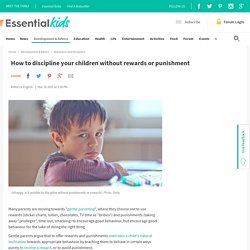
Gentle parents argue that to offer rewards and punishments overrides a child's natural inclination towards appropriate behaviour by teaching them to behave in certain ways purely to receive a reward, or to avoid punishment. What is discipline? For most people it would seem impossible to discipline without rewards and punishments. However, it depends on your understanding of "discipline". Discipline always has a silent "self" in front of it because it's about controlling yourself. So, in the case of parenting, it's about helping children learn to manage themselves, their feelings, their behaviour and their impulses. The surprising science of fidgeting.
Hand-held toys known as “fidget spinners” – marketed as “stress relievers” – have become so popular and distracting in classrooms that they are now being banned in many schools.

And it’s not just kids who like to fidget. Look around your office and you will probably see people bouncing their legs up and down, turning pens over and over in their hands, chewing on things, sucking on their lower lips and pulling bits of their beard out – seemingly completely unconsciously. But why do we fidget, and why do some people do it more than others? And if it really helps to relieve stress, does that mean we should all embrace it? These are actually rather difficult questions to answer, as there appear to be various definitions of what fidgeting is and why it happens. Theconversation. Imagine a classroom where children are unable to wait their turn or stay focused on their work.
They are easily distracted, cannot remember basic instructions or hold enough information in their head to solve problems – skills teachers rely on in order to teach successfully. These behavioural issues are all examples of problems that can arise from attachment issues – based on the relationship between children and their main caregiver. Attachment theory is now one of the world’s most well-researched theories about human development. It was first proposed by the 20th-century British psychiatrist John Bowlby, who considered that children needed to develop a secure attachment with their main caregiver via sufficiently consistent, responsive, sensitive, appropriate and predictable care and support. Research has shown that secure attachments create mental processes that enable a child to regulate emotions and attune to others. A Super Simple Way to Help Your Students Focus. 10 Traits of Impactful Christian Teachers.
Back-to-School Classroom Management Solutions. An ELT Notebook: 5 Classroom Management Tips To Silence A Noisy Class. Suggests 5 tips to help you get silence from the worst kids in school... 1.
The first thing to remember is that you are the boss. Self belief is incredibly important in this job. You can’t expect pupils to respond positively to you unless you believe, really believe, that you fully deserve their respect and compliance. The thought that you are the leader in the classroom must be at the forefront of your mind. If you give any sign at all that you are NOT in FULL CONTROL, children will sense this and exploit your weaknesses. All too often a teacher will enter a lesson filled with dread and give out the signal that they are beaten before the lesson even starts. 30 Techniques to Quiet a Noisy Class. One day, in front 36 riotous sophomores, I clutched my chest and dropped to my knees like Sergeant Elias at the end of Platoon.
Instantly, dead silence and open mouths replaced classroom Armageddon. Standing up like nothing had happened, I said, "Thanks for your attention -- let's talk about love poems. " I never used that stunt again. After all, should a real emergency occur, it would be better if students call 911 rather than post my motionless body on YouTube. I've thought this through. Most teachers use silencing methods, such as flicking the lights, ringing a call bell (see Teacher Tipster's charming video on the subject), raising two fingers, saying "Attention, class," or using Harry Wong's Give Me 5 -- a command for students to: Focus their eyes on the speaker Be quiet Be still Empty their hands Listen.
There is also the "three fingers" version, which stands for stop, look, and listen. Lesser known techniques are described below and categorized by grade bands: Call and Response. 30 Techniques to Quiet a Noisy Class. 20 Tips to Help De-escalate Interactions With Anxious or Defiant Students. Anxiety is a huge barrier to learning and very difficult for educators to identify.
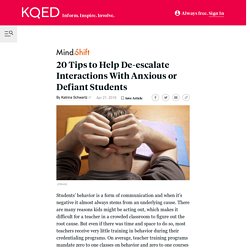
“When anxiety is fueling the behavior, it’s the most confusing and complicated to figure out,” Minahan said. That’s because a student isn’t always anxious; it tends to come and go based on events in their lives, so their difficulties aren’t consistent. When we are anxious our working memory tanks, making it very difficult to recall any salient information. Researchers surveyed a group of first graders none of whom had any reading or math disabilities. Restorative Practice. Page Content Restorative practice is a strategy that seeks to repair relationships that have been damaged, including those damaged through bullying.

It does this by bringing about a sense of remorse and restorative action on the part of the offender and forgiveness by the victim. Rationale. New online technology aims to change bullying behvaiour » headspace. 49 Phrases to Calm an Anxious Child. It happens to every child in one form or another – anxiety.
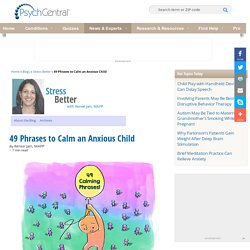
As parents, we would like to shield our children from life’s anxious moments, but navigating anxiety is an essential life skill that will serve them in the years to come. In the heat of the moment, try these simple phrases to help your children identify, accept, and work through their anxious moments. 1. “Can you draw it?” Drawing, painting or doodling about an anxiety provides kids with an outlet for their feelings when they can’t use their words. 2. Being told that you will be kept safe by the person you love the most is a powerful affirmation. 3. If you tell a child to take a deep breath in the middle of a panic attack, chances are you’ll hear, “I CAN’T!” 4. Marathon runners use this trick all of the time to get past “the wall.” 5. This is especially helpful for older kids who can better articulate the “Why” in what they are feeling. 6. 7. Separation is a powerful anxiety trigger for young children. 8. 9. 10. 11. 12. 13. 14.
How teachers are taught to discipline a classroom might not be the best way. The national review of teacher education, released last week, emphasised that teaching graduates need to enter the classroom with practical skills for handling a classroom, and not just knowledge of the subject they’re teaching.
One of the most important aspects of educating future teachers is teaching them how to manage a classroom. Theconversation. Around one in five Australian school students don’t find school engaging, which means they are less likely to learn properly..
It’s an issue that tends to worsen as students become older. A study showed that in year 7, 70% of students observed found school engaging, but in year 9, this dropped to 55%. Part of the reason is that the brightest kids are not being challenged enough, leading to students becoming disconnected and disengaged from their studies. Disengagement has resulted in Australian classrooms becoming rowdier and bullying becoming more prevalent. A 2012 study revealed that just 60% of students in South Australian secondary schools found school engaging. How to Cope With Frustrated Child in Elementary School. It’s common for grade-schoolers to push their parents’ buttons sometimes. But there may be times when your child has strong reactions that seem to come out of nowhere. You might think he’s simply testing limits (or your patience). Instead, his reactions may be outbursts of frustration related to his learning and attention issues.
Knowing what’s behind his behavior can help you keep your cool. Top 10 Behaviour Management Strategies. Most teachers are not surprised to learn that successful behaviour management is crucial to both students’ success and to their own sanity. However, you may not be sure which behaviour management strategies have the most impact. When behaviour management is talked about in many schools, the conversation focuses on the: Importance of rules and routinesAppropriateness of punishments or consequencesNeed for ‘admin’ to do something about it You may be surprised to learn that while it is true, that all three of these strategies help to reduce misbehaviour, there are simpler strategies that have far more impact.
In fact, if you look at the five strategies that have the largest impact, you will not find anything about rules, routines, consequences, punishments or the principal. Bill Rogers Behaviour Management. I came across Bill Rogers‘ work on behaviour management early in my career. I started working in some really tough schools. In some ways, it was lucky, because it made the rest of my career less challenging and prepared me for my very first principal’s role in 1995 (teaching principal), at a school with a teacher turnover rate of 400% over the two years prior to my starting. A lot of my success with challenging classes was due to the work of behaviour management guru Bill Rogers – a real teacher with extensive expertise in behaviour management.
10 Super Effective Ways to Grab Your Students’ Attention. It’s one of the great challenges of teaching. Six classroom management tips for new teachers. As a new teacher facing their first classroom experience, you will have no doubt been bombarded with information. Strategies for Helping Students Motivate Themselves. Editor's Note: This piece was adapted from Building a Community of Self-Motivated Learners: Strategies to Help Students Thrive in School and Beyond by Larry Ferlazzo, available March 21, 2015 from Routledge.
My previous post reviewed research on extrinsic and intrinsic motivation, and described the four qualities that have been identified as critical to helping students motivate themselves: autonomy, competence, relatedness, and relevance. At a school in Brooklyn’s poorest neighborhood, literacy is up and disciplinary problems are down. BROOKLYN, N.Y. — Three years ago, when Public School 446 opened in a building where two others had failed, it inherited many of the youngest students.
Super Seven Tips to Engage the Disengaged Child.