
Time Line of History in the Middle East. As of July 1, 2013 ThinkQuest has been discontinued.

We would like to thank everyone for being a part of the ThinkQuest global community: Students - For your limitless creativity and innovation, which inspires us all. Teachers - For your passion in guiding students on their quest. Partners - For your unwavering support and evangelism. Return to The Giza Power Plant - Christopher Dunn. Civilizations such as ours can rise to great heights and be dashed onto a path of devolution by natural or engineered effects. In a blink of an eye, we can lose it all! Whether as one or multiple blinks of an eye, our distant ancestors in prehistoric Egypt received a mortal blow to the industry that was capable of creating the artifacts we see there today. Whether that blow came from extraterrestrial forces such as a comet, geophysical disturbances, or even a nuclear war, are open to speculation, the fact remains that their industries did exist, and they somehow became extinct!
The purpose for this article is not to belabor the obvious or to restate what others have stated more eloquently, but to bring you an update on what has happened since the book was published. There has been a lot of activity and some startling discoveries, and I have looked forward to and appreciate this opportunity to tell you about them.
The answer, I found, was NO and YES! Return to The Giza Power Plant - Christopher Dunn. Archaeological Haecceities. Ancient Europe: 50,000 BC to AD 500. Theories in Anthropology. Ancient Europe: 50,000 BC to AD 500. Chapter I - From Creation to Evolution. You must acknowledge that you have read the following disclaimer in order to view documents in the Historical Library.
The Historical Library contains writings written before 1970, only. For material written during or after 1970, please refer to the Modern Documents section of the Secular Web Library. This Historical Library is provided for those doing research into the history of nontheism. It is not intended to be--and should not be used as--a source of modern, up-to-date information regarding atheistic issues. America's War on Afghanistan. History Hunters International « Studying cultural layers.
MacroHistory : World History. Axis Alliance in World War II. The belligerents during World War II fought as partners in one of two major alliances: the Axis and the Allies.

The three principal partners in the Axis alliance were Germany, Italy, and Japan. These three countries recognized German hegemony over most of continental Europe; Italian hegemony over the Mediterranean Sea; and Japanese hegemony over East Asia and the Pacific. Although the Axis partners never developed institutions to coordinate foreign or military policy as the Allies did, the Axis partners had two common interests: 1) territorial expansion and foundation of empires based on military conquest and the overthrow of the post-World War I international order; and 2) the destruction or neutralization of Soviet Communism. On November 1, 1936, Germany and Italy, reflecting their common interest in destabilizing the European order, announced a Rome-Berlin Axis one week after signing a treaty of friendship. Medieval Technology and American History. From the early 16th century onwards, European settlers arriving in the Americas brought not only ideas about religious and political freedom, but also the skills needed to build communities, the ways of daily life in the Old World.
The technologies in particular differed little if at all from those their medieval forebears used to construct European civilization after the fall of Rome. The colonial American environment in which these technologies were applied led to a reorganization of industry and society outside the aristocratic control of Europe and provided the basis for the political developments that made a new nation. This website explores some of the core medieval technologies that built the American colonies into an industrial powerhouse: milling and iron manufacture. In-depth articles, short essays, photo archives, videos, comparative timelines, and class projects all seek to demonstrate the transfer of these technologies to colonial America. Arts & Humanities Mathematics. Medievalists.net.
The Celts. The Celts were a group of peoples that occupied lands stretching from the British Isles to Gallatia.
The Celts had many dealings with other cultures that bordered the lands occupied by these peoples, and even though there is no written record of the Celts stemming from their own documents, we can piece together a fair picture of them from archeological evidence as well as historical accounts from other cultures. A history of conflicts. Capuchin Catacombs - Palermo, Italy. For visitors to Palermo who enjoy the macabre and/or bizarre, the Catacombe dei Cappuccini (Catacombs of the Capuchins or Capuchin Catacombs) are a must-see.
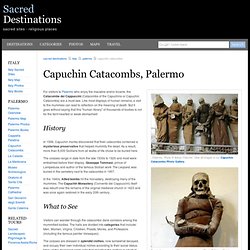
Like most displays of human remains, a visit to the mummies can lead to reflection on the meaning of death. But it goes without saying that this "human library" of thousands of bodies is not for the faint-hearted or weak-stomached! History In 1599, Capuchin monks discovered that their catacombs contained a mysterious preservative that helped mummify the dead. As a result, more than 8,000 Sicilians from all walks of life chose to be buried here. The corpses range in date from the late 1500s to 1920 and most were embalmed before their display.