
Meditation. 4 Powerful Reasons to Meditate and How To Get Started. Meditation is the art of silencing the mind.
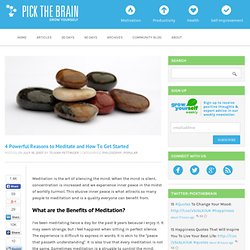
When the mind is silent, concentration is increased and we experience inner peace in the midst of worldly turmoil. This elusive inner peace is what attracts so many people to meditation and is a quality everyone can benefit from. What are the Benefits of Meditation? I’ve been meditating twice a day for the past 9 years because I enjoy it. It may seem strange, but I feel happiest when sitting in perfect silence. The Headspace meditation podcasts: Sleeping - audio. Meditation found to increase brain size. Kris Snibbe/Harvard News Office Sara Lazar (center) talks to research assistant Michael Treadway and technologist Shruthi Chakrapami about the results of experiments showing that meditation can increase brain size.

People who meditate grow bigger brains than those who don’t. Researchers at Harvard, Yale, and the Massachusetts Institute of Technology have found the first evidence that meditation can alter the physical structure of our brains. Brain scans they conducted reveal that experienced meditators boasted increased thickness in parts of the brain that deal with attention and processing sensory input. In one area of gray matter, the thickening turns out to be more pronounced in older than in younger people. Zencast.org. Mindfulness meditation training changes brain structure in eight weeks. Participating in an 8-week mindfulness meditation program appears to make measurable changes in brain regions associated with memory, sense of self, empathy and stress.
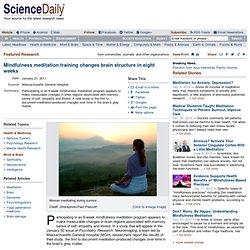
In a study that will appear in the January 30 issue of Psychiatry Research: Neuroimaging, a team led by Massachusetts General Hospital (MGH) researchers report the results of their study, the first to document meditation-produced changes over time in the brain's grey matter. "Although the practice of meditation is associated with a sense of peacefulness and physical relaxation, practitioners have long claimed that meditation also provides cognitive and psychological benefits that persist throughout the day," says Sara Lazar, PhD, of the MGH Psychiatric Neuroimaging Research Program, the study's senior author. The Art of Meditation / Stop Being a Zombie! A person who thinks all the time has nothing to think about except thoughts.
So he loses touch with reality, and lives in a world of illusion – Alan Watts Tweet This Have you ever driven your car or bicycle and suddenly you wake up somewhere down the road and can’t remember how you got there? What happened in those few minutes? When you put some effort in it you probably remember some of the thoughts you had. And when you are honest about it, it was probably a fantasy. And so did I when I first started meditating. So before I continue I’d like everyone to experience this to understand what I’m talking about. Did you do the two minutes? There’s a lot been written on meditation, and to be honest, I ain’t got anything new or groundbreaking stuff to tell. What is walking meditation? Bodhipaksa Walking meditation is a form of meditation in action.
In walking meditation we use the experience of walking as our focus. We become mindful of our experience while walking, and try to keep our awareness involved with the experience of walking. Actually, there are several different kinds of walking meditation. We’ll just be looking at one of them in detail, although we’ll touch on the others.
Develop a Two-Minute Meditation Habit and Make It Stick. No matter what religion you are, if your prayer isn't meditation, you're doing it wrong.
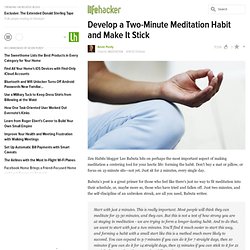
No matter what subject you study, if your deep thought, introspection, or focus, isn't a form of meditation, you're doing it wrong. Meditation comes in many forms, and unless you have severe ADHD, everyone does it. It's part of the human condition. Yes, even that kid who loses time playing his video games with almost intense abandon of the rest of the world. There is meditation for relaxation, for focus, and for both. I like this bite sized approach. Meditation - Lifehacker. Meditation - Lifehacker. Buddhify Teaches You to Meditate and Relax a Little on the Go. Meditation - Lifehacker. Meditation - Lifehacker. Spirit Vaults : Meditation - Essay.
It seems everyone is interested in meditation...talking about the wonderful benefits, recommending classes and discussing the different ways to "do it".
But, for a beginner, just what is "it"? And how do you do "it"? Our busy, hectic, lifestyles may seem to prohibit this peaceful practice, or provide a convenient "excuse" not to begin, or continue, to meditate...but, the happy news is, you CAN successfully benefit even if you practice for short periods. With the simple technique described below, you will begin and incredible journey. Transpersonal. Meditation Can Improve Your Memory, Focus, and Productivity at Work. Buddhist Meditation.
Meditation is the practice Buddhists know very well.
How To Meditate Without Meditating At All. Your meditation doesn't have to emulate the Buddha's 49-day retreat.
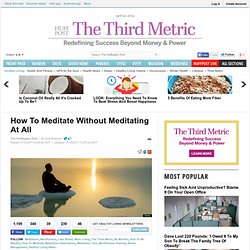
Whether you think there's no time for a mindfulness meditation practice, or the concept of sitting in stillness is more daunting than restful, there are still ways to reap the benefits of the ancient art. That's right -- you can manifest an informal practice within your daily habits. You don't have to change your routine all that much: All it takes is tweaking your intention. Informal mindfulness practices are ones in which you pay attention to your moment-to-moment experience. These are "everyday actives of life that can support the cultivation of mindfulness," writes Karen Kissel Wegela, Ph.D. on Psychology Today. Many successful people (like Oprah, Rupert Murdoch and even Arianna Huffington, to name a few) credit meditation for their razor-sharp focus, enviable level of productivity and bountiful amounts of creative juice. » Meditation for Beginners: 20 Practical Tips for Quieting the Mind.
Editor’s note: This is a guest post from Todd Goldfarb at the We The Change blog.
Meditation is the art of focusing 100% of your attention in one area. The practice comes with a myriad of well-publicized health benefits including increased concentration, decreased anxiety, and a general feeling of happiness. Although a great number of people try meditation at some point in their lives, a small percentage actually stick with it for the long-term. This is unfortunate, and a possible reason is that many beginners do not begin with a mindset needed to make the practice sustainable.
The purpose of this article is to provide 20 practical recommendations to help beginners get past the initial hurdles and integrate meditation over the long term: 1) Make it a formal practice. 2) Start with the breath. 4) Meditate with Purpose. 5) Notice frustration creep up on you. 6) Experiment. 7) Feel your body parts. How to Meditate - Guided Meditation Techniques - Buddhist Meditations. Relaxation audio.