
What Is Life? Is Death Real? Crown Shyness: A Peculiar Natural Phenomenon. Crown shyness or canopy disengagement is a phenomenon observed in some tree species in which the crowns of neighboring trees of similar height do not touch each other, but are separated by a gap.
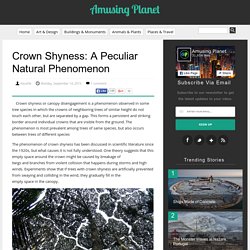
This forms a persistent and striking border around individual crowns that are visible from the ground. The phenomenon is most prevalent among trees of same species, but also occurs between trees of different species The phenomenon of crown shyness has been discussed in scientific literature since the 1920s, but what causes it is not fully understood.
Fantastically Wrong: What Darwin Really Screwed Up About Evolution. It’s hard to overstate just how brilliant and huge an idea Charles Darwin’s theory of evolution by natural selection was and continues to be.
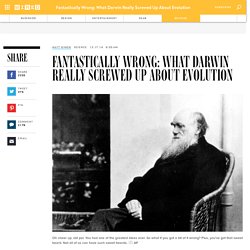
It absolutely rocked Victorian England, to the extent that stuffy old Victorian England could be rocked past people just barely raising their voices in polite protest. But some folks, particularly highly religious types, weren’t too happy with the idea that nature can run perfectly fine on its own, without the guiding hand of a higher power. Not happy in the least bit. More Fantastically Wrong Science. Why are there gay, lesbian, and bisexual people? We know now that homosexuality is connected to genetics — and there's probably more than one gene involved.

But why would that trait have been selected for strongly enough to make it present in 5-to-15 percent of the population? At The Conversation, geneticist Jenny Graves presents an interesting theory that I'd never heard before. Homosexuality is evolutionarily adaptive, according to this idea, because the same genes that give you women who love women and men who love men also give you men who love women and women who love men. In fact, Graves suggests, it's better to think of these genes as "male loving" and "female loving" rather than "gay" or "lesbian" or "straight". Scientists snap a picture of DNA’s double helix for the very first time. Pulp Science Fiction Under German Totalitarianism. Strange, yesterday came across old German pulp magazines as I was researching the whole Eurospy genre.
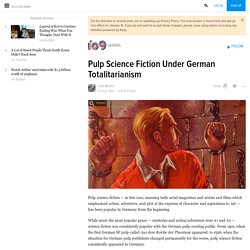
Pulp Science Fiction Under German Totalitarianism. The 10 Books You Absolutely Must Read to Understand the History of Earth. The 10 Books You Absolutely Must Read to Understand the History of Earth. The origin of breathing: how bacteria learnt to use oxygen. Thursday 26th July saw the launch of SciLogs.com, a new English language science blog network. SciLogs.com, the brand-new home for Nature Network bloggers, forms part of the SciLogs international collection of blogs which already exist in German, Spanish and Dutch. To celebrate this addition to the NPG science blogging family, some of the NPG blogs are publishing posts focusing on “Beginnings”. Participating in this cross-network blogging festival is nature.com’s Soapbox Science blog, Scitable’s Student Voices blog and bloggers from SciLogs.com, SciLogs.de, Scitable and Scientific American’s Blog Network. Join us as we explore the diverse interpretations of beginnings – from scientific examples such as stem cells to first time experiences such as publishing your first paper.
You can also follow and contribute to the conversations on social media by using the #BeginScights hashtag. The first cloned animals were cloned over a century ago. Clone really just means copy.
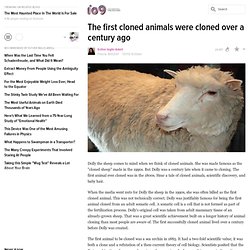
When an organism has identical genes to the original. A twin is a copy(ergo clone) of the other twin. Though in this case telling which is the original is a bit hard if not impossible. but which one is the real one? Because that is really all that matters. which one is the clone, which we all know is evil, and the original, which we all know is good?
This post is written in a font made of DNA. Ten Things You Probably Didn't Know About DNA. XNA is synthetic DNA that's stronger than the real thing. But scientists have been synthesizing XNA molecules for well over a decade.
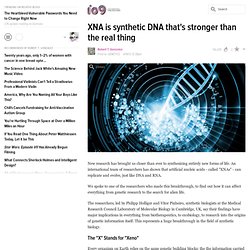
Your link appears not to be a link, but certainly PNAs (peptide nucleic acids - not really nucleic acids, but still ...) and GNAs (glycol nucleic acids) have been documented since the early '90s, so, yes, considerably more than a decade. Could Human and Computer Viruses Merge, Leaving Both Realms Vulnerable? Mark Gasson had caught a bad bug.
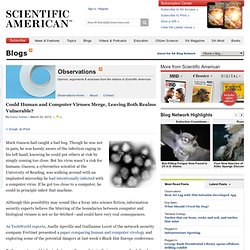
Though he was not in pain, he was keenly aware of the infection raging in his left hand, knowing he could put others at risk by simply coming too close. But his virus wasn’t a risk for humans.
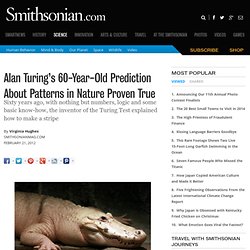
Alan Turing's 60-Year-Old Prediction About Patterns in Nature Proven True. Image by Flickr user quinn.anya.
The Oldest Living Trees in the World. Diversity by Design. Did Sex Emerge from Cannibalism? Sex, Death and Kefir, by Lynn Margulis (1938–2011) Editor's note: This essay, by renowned evolutionary biologist Lynn Margulis, was published in the August 1994 issue of Scientific American with the title, "Sex, Death and Kefir.
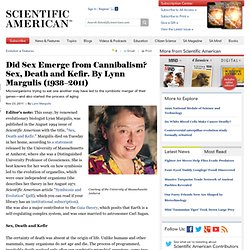
" Margulis died on Tuesday in her home, according to a statement released by the University of Massachusetts at Amherst, where she was a Distinguished University Professor of Geosciences. 2012 August 21 - DNA: The Molecule that Defines You. Molecular Visualizations of DNA - Original High Quality Version. Longevity Shown for First Time to Be Inherited via a Non-DNA Mechanism. In October 2009 Stanford University geneticist Anne Brunet was sitting in her office when graduate student Eric Greer came to her with a slightly heretical question.
Brunet's lab had recently learned that they could lengthen a worm's lifetime by manipulating levels of an enzyme called SET2. "What if extending a worm's lifetime using SET2 can affect the life span of its descendants, even if the descendants have normal amounts of the enzyme? " he asked. The question was unorthodox, Brunet says, "because it touches upon the Lamarckian idea that you can inherit acquired traits, which biologists have believed false for years.
" Lions and Tigers Bear Vocal Cords for Roars: Scientific American Podcast. For many potential entrée animals this [sound of lion roar] is one of the scariest sounds around. Scientists long thought the lion’s distinctive roar was due to thick layers of fat inside the vocal cords. But new research suggests that it's not the fat that makes the roar, it's the shape of the vocal cords themselves. Most animals have triangular vocal cords.
Stunning Images Under the Microscope Capture the Lives of the Tiniest Creatures [Slide Show] Evolution: The Rise of Complexity. Let’s rewind time back about 3.5 billion years. Our beloved planet looks nothing like the lush home we know today – it is a turbulent place, still undergoing the process of formation. Land is a fluid concept, consisting of molten lava flows being created and destroyed by massive volcanoes. The air is thick with toxic gasses like methane and ammonia which spew from the eruptions. Over time, water vapor collects, creating our first weather events, though on this early Earth there is no such thing as a light drizzle. Boiling hot acid rain pours down on the barren land for millions of years, slowly forming bubbling oceans and seas. Infinity Imagined. Infinity Imagined. Infinity Imagined. Infinity Imagined.
Infinity Imagined. Infinity Imagined. Infinity Imagined. Infinity Imagined. Infinity Imagined. Infinity Imagined. Logy Magazine. When a bacterial cell divides into two daughter cells and those two cells divide into four more daughters, then 8, then 16 and so on, the result, biologists have long assumed, is an eternally youthful population of bacteria. Bacteria, in other words, don’t age—at least not in the same way all other organisms do. But a study conducted by evolutionary biologists at the University of California, San Diego questions that longstanding paradigm.
In a paper published in the November 8 issue of the journal Current Biology, they conclude that not only do bacteria age, but that their ability to age allows bacteria to improve the evolutionary fitness of their population by diversifying their reproductive investment between older and more youthful daughters. An advance copy of the study appears in the journal’s early online edition.
Infinity Imagined. Infinity Imagined. Infinity Imagined. Infinity Imagined. Infinity Imagined. Logy Magazine. BOLD Systems. New Magnetic Bacteria! I’ve mentioned magnetic bacteria a couple of times now, so I got quite excited when Lucas Brouwers alerted me to a recent paper in Science (ref below) that explored a whole new group of magnetic bacteria.
As I’ve covered before, these magnetotactic bacteria contain small nanoparticles of magnetic material which allow them to swim along magnetic field lines. It isn’t just one clear species of bacteria that has magnetotactic ability, rather there are several different groups of bacteria of different shapes and sizes. Some of these are large multicellular bacterial groups, while others are single-celled large and rod-shaped. It is these large rod-shaped bacteria that the paper has been exploring, putting together a comprehensive description of them as a group. The magnetotactic bacteria will swim along the field lines. Infinity Imagined. Gold Leaf Painting. Microbes generate electricity while cleaning up nuclear waste. EAST LANSING, Mich. — Researchers at Michigan State University have unraveled the mystery of how microbes generate electricity while cleaning up nuclear waste and other toxic metals.
Details of the process, which can be improved and patented, are published in the current issue of the Proceedings of the National Academy of Sciences. Lennart Nilsson Photography. Pictures of the day: 1 December 2011. Evolution World Tour: Galápagos Islands, Ecuador. Before DNA, before RNA: Life in the hodge-podge world - life - 08 January 2012. Mammals Made By Viruses. DNA Barcoding Goes Mainstream. By Mark Brown, Wired UK This week, more than 450 scientists and industry experts are to converge upon Australia’s University of Adelaide, for the fourth International Barcode of Life Conference. 8 Things You Won't Believe Plants Do When No One's Looking. #4. VI. EVOLUTION GOING ON. Evolution, as we have seen in a previous chapter, is another word for race-history. Alan Turing's Patterns in Nature, and Beyond. Mini Motion: Award-Winning Microscope Videos.
Meet the ancestor of all living things on Earth. There are several theories on the origin of viruses. Can a venus flytrap digest human flesh? Timeline: The evolution of life - life - 14 July 2009. Read full article. Behold, the future's bioluminescent billboards. Biological clock began ticking 2.5 billion years ago - life - 16 May 2012. Drew Berry: Animations of unseeable biology. Meet the molecule responsible for giving Earth all of its oxygen. Blonde hair evolved independently in Pacific islands - life - 03 May 2012. Science can't yet tell us whether they have more fun – but it has uncovered a new genetic change that makes people blonde. Watch this team of scientists make a lion roar. Oh, and did I mention the lion is dead?
A plausible end-of-the-world scenario you've probably never thought of. Why Albino Animals Aren't Always White (And Non-Albino Animals Are) Why we evolved two nostrils (hint: it's all about domination) For the first time in 75 years, an entire genus of mammal is on the brink of extinction. Whoa, a Petri Dish That Has a Pulse. A Microbe Metropolis. Nature Under Glass: Gallery of Victorian Microscope Slides.
Life began with a planetary mega-organism - life - 25 November 2011. How does reproductive cloning work? Is it possible to reanimate the dead? Can dead people be brought back to life? Anti-Gravity Machine for Levitating Fruit Flies. Climate Change & Animal Body Size. Life on Earth began in . . . Greenland!? Ancient Plants Resurrected from Siberian Permafrost. Scientists confirm Alan Turing's 60-year-old theory for why tigers have stripes. Zoology & Animal behaviour.