
Teamwork, Librarians and Google. Project Based Students - Google Slides. 20 Tips To Use Google Search Efficiently. Millions of people use Google search every day for a variety of reasons.

Students use it for school, business people use it for research, and millions more use it for entertainment. Did you know that you may not be using Google search to its full potential? Here are 20 tips and tricks to maximize your search efficiency. 1. Use the tabs The first tip is to use the tabs in Google search. 2. When searching for something specific, try using quotes to minimize the guesswork for Google search. 3. Sometimes you may find yourself searching for a word with an ambiguous meaning. Mustang -cars This tells the search engine to search for mustangs but to remove any results that have the word “car” in it. 4.
There may be an instance where you need to Google search for articles or content on a certain website. Sidney Crosby site:nhl.com This will search for all content about famous hockey player Sidney Crosby, but only on NHL.com. 5. This Google search tip is a little obscure. Link:nytimes.com. Stavenski, Teresa (Social Studies) / Psychology/Sociology Unit Essential Questions. Psychology/Sociology Unit One Essential Questions Unit One--Introduction to Psychology and Psychological Methods Unit Essential Questions 1.
What are the foundations of psychology, reasons for studying psychology, and contemporary perspectives of psychology? 2. How do Psychologists carry out research? Foundations of Psychology. Log In. What is Genius Hour? #GeniusHour. I don’t want children to stop asking questions.
I want to be the teacher that welcomes provocative questions. That’s why I so firmly believe in getting out of the way of children and letting them question and learn. Genius Hour has been a way to affirm this in my classroom. I’ve been wondering how to do more Genius Hour in my kindergarten class. It was great with junior highers, but kindergarten has been a steep learning curve. First, just like with almost any activity in kindergarten, we don’t want to start Genius Hour until we have established rapport and routines with our young learners. In the meantime, during all of your days, starting on Day 1, we want to be sure to nurture young learners’ curiosity. My students and I adopted this “Genius Hour anthem” from Debbie Clement, “You’re Wonderful.” Teacher: I think you’re wonderful. Before they start, gather resources–a stack of nonfiction and fiction books, art and building supplies, videos, appropriate web pages, etc. Genius Hour - Where Passions Come Alive - Genius Hour.
What is Genius Hour? Geniushour - home. Geniushour - home. Getting Started with Genius Hour - A Free Webinar - Genius Hour. Student Projects - High Tech High. The Difference Between Doing Projects Versus Learning Through Projects. The Difference Between Doing Projects Versus Learning Through Projects by TeachThought Staff We’ve clarified the difference between projects and project-based learning before.
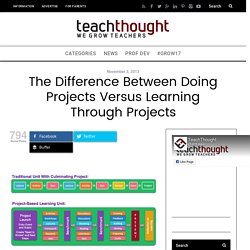
Projects are about the product, while project-based learning is about the process. Projects are generally teacher-directed, universal, and tangent to the learning, while project-based learning is student-centered, personal, and the learning pathway itself. Put simply, it is an approach to learning rather than something to complete. Paul Curtis recently shared this excellent visual on twitter that takes a different approach to clarifying the difference, looking at it from the perspective of curriculum planning and instructional design. Note that this is only one approach. Thoughts, comments, or related resources in the comments below. Making Projects Click. The Difference Between Projects And Project-Based Learning.
The Difference Between Projects And Project-Based Learning by TeachThought Staff Projects in the classroom are as old as the classroom itself.
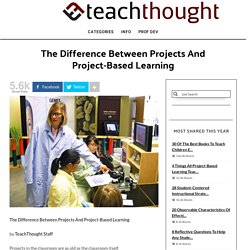
“Projects” can represent a range of tasks that can be done at home or in the classroom, by parents or groups of students, quickly or over time. While project-based learning (PBL) also features projects, in PBL the focus is more on the process of learning and learner-peer-content interaction that the end-product itself. The learning process is also personalized in a progressive PBL environment by students asking important questions, and making changes to products and ideas based on individual and collective response to those questions.
Project-Based Learning Research Review. Editor's Note: This article was originally written by Vanessa Vega, with subsequent updates made by the Edutopia staff.
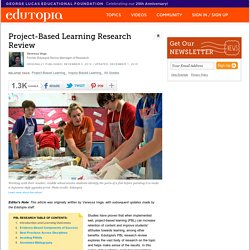
Studies have proven that when implemented well, project-based learning (PBL) can increase retention of content and improve students' attitudes towards learning, among other benefits. Edutopia's PBL research review explores the vast body of research on the topic and helps make sense of the results. In this series of five articles, learn how researchers define project-based learning, review some of the possible learning outcomes, get our recommendations of evidence-based components for successful PBL, learn about best practices across disciplines, find tips for avoiding pitfalls when implementing PBL programs, and dig in to a comprehensive annotated bibliography with links to all the studies and reports cited in these pages.
What is Project-Based Learning?