
Trail: Learning the Java Language (The Java™ Tutorials) A printf format reference page (cheat sheet) By Alvin Alexander.
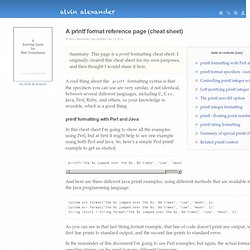
Last updated: Dec 18, 2013 Summary: This page is a printf formatting cheat sheet. I originally created this cheat sheet for my own purposes, and then thought I would share it here. A cool thing about the printf formatting syntax is that the specifiers you can use are very similar, if not identical, between several different languages, including C, C++, Java, Perl, Ruby, and others, so your knowledge is reusable, which is a good thing. printf formatting with Perl and Java In this cheat sheet I'm going to show all the examples using Perl, but at first it might help to see one example using both Perl and Java.
Printf("the %s jumped over the %s, %d times", "cow", "moon", 2); And here are three different Java printf examples, using different methods that are available to you in the Java programming language: In the remainder of this document I'm going to use Perl examples, but again, the actual format specifier strings can be used in many different languages. Java Code Examples, Java Tips and Java Related Articles. Introduction to Computer Science using Java. This is a course in Java programming for beginners.
It covers the fundamentals of programming, roughly the same material that is covered in a beginning programming course in a university or in a high school AP Computer Science course. For maximum benefit, go though these notes interactively, thinking about and answering the question at the bottom of each page. There are about 20 pages per chapter. If you spend about 3 minutes per page each chapter will take about 60 minutes, or longer if you copy and run some of the programs. GitHub - Social Coding. Introduction to Computer Science using Java. This is a course in Java programming for beginners.
It covers the fundamentals of programming, roughly the same material that is covered in a beginning programming course in a university or in a high school AP Computer Science course. For maximum benefit, go though these .. /Java5/Notes interactively, thinking about and answering the question at the bottom of each page. There are about 20 pages per chapter. If you spend about 3 minutes per page each chapter will take about 60 minutes, or longer if you copy and run some of the programs. These Notes assume that you have a recent version of Java, available from Oracle, Inc. at and a text editor such as Notepad. For more about these .. A German translation of these .. A French translation of selected chapters is available at www.lifl.fr/~secq/IUT/JAVA/intro.html Here is very nice site (unrelated to this site) that allows you to practice Java programming on line: Best viewed at 1024 x 768 or higher.
Welcome to Freewarejava.com, the place to find free Java applets, tutorials, references, Java books, and more! Convert from type X to type Y. Java Programming. Java Interview Questions, Java Forums, Java Source codes, Free online Java Certification - Javagalaxy.com. Java,Free source code for the taking. Over five million lines of programs. Java on the Brain. This is a list of the more significant applets I've written since I started hacking Java in February 1996.
I felt the need to group them into three basic categories depending on how they came about. There are those written just for fun, there are custom-made ones and, finally, those that have not yet been finished. The further down in each category, the newer the applet. Last modified September 28, 2012. Added a demo version of my iPhone/iPad game Multiplayer Speedoku. A lot of people have been asking me for permission to copy my applets to their own pages. You can copy whatever product you want from here (with the exception of the games marked "SOLD", which I no longer own) as long as you make sure to include my name and a link to my site. Please note that I don't have enough spare time to teach people the basics of downloading and installing Java applets.
Java Tutorial. Code Format Test. Java Vector,Using Vectors in Java,Vector Object in Java,Online Java Vector Example. Welcome to the NetBeans Platform Certified Training. The NetBeans Platform is a mature open sourced Swing framework for building general rich client applications.
The platform is a "generic application", that is, a runtime which can be used to develop desktop applications. NetBeans IDE is one example of this type of application, but there are many others. One of the key distinctions of software built upon the NetBeans Platform is modularity: reuse in the large. Such software is designed as logical sets of macro-components which integrate through well-defined API contracts. Writing modular applications brings some enhancements to programming in standard Java, particularly in the ability to have Java classes which are only public to other classes within the archive they reside in. This course covers developing on the NetBeans Platform from the ground-up. Finally, after the two days outlined above, you will develop a functioning project consisting of one or more modules. Contents Goals Content. Game applets.