
Agence Française pour le Développement et la Promotion de l'Agriculture Biologique - Agence BIO. Fnab.org. Conversionbio.org. ITAB. Synabio - Syndicat national des entreprises bio au service de la filière agriculture biologique. Le site officiel de gestion des variétés disponibles en semences issues de l'agriculture biologique.
Ministère de l'agriculture, de l'alimentation, de la pêche, de la ruralité et de l'aménagement du territoire - Agreste - La statistique, l'évaluation et la prospective agricole. Livres Agriculture (nature ) Association pour la Diffusion de Documentaires Scientifiques. Notre prochain film : LES AGRONAUTES Nous sommes agriculteurs dans une petite commune aux portes de Lyon.
Les lotissements et villas de luxe grignotent peu à peu l'espace agricole. Les prix des terres flambent et deviennent inaccessibles pour des paysans, alors même que les citadins réclament une agriculture de proximité. À travers notre aventure familiale, le film pointe la complexité et l'incohérence des règles et usages qui régissent le foncier agricole en zone péri-urbaine. Réalisation : Honorine Perino Musique originale : Denis Mignard La "ferme" s'appelle LE CROISSANT FERTILE. Addocs, des films qui sèment des idées sur la diversité agricole Quelles sont les alternatives expérimentées aujourd'hui par des cultivateurs respectueux de la nature et de la vie humaine ?
Elle s'intéresse aux initiatives locales qui visent à changer la société et à recréer les liens entre l'homme et la terre. Les jeunes agriculteurs. Jeunes Agriculteurs et l’ensemble des partenaires de Demain Je Serai Paysan relancent leur jeu concours vidéo ! Cette année, l’objectif est de mettre en musique les métiers de l’agriculture ! Les clips devront respecter la thématique proposée et ne pas dépasser 2’30. Ces vidéos seront ensuite soumises à un jury régional qui transmettra la vidéo lauréate à un jury national. Les 3 lauréats nationaux seront ensuite invités à venir récupérer leurs prix (1er : tablette – 2e : lot de clés USB – 3e : chèque) lors du Salon International de l’Agriculture 2014, porte de Versailles.
Le calendrier du jeu est le suivant : o 1er trimestre scolaire 2013/2014: Mobilisation des lycées et réalisation de 10 vidéos maximum par département. o Avant le 20 décembre 2013 : Restitution des productions aux délégations régionales o Du 6 au 17 janvier 2014 : Réunion du jury régional, définition du palmarès régional. o Du 27 janvier au 7 février 2014 : Réunion du jury national, définition du palmarès. Installation. Accueil. Ten Years of Genetically Modified Crops Fail to Deliver Benefits to Africa. Ten Years of Genetically Modified Crops Fail to Deliver Benefits to Africa PRESS RELEASE African Center for Biosafety and Friends of the Earth Nigeria January 10, 2006 Johannesburg (South Africa), Lagos (Nigeria), January 10, 2006 – Ten years after the first significant planting of Genetically Modified (GM) crops there are no apparent benefits for consumers, farmers or the environment, and despite renewed promises by biotech corporations, there has been no impact on hunger and poverty, according to a report by the African Center for Biosafety and Friends of the Earth International. [1]
Seeds of Suicide. Before BP destroyed habitats and livelihoods in the Gulf, Monsanto landed in India.
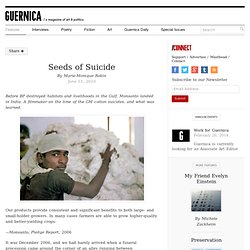
A filmmaker on the time of the GM cotton suicides, and what was learned. Our products provide consistent and significant benefits to both large- and small-holder growers. In many cases farmers are able to grow higher-quality and better-yielding crops. —Monsanto, Pledge Report, 2006 It was December 2006, and we had barely arrived when a funeral procession came around the corner of an alley running between whitewashed walls, shattering the torpor of the little Indian village under the burning sun. Three Suicides a Day “Can we film?” Kishor Tiwari is the leader of the Vidarbha Jan Andolan Samiti (VJAS), a peasant movement whose members have been harassed by the police because they have insistently denounced the “genocide” caused by genetically modified Bt cotton in this agricultural region, formerly celebrated for the quality of its “white gold.”
COMBAT-MONSANTO - Pour que le monde de Monsanto ne devienne jamais le nôtre. Garden as if Your Life Depended On It, Because It Will. {*style:<i> It is time to take your nourishment into your own hands. Savoir Faire et Découverte, Stages et activités à pratiquer chez des artisans, des agriculteurs, des artistes - découverte, plaisir et formation. La phacélie. EAP Publications | Virtual Library | Magazine Rack | Search | What's new Ecological Solutions Roundtable Table des matières Par Jean Duval, agr., M.Sc. mars 1992 La phacélie à feuilles de tanaisie (Phacelia tanacetifolia) de la famille des hydrophylacées est une plante fascinante à bien des égards.
Originaire d'Europe de l'est, cette plante est utilisée comme engrais vert, comme culture intercalaire, comme culture fourragère, comme culture mellifère et telle sa cousine P. campanularia, comme plante ornementale. Peu connue chez nous, cette plante ne compte pas non plus de parents rapprochés dans nos régions, bien qu'il y ait des représentants du même genre dans les régions arides et semi-arides de l'Amérique du Nord. Le principal obstacle à la culture de la phacélie au Québec est le coût d'ensemencement qui se chiffre en général à plus de 100 $/ha en semis pur. Germination La germination de la phacélie est des plus capricieuses et constitue un second obstacle à sa culture(1) FARMAGEDDON.