
33 Ways To Stay Creative. The talent myth: How to maximise your creative potential - Features - Books. My research also took me to a different sort of hotbed: the laboratories and research centres around the country investigating the new science of talent development.
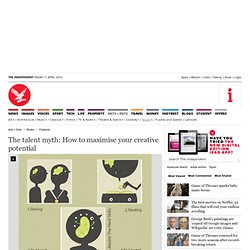
For centuries, people have instinctively assumed that talent is largely innate, a gift given out at birth. But now, thanks to the work of a wide-ranging team of scientists, including Dr K Anders Ericsson, Dr Douglas Fields, and Dr Robert Bjork, the old beliefs about talent are being overturned. In their place, a new view is being established, one in which talent is determined far less by our genes and far more by our actions: specifically, the combination of intensive practice and motivation that produces brain growth. It started when I visited my first talent hotbed, the Spartak Tennis Club in Moscow. On my first morning there, I walked in to see a line of players swinging their racquets in slow motion, without the ball, as a teacher made small, precise adjustments to their form. 201 Ways to Arouse Your Creativity.
Arouse your creativity Electric flesh-arrows … traversing the body.

A rainbow of color strikes the eyelids. A foam of music falls over the ears. It is the gong of the orgasm. ~ Anais Nin Creativity is like sex. List of Journal Ideas. Do not stand at my grave and weep. Do Not Stand at My Grave and Weep is a poem written in 1932 by Mary Elizabeth Frye.

Although the origin of the poem was disputed until later in her life, Mary Frye's authorship was confirmed in 1998 after research by Abigail Van Buren, a newspaper columnist.[1] Full text[edit] Do not stand at my grave and weep, I am not there; I do not sleep. I am a thousand winds that blow, I am the diamond glints on the snow, I am the sunlight on ripened grain, I am the gentle autumn rain. When you awaken in the morning’s hush I am the swift uplifting rush Of quiet birds in circled flight. I am the soft stars that shine at night. Do not stand at my grave and cry, I am not there; I did not die. Origins[edit] - StumbleUpon. Guidelines on Writing a Philosophy Paper. Use simple prose Don't shoot for literary elegance.
Use simple, straightforward prose. Keep your sentences and paragraphs short. Use familiar words. We'll make fun of you if you use big words where simple words will do. If your paper sounds as if it were written a third-grade audience, then you've probably achieved the right sort of clarity. It's OK to show a draft of your paper to your friends and get their comments and advice.
Read your paper out loud. "Does this really make sense? " Presenting and assessing the views of others If you plan to discuss the views of Philosopher X, begin by isolating his arguments or central assumptions. Keep in mind that philosophy demands a high level of precision. At least half of the work in philosophy is making sure that you've got your opponent's position right.
77 Ways to Learn Faster, Deeper, and Better. If someone granted you one wish, what do you imagine you would want out of life that you haven’t gotten yet?
For many people, it would be self-improvement and knowledge. Newcounter knowledge is the backbone of society’s progress. Great thinkers such as Leonardo da Vinci, Thomas Edison, Benjamin Franklin, Albert Einstein, and others’ quests for knowledge have led society to many of the marvels we enjoy today. Your quest for knowledge doesn’t have to be as Earth-changing as Einstein’s, but it can be an important part of your life, leading to a new job, better pay, a new hobby, or simply knowledge for knowledge’s sake — whatever is important to you as an end goal. Life-changing knowledge does typically require advanced learning techniques. Health Shake a leg. Balance Sleep on it. Perspective and Focus. Do Something Productive with Your Life.
105 Tips from Professional Writers. Ten Steps for Boosting Your Creativity. 10 More Common Faults in Human Thought. Humans This list is a follow up to Top 10 Common Faults in Human Thought.
Thanks for everyone’s comments and feedback; you have inspired this second list! It is amazing that with all these biases, people are able to actually have a rational thought every now and then. There is no end to the mistakes we make when we process information, so here are 10 more common errors to be aware of.
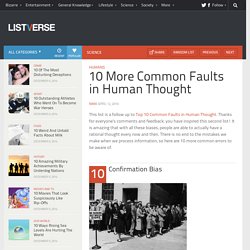
The confirmation bias is the tendency to look for or interpret information in a way that confirms beliefs. The Availability heuristic is gauging what is more likely based on vivid memories. Illusion of Control is the tendency for individuals to believe they can control or at least influence outcomes that they clearly have no influence on. Interesting Fact: when playing craps in a casino, people will throw the dice hard when they need a high number and soft when they need a low number.
The Planning fallacy is the tendency to underestimate the time needed to complete tasks. Bonus.