
Martin Heidegger. Martin Heidegger (German: [ˈmaɐ̯tiːn ˈhaɪdɛɡɐ]; 26 September 1889 – 26 May 1976) was a German philosopher, widely seen as a seminal thinker in the Continental tradition, particularly within the fields of existential phenomenology and philosophical hermeneutics.

From his beginnings as a Catholic academic, he developed a groundbreaking and widely influential philosophy. His relationship with Nazism has been a controversial and widely debated subject. For Heidegger, the things in lived experience always have more to them than what we can see; accordingly, the true nature of being is “withdrawal”. The interplay between the obscured reality of things and their appearance in what he calls the “clearing” is Heidegger's main theme. The presence of things for us is not their being, but merely their being interpreted as equipment according to a particular system of meaning and purpose. It has been suggested[by whom?] Biography[edit] Early years[edit] William James - Wikipedia. William James (January 11, 1842 – August 26, 1910) was an American philosopher and psychologist, and the first educator to offer a psychology course in the United States.[5] James is considered to be a leading thinker of the late nineteenth century, one of the most influential philosophers of the United States, and the "Father of American psychology".[6][7][8] Along with Charles Sanders Peirce, James established the philosophical school known as pragmatism, and is also cited as one of the founders of functional psychology.

A Review of General Psychology analysis, published in 2002, ranked James as the 14th most eminent psychologist of the 20th century.[9] A survey published in American Psychologist in 1991 ranked James's reputation in second place,[10] after Wilhelm Wundt, who is widely regarded as the founder of experimental psychology.[11][12] James also developed the philosophical perspective known as radical empiricism. Early life[edit] Jean-Jacques Rousseau. Jean-Jacques Rousseau (/ruːˈsoʊ/;[1] French: [ʒɑ̃ʒak ʁuso]; 28 June 1712 – 2 July 1778) was a Genevan philosopher, writer, and composer of the 18th century.
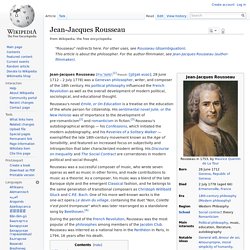
His political philosophy influenced the French Revolution as well as the overall development of modern political, sociological, and educational thought. Biography[edit] Youth[edit] Rousseau was born in Geneva, which was at the time a city-state and a Protestant associate of the Swiss Confederacy. Since 1536, Geneva had been a Huguenot republic and the seat of Calvinism. Rousseau was proud that his family, of the moyen order (or middle-class), had voting rights in the city. Geneva, in theory, was governed democratically by its male voting "citizens". There was much political debate within Geneva, extending down to the tradespeople. The house where Rousseau was born at number 40, Grand-Rue. Auguste Comte. Isidore Auguste Marie François Xavier Comte (19 January 1798 – 5 September 1857), better known as Auguste Comte (French: [oɡyst kɔ̃t]), was a French philosopher.
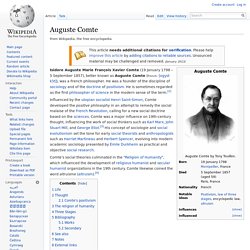
He was a founder of the discipline of sociology and of the doctrine of positivism. He is sometimes regarded as the first philosopher of science in the modern sense of the term.[2] Influenced by the utopian socialist Henri Saint-Simon, Comte developed the positive philosophy in an attempt to remedy the social malaise of the French Revolution, calling for a new social doctrine based on the sciences. Comte was a major influence on 19th-century thought, influencing the work of social thinkers such as Karl Marx, John Stuart Mill, and George Eliot.[3] His concept of sociologie and social evolutionism set the tone for early social theorists and anthropologists such as Harriet Martineau and Herbert Spencer, evolving into modern academic sociology presented by Émile Durkheim as practical and objective social research. Peter Singer. On two occasions Singer served as chair of the philosophy department at Monash University, where he founded its Centre for Human Bioethics.
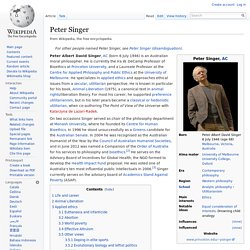
In 1996 he stood unsuccessfully as a Greens candidate for the Australian Senate. In 2004 he was recognised as the Australian Humanist of the Year by the Council of Australian Humanist Societies, and in June 2012 was named a Companion of the Order of Australia for his services to philosophy and bioethics.[2] He serves on the Advisory Board of Incentives for Global Health, the NGO formed to develop the Health Impact Fund proposal. He was voted one of Australia's ten most influential public intellectuals in 2006.[3] Singer currently serves on the advisory board of Academics Stand Against Poverty (ASAP). Life and career[edit] Singer's parents were Viennese Jews who emigrated to Australia from Vienna in 1938, after Austria's annexation by Nazi Germany.[4] They settled in Melbourne, where Singer was born.
Animal Liberation[edit] Applied ethics[edit]