
Deconstructing Role Play – Provide the Resources, Step Back and Watch Children’s Learning Flourish. Hospital, vet’s surgery, post office, travel agent – themed role play areas are often seen as a must for an early years setting. They are often meticulously prepared to be aesthetically pleasing, covered in laminated words and pictures with the aim of enticing children in.
But this is where I encountered a problem: in these areas, children are expected to come together to play out adult scenarios that are consistent with these themes. Yet how many children have visited a travel agent to book a holiday recently, or operated on a pet dog in a vet’s surgery? For the majority of children, themed areas such as those described above are simply too alien for high-quality cooperative play to develop – which is why I found the children in my class would revert back to playing ‘mums and dads’ by mid-morning, rather than booking a holiday to Costa Rica, as the poster on the wall in the travel agent suggested! Choice page.
The cognitive benefits of play: Effects on the learning brain. © 2008 - 2014, Gwen Dewar, Ph.D., all rights reserved Science supports many of our intuitions about the benefits of play. Playful behavior appears to have positive effects on the brain and on a child’s ability to learn. The cognitive benefits of play: Effects on the learning brain. Low-cost play ideas: video. Primary school shake-up to focus on ‘play-led’ learning. Children at primary schools would not study traditional subjects until as late as 10 years of age, under proposals being considered by policymakers. Instead, there would be a much greater emphasis on creative play during the early years of primary school, and broader areas of learning in later years.
The reforms are based loosely on some of the features of top-performing education systems in countries such as Finland, as well as new research on how children learn. Why Movement is Essential in Early Childhood. With so few years under their belts, my 3- and 6-year-old daughters are still learning to inhabit their bodies. They are learning how to maneuver themselves physically, how to orient themselves in space. As Vanessa Durand, a pediatrician at St. Play to Learn: Discussion. Play to Learn. Play to Learn. Why play-based learning? - Early Childhood Australia. Taking Playtime Seriously.
So part of encouraging play is pulling back on how much programmed goal-directed learning we expect from very young children, to leave them time for the fun of exploration, curiosity and, well, fun. But another important part may be creating environments that foster children’s play and parents’ participation and attention. Dr. Importance of play for babies & children. Australian Government Department of Education and Training (2009). Belonging, being and becoming: The early years learning framework for Australia.
Canberra: Commonwealth of Australia. How young children learn English through play. As we release Learning Time with Timmy – our first app for early-years learners of English – Danitza Villarroel, a teacher on our Learning Time with Shaun and Timmy course in Chile, explains the importance of learning through play, and offers a few tips for teachers new to this age group. Teaching English to pre-school children can be daunting for teachers new to this age group.
Young children have shorter attention spans than older children and adults, and they're still learning their mother tongue. But teaching these learners can be enormously rewarding once you've taken a few basic principles on board. The importance of active learning Active learning means fully involving children in the learning process. ZERO TO THREE. Dr david whitebread the importance of play. Theimportanceofplay. Teachers TV- How Do They Do It In Sweden? 6 Types of Play: How Children's Play Becomes More Social. Play is a serious business.
The pioneering developmental psychologist Lev Vygotsky thought that, in the preschool years, play is the leading source of development. Through play children learn and practice many basic social skills. They develop a sense of self, learn to interact with other children, how to make friends, how to lie and how to role-play. Getting the right balance between adult-led and child-initiated learning. As an early years practitioner you will know the importance of creating the right balance between adult-led and child-initiated learning. Help all children learn and develop with this guide. Adult-led activities are based on our own professional understanding of what we should teach young children and what experiences they should have.
Through adult-led activities we can introduce children to new ideas, provide opportunities for them to develop their skills and ensure that they experience all areas of learning in the Early Years Foundation Stage (EYFS). Different types play. How can young children best learn languages? The British Council's Tracey Chapelton explains how parents of young children can lay the foundations for success. Children's brains are highly active Your child is unique, but what all children have in common is natural curiosity and an innate ability to learn. Kuhl states that babies and young children are geniuses at acquiring a second language. How young children learn English as another language.
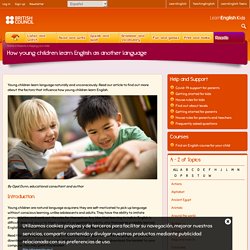
By Opal Dunn, educational consultant and author Introduction Young children are natural language acquirers; they are self-motivated to pick up language without conscious learning, unlike adolescents and adults.
Alison Gopnik: What do babies think? Patricia Kuhl: The linguistic genius of babies. Public Media for Northern CA. There was a direct correlation between the children who’d heard a lot of parent talk and how prepared they were to learn once they arrived at school.
Hart and Risley wrote, “With few exceptions, the more parents talked to their children, the faster the children’s vocabularies [grew] and the higher the children’s IQ test scores at age 3 and later.” For Suskind, a lightbulb went on. “The truth is, much of what you see in children born into poverty is analogous to children born deaf,” Suskind said. “It’s a really important point.
The most fundamental science shows that it’s really language, and all that comes with it, the brain-building aspect of things, that makes a difference.” Learning Time with Timmy. Surprisingly Simple Techniques for Challenging Behaviour - Kathy Brodie Early Years Training.
I often get asked about children’s behaviour. It is a massive topic, with many facets. However, I would always start from the perspective that all behaviour, good or unacceptable, is a form of communication. It is how we, as practitioners and adults, respond to that communication that makes all the difference. The Webster Stratton method is a well known and widely used behaviour management strategy. It is based on a hierarchy pyramid, with Play at the foundation, moving up through Praise, Limit setting, Ignoring and using Time out as a final resort. Classroom management for young learners. Definition of Classroom Management Classroom management refers to the ways in which student behaviour, movement and interaction during a lesson are organized and controlled by the teacher” Richards (1990, 10) .
Definition of Discipline To maintain order and to keep the group on task and moving ahead, not to spot and punish those students who are misbehaving.“( Greenwood and Parkay, 1989) The best teachers anticipate when misbehaviours are likely to occur and intervene early to prevent them. The most effective interventions are subtle, brief and almost private. Moodle. Multilingual Preschoolers. It’s amazing how young children learn to converse with others. They have to not only internalize grammar and vocabulary, but also develop an understanding of culture: how to take turns in a conversation, who to talk to, and how to narrate a story.
For dual language learners (DLLs) — children under the age of 5 with a home language other than English — that process can be complex. These young children must constantly navigate between two languages and cultures, while learning the rules of both. Moodle. Moodle. How can I help my child to start talking? (Video) Let's Talk. Listen to Your Mother. Deb Roy: The birth of a word.
FAQ: Raising Bilingual Children. You speak with an accent. I don’t. Early childhood development – it’s not rocket science, it’s neuroscience! - Kathy Brodie Early Years Training. The Woman Who Changed Her Brain: Barbara Arrowsmith-Young at TEDxToronto. How do you speak 'Motherese'?