
How to brainstorm effectively. Mr.
Malfoy is new to the business of having ideas, and so when he has one, he becomes proud of himself for having it. He has not yet had enough ideas to unflinchingly discard those that are beautiful in some aspects and impractical in others; he has not yet acquired confidence in his own ability to think of better ideas as he requires them.
What we are seeing here is not Mr. Malfoy's best idea, I fear, but rather his only idea. - Harry Potter and the Methods of Rationality I want to emphasize yet again that the tools [described in Serious Creativity] are deliberate and can be used systematically. . - Edward De Bono, Serious Creativity I will summarize some of the techniques for how to generate ideas presented in Serious Creativity. How to Make a Complete Map of Every Thought you Think. The Beginning of Infinity. Building better minds together. An information integration theory of consciousness. Consciousness, information integration, and the brain Based on a phenomenological analysis, we have argued that consciousness corresponds to the capacity to integrate information.
We have then considered how such capacity can be measured, and we have developed a theoretical framework for consciousness as information integration. We will now consider several neuroanatomical or neurophysiological factors that are known to influence consciousness. After briefly discussing the empirical evidence, we will use simplified computer models to illustrate how these neuroanatomical and neurophysiological factors influence information integration. A categorical foundation for Bayesian probability theory. A Tutorial on Bayesian Belief Netoworks. Bayes' Theorem. An Intuitive Explanation of Bayes' Theorem Bayes' Theorem for the curious and bewildered; an excruciatingly gentle introduction.

Your friends and colleagues are talking about something called "Bayes' Theorem" or "Bayes' Rule", or something called Bayesian reasoning. They sound really enthusiastic about it, too, so you google and find a webpage about Bayes' Theorem and... It's this equation. That's all. Kolmogorov complexity. In algorithmic information theory (a subfield of computer science and mathematics), the Kolmogorov complexity (also known as descriptive complexity, Kolmogorov–Chaitin complexity, algorithmic entropy, or program-size complexity) of an object, such as a piece of text, is a measure of the computability resources needed to specify the object.
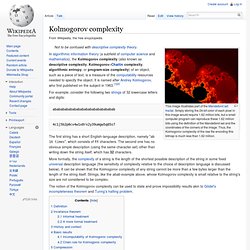
It is named after Andrey Kolmogorov, who first published on the subject in 1963.[1][2] abababababababababababababababab 4c1j5b2p0cv4w1x8rx2y39umgw5q85s7 The first string has a short English-language description, namely "ab 16 times", which consists of 11 characters. The second one has no obvious simple description (using the same character set) other than writing down the string itself, which has 32 characters. Inductive inference. Inductive reasoning (as opposed to deductive reasoning or abductive reasoning) is reasoning in which the premises seek to supply strong evidence for (not absolute proof of) the truth of the conclusion.
While the conclusion of a deductive argument is certain, the truth of the conclusion of an inductive argument is probable, based upon the evidence given.[1] The philosophical definition of inductive reasoning is more nuanced than simple progression from particular/individual instances to broader generalizations. Rather, the premises of an inductive logical argument indicate some degree of support (inductive probability) for the conclusion but do not entail it; that is, they suggest truth but do not ensure it. In this manner, there is the possibility of moving from general statements to individual instances (for example, statistical syllogisms, discussed below). Description[edit] LessWrong. LessWrong Sequences. A sequence is a series of multiple posts on Less Wrong on the same topic, to coherently and fully explore a particular thesis.
Reading the sequences is the most systematic way to approach the Less Wrong archives. If you'd like an abridged index of the sequences, try XiXiDu's guide, or Academian's guide targeted at people who already have a science background. Benito's Guide aims to systematically fill the reader in on the most important ideas discussed on LessWrong (not just in the sequences). It also begins with a series of videos, which are a friendly introduction, and useful if you enjoy talks and interviews. If you prefer books over blog posts, Thinking and Deciding by Jonathan Baron and Good and Real by Gary Drescher have been mentioned as books that overlap significantly with the sequences. The Disagreement Hierarchy. References & Resources for LessWrong. A list of references and resources for LW Updated: 2011-05-24 F = Free E = Easy (adequate for a low educational background)M = Memetic Hazard (controversial ideas or works of fiction) Summary.
LW How-to Guides and Tips. The Best Textbooks on Every Subject. For years, my self-education was stupid and wasteful.
I learned by consuming blog posts, Wikipedia articles, classic texts, podcast episodes, popular books, video lectures, peer-reviewed papers, Teaching Company courses, and Cliff's Notes. How inefficient! I've since discovered that textbooks are usually the quickest and best way to learn new material. How to explain things! (fiddlemath) How to explain things! (SilasBarta) Harry Potter and the Methods of Rationality. List of cognitive biases. Systematic patterns of deviation from norm or rationality in judgment Cognitive biases are systematic patterns of deviation from norm and/or rationality in judgment.
They are often studied in psychology, sociology and behavioral economics.[1] Although the reality of most of these biases is confirmed by reproducible research,[2][3] there are often controversies about how to classify these biases or how to explain them.[4] Several theoretical causes are known for some cognitive biases, which provides a classification of biases by their common generative mechanism (such as noisy information-processing[5]). Gerd Gigerenzer has criticized the framing of cognitive biases as errors in judgment, and favors interpreting them as arising from rational deviations from logical thought.[6] Explanations include information-processing rules (i.e., mental shortcuts), called heuristics, that the brain uses to produce decisions or judgments.
Belief, decision-making and behavioral[edit] Social[edit] [edit] How Near-Miss Events Amplify Risky Decision Making. The scourge of perverse-mindedness. Gwern. Multiple comparisons. In statistics, the multiple comparisons, multiplicity or multiple testing problem occurs when one considers a set of statistical inferences simultaneously[1] or infers a subset of parameters selected based on the observed values.[2] Errors in inference, including confidence intervals that fail to include their corresponding population parameters or hypothesis tests that incorrectly reject the null hypothesis are more likely to occur when one considers the set as a whole.
Several statistical techniques have been developed to prevent this from happening, allowing significance levels for single and multiple comparisons to be directly compared. These techniques generally require a higher significance threshold for individual comparisons, so as to compensate for the number of inferences being made. History[edit] The interest in the problem of multiple comparisons began in the 1950s with the work of Tukey and Scheffé. The problem[edit]