
FUTUREMAG sur Twitter : "#Jugaad, faites le tour du monde des #innovations #frugales > cc @NaviRadjou #FUTUREMAG. Jugaad : tour du monde des innovations frugales. Pour proposer un produit collant aux besoins du consommateur, il faut être à l’écoute de celui-ci.
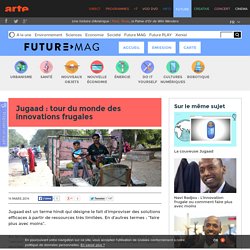
Pour vendre du ciment aux habitants du bidonville de Dharavi, le bétonnier Lafarge a donc créé un produit sur mesure. Il s’agit d’un béton prêt à l’emploi, à prise tardive. Impossible en effet de faire entrer une bétonnière dans les ruelles. étroites et bondées de ce quartier de Bombay. Fabriqué en périphérie du bidonville, ce ciment peut ensuite être transporté à l’intérieur à moto. Mitticool, le réfrigérateur en argile Mansukh Prajapati est potier. Il s’agit d’un cube d’argile aux parois creuses dans lesquelles on verse de l’eau. Manskh Pradjapati explique son projet en détail lors d’un conférence du TED TalentSearch.
Tata nano, la voiture la moins chère du monde Dans les métropoles indiennes, il n’est pas rare de croiser une famille de quatre entassée sur une seule mobylette. Gizmag sur Twitter : "Ziosk e-menus: Improving the restaurant experience for owners, diners… AND waiters - Reality check: How close are we to teleportation and Mars colonies? Americans tend to be optimists when it comes to new technologies.
According to a new Pew Research Center survey in partnership with Smithsonian Magazine, 59% of Americans think scientific and technological innovations over the next half-century will, overall, improve people’s lives. We recently asked Americans about their views on a variety of scientific developments, including some innovations that are already moving out of the lab and into the real world, such as Japan’s robotic attendants for the elderly and self-driving cars. We also asked Americans how likely they thought five things were to happen by 2064. A Media Innovation Hackathon from Al Jazeera Innovation & Research.
New Innovations, New Inventions, Future Technology. 5 future-proof questions to ask people in the know. Leaders should always be asking themselves What’s new?
, What’s next? And What’s better? ; that’s where the future is. And we can take deliberate steps to answers those questions… Why Disruptive Innovation Can Help Market Leaders. Talk to any CEO about what haunts them the most and disruptive innovation will be at the top of the list.
It is a logical fear: A company whose existence depends on established technologies could face extinction or loss of market leadership if a revolutionary innovation comes along. Just ask smartphone maker BlackBerry after Apple launched the iPhone. Surprise! Four Strategies for Coping with Disruptions - Rosabeth Moss Kanter. By Rosabeth Moss Kanter | 8:22 AM April 19, 2010 Surprises are the new normal, and they are not fun.

I was about to write a joyous paean to Earth Day and the glories of celebrating the great outdoors, when volcanic ash closed European airports. My flights to a global health summit were cancelled, making me cranky about nature instead. Intellectual Ventures Laboratory. Five Top VCs Pick The Ten Biggest Tech Trends Of The Next Five Years. EASYBREATH snorkeling mask.
Foldscope: The 50-Cent Origami Microscope. How Home Depot Copied Apple to Build an Ingenious New Bucket. <img title="" alt="" src=" />An ergonomic handle and patent pending "pocket grip" on the underside sets Home Depot's new BigGripper bucket apart on the shelf, but more importantly, the design is a showpiece for a new approach to big box merchandising. Photo: Herbst Produkt <img title="" alt="" src=" />Brick-and-mortar retailers have learned a lesson from Apple and are following their vertically integrated approach by developing high-quality, and exclusive, products to remain competitive in the age of Amazon. Photo: Herbst Produkt <img title="" alt="" src=" />The clever container was developed in textbook fashion by Herbst Produkt, an award-winning firm with a client list that includes Clorox and Facebook.
Photo: Herbst Produkt <img title="" alt="" src=" />Like a good user-centered designer, founder Scot Herbst started the project by observing customers in their natural habitats and recording their difficulties using similar products. 21 Technologies That Will Decentralize the World. Across the planet, new technologies and business models are decentralizing power and placing it in the hands of communities and individuals.
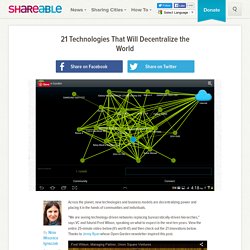
"We are seeing technology-driven networks replacing bureacratically-driven hierarchies," says VC and futurist Fred Wilson, speaking on what to expect in the next ten years. View the entire 25-minute video below (it's worth it!) And then check out the 21 innovations below. Thanks to Jenny Ryan whose Open Garden newsletter inspired this post. Here are 21 innovations that will help make it happen: The Other Factor that Makes an Idea Spread - Julianne Wurm. By Julianne Wurm | 11:00 AM February 17, 2014 How do ideas spread?

Previous research has focused on what happens to the sharers of an idea: what emotions they feel, what types of content inspire them to share (practical, funny, “sticky” and so on). And it is true that from memetics to mirror neurons to social contagion, it is likely that for any given idea, multiple factors are involved. And yet the role of content seems to get all of the focus. Culture tells us what to do when the leader isn't in the room. The top 10 Internet and technology trends for 2014. 1.
The Internet of things Little by little, all electronic devices are connecting to the Internet. It started with personal computers, notebooks, tablets and mobile phones. What Can Water Fleas Teach Us About Innovation? In business, innovation is non-negotiable.

Stay fresh, rot, or go stale. Why Google Glass is Doomed. Army CoCreate. Innovation 1000 Study. What shall we do with a neutron microscope? Neutrons have a set of unique properties that make them better suited than light, electrons, or x-rays for looking at the physics and chemistry going on inside an object.
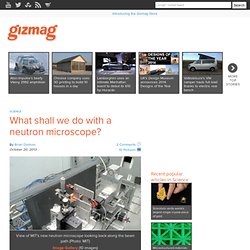
Scientists working out of MIT's Nuclear Reactor Laboratory have now invented and built a high-resolution neutron microscope, a feat that required developing new approaches to neutron optics. View all. Kenya's tech visionaries lead the way. It is mid-morning in Nairobi's iHub, a community space for techies and a kids' hackathon – where children as young as 10 are learning some of the basics of coding – is in full swing. The hangar-like space boasts table football, a coffee bar and an ambience that is more Seattle than African savannah. Amid the eager people huddled over laptops and tablets is the towering figure of Erik Hersman, with his bald head and reddish beard. Known to most Kenyans online as @WhiteAfrican, the American, who grew up in East Africa, has become one of the most effective evangelists for the technological future of his adopted country.
The co-founder of both the iHub and Ushahidi, software, which has been used from Haiti to New Zealand to crowd-source information and map crises, wants to challenge the notion of Africa being a single entity blighted by wars and famine. 5 Crazy New Man-Made Materials That Will Shape the Future. The Four Disruptive Technology Forces that Will Change the World. The shape of things to come: designs that will define the future. Most people feel anxious when their smartphone is out of arm's reach. But what if it was actually on your arm, woven into the very fabric of your sweater? Sportswear designers Under Armour are already on the case. They recently unveiled their touchscreen t-shirt concept, Armour39, which measures your athletic performance.It's just one recent example of how design, technology and science are coming together to form a new generation of consumer products that look set to shape the future.
Marcus Fairs, editor-in-chief of design magazine Dezeen, says that wearable technology will be a defining feature of future design. Fairs points to the likes of MC10, whose founder Professor John Rogers designed the stretchable circuit, and whose mission statement is to "extend human capabilities by making high-performance electronics virtually invisible, conformal, and wearable".
One step on from wearable technology is technology concealed inside the body altogether. Infographic: The World’s Technology Hubs. THE SIXTH WAVE: THE RISE OF THE CREATIVE CITIES. Innovation is no longer driven by states or nations. It’s driven by cities. The key for the future of competitiveness is the development of local ecosystems. And these ecosystems will be built around cities.
Infographic: The World’s Technology Hubs. The Rise of the Intangible Economy: U.S. GDP Counts R&D, Artistic Creation. On July 31, the U.S. Bureau of Economic Analysis will rewrite history on a grand scale by restating the size and composition of the gross domestic product, all the way back to the first year it was recorded, 1929.
The biggest change will be the reclassification—nay, the elevation—of research and development. R&D will no longer be treated as a mere expense, like the electricity bill or food for the company cafeteria. It will be categorized on the government’s books as an investment, akin to constructing a factory or digging a mine. In another victory for intellectual property, original works of art such as films, music, and books will be treated for the first time as long-lived assets. Atul Gawande: How Do Good Ideas Spread? Coca-Cola to open startup accelerators in nine countries around the world. Coca-Cola has already launched accelerators in Sydney and San Francisco.
Habits of Successful People: Start Before You Feel Ready. This Little Sticker Works Like an Anti-Mosquito Force Field. Creativity at the Workplace—It Is Possible. Insight. A Fifteen-Year-Old Has Invented an Incredible New Kind of Flashlight. Disruptive Innovation in Service of Social Business Growth (Part 1) Helix - An unexpected twist. Twist-off cork shifts the wine paradigm. Helix - An unexpected twist. The Concept Of Wabi-Sabi, And Why Perfection Is The Wrong Goal. Brain-to-brain interface allows transmission of tactile and motor information between rats.
The 10 Tech Terms to Know in 2013. Cognitive Radio. Companies See High-Tech Factories as Fonts of Ideas. Tracking innovations in the development of innovations - whatmore's posterous. 32 Innovations That Will Change Your Tomorrow. GE Ideas Roundtable - Sponsored. Why is sustainability seen as a rollercoaster for business leaders?
Design Thinking for Social Innovation. MIT'S Technology Review Identifies 10 Technologies Set to Transform Our World. Adobe Study Reveals Japan As The Most Creative Country. Designing the new normal. How Not to Kill Creativity – Jonah Lehrer LIVE on Big Think. Solve For X. Why Nations Fail. The Baloney Detection Kit: A 10-Point Checklist for Science Literacy. The truth about creativity - Author Interviews. Jonah Lehrer on How to Be Creative. A Wandering Mind Is an Intelligent Mind. Making Sense of Minimum Viable Products.
Innovation's Hidden Enemies - Alessandro Di Fiore. Design Indaba 2012: Trust Your Gut And Take Risks To Really Be Creative. The Giant Mirror of Viganella. 3 Ways To Predict What Consumers Want Before They Know It. Systematic Wonder: A Definition of Science That Accounts for Whimsy. Innovation and the Bell Labs Miracle. Brainstorming Doesn’t Really Work. Inventing the Digital Medium: An Interview with Janet Murray. Networked Knowledge and Combinatorial Creativity. Braden Kelley: The Value of Confusion - h... The Value of Confusion. Sharing App Bump 3.0 Slashes Most Features, Proves Less Really Can Be More. Crowdsourced Product Developers Open An Advanced Lab To Make Your Ideas Real. Why Being Sleepy and Drunk Are Great For Creativity. Annoucing Fuse Corps: a bold new approach to social innovation — Peter Sims. Innovation Problem: New Ideas Spread Slowly.