
Jim Crow Laws. Remembering Jim Crow : Presented by American RadioWorks. Jim Crow laws robbed African Americans of basic rights.
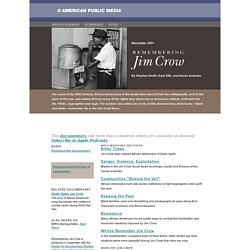
Danger, Violence, Exploitation Blacks in the Jim Crow South faced lynchings, insults and thievery at the hands of whites. Communities "Behind the Veil"African Americans built vital social institutions to fight segregation and uplift the race. Keeping the PastBlack families used oral storytelling and photography to pass along their memories of slavery and Reconstruction. ResistanceMany African Americans found subtle ways to combat the humiliation and economic hardship imposed by Jim Crow. Whites Remember Jim Crow In the southwestern Louisiana town of New Iberia, older whites say race relations were more peaceful during Jim Crow than they are now. Jim Crow LawsA sampling of repressive Jim Crow laws. Resources Informants, documentary audio and transcript, links, and books. List of Jim Crow law examples by State. A Black American drinks from a segregated water cooler in 1939 at a streetcar terminal in Oklahoma City.

This is a list of examples of Jim Crow laws, which were state and local laws in the United States enacted between 1876 and 1965. Jim Crow laws existed mainly in the South and originated from the Black Codes that were enforced from 1865 to 1866 and from prewar segregation on railroad cars in northern cities. The laws sprouted up in the late 19th century after Reconstruction and lasted until the 1960s.[1] They mandated de jure segregation in all public facilities, with a supposedly "separate but equal" status for black Americans. In reality, this led to treatment that was usually inferior to those provided for white Americans, systematizing a number of economic, educational and social disadvantages.[2] State-sponsored school segregation was declared unconstitutional by the Supreme Court of the United States in 1954 in Brown v.
Arizona[edit] California[edit] Colorado[edit] 1946 Columbia Race Riot. Jim Crow Laws - Separate Is Not Equal. “Marriages are void when one party is a white person and the other is possessed of one-eighth or more negro, Japanese, or Chinese blood.”
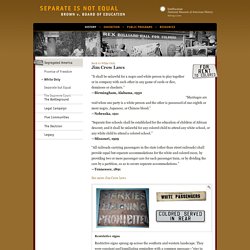
—Nebraska, 1911 “Separate free schools shall be established for the education of children of African descent; and it shall be unlawful for any colored child to attend any white school, or any white child to attend a colored school.” —Missouri, 1929 “All railroads carrying passengers in the state (other than street railroads) shall provide equal but separate accommodations for the white and colored races, by providing two or more passenger cars for each passenger train, or by dividing the cars by a partition, so as to secure separate accommodations.”
—Tennessee, 1891 See more Jim Crow laws Restricted real-estate covenant In communities across the country, property owners signed agreements called restrictive covenants. The Rise and Fall of Jim Crow. Jim Crow Stories. Harper Lee's To Kill a Mockingbird: Profiles in Courage. Activity 1.
History and cultural milieu of the deep South in 1930s America—an Introduction Use of the Internet, an LCD player, and speakers will be useful. Before beginning the novel, the students should read in class The Need for Change section of the EDSITEment-recommended We Shall Overcome: Historic Places of the Civil Rights Movement for general background information on what life was like for an African American living in the south under Jim Crow laws.
In addition to this site, the class should also examine Remembering Jim Crow from the Edsitement approved History Matters website History Matters. Particularly good sections from this site include those entitled "Bitter Times," "Danger Violence and Exploitation," "Whites Remember Jim Crow," and "Jim Crow Laws. " Both Remembering Jim Crow and We Shall Overcome will help students get a sense of the world Harper Lee describes in To Kill A Mockingbird. Questions to Consider During Class Discussion: Define Jim Crow. Activity 2. Activity 3.