
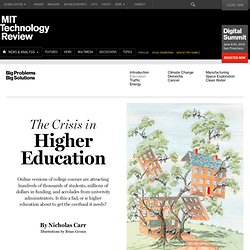
The Crisis in Higher Education. A hundred years ago, higher education seemed on the verge of a technological revolution.
The spread of a powerful new communication network—the modern postal system—had made it possible for universities to distribute their lessons beyond the bounds of their campuses. Anyone with a mailbox could enroll in a class. Frederick Jackson Turner, the famed University of Wisconsin historian, wrote that the “machinery” of distance learning would carry “irrigating streams of education into the arid regions” of the country. Sensing a historic opportunity to reach new students and garner new revenues, schools rushed to set up correspondence divisions. By the 1920s, postal courses had become a full-blown mania. The hopes for this early form of distance learning went well beyond broader access. We’ve been hearing strikingly similar claims today. Elite education for the masses. They included Patrycja Jablonska in Poland, Ephraim Baron in California, Mohammad Hijazi in Lebanon and many others far from Baltimore who ordinarily would not have a chance to study at the elite Johns Hopkins Bloomberg School of Public Health.
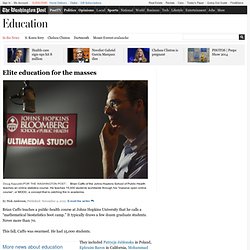
They logged on to a Web site called Coursera and signed up. They paid nothing for it. These students, a sliver of the more than 1.7 million who have registered with Coursera since April, reflect a surge of interest this year in free online learning that could reshape higher education. Openness, the double bind, and ecologies of yearning. » EdTech@VCCS. I’ve seen my share of conference keynotes, some tedious, some exhilarating, many forgettable.
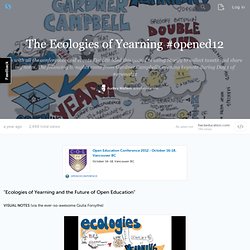
But I have never seen a keynote quite like the one delivered by Gardner Campbell on the morning of the first day of the OpenEd Conference. In fact, calling it a keynote is a disservice. It was more of a meditation. A performance. The Ecologies of Yearning #opened12 (with image, tweets) · audreywatters. Ecology of ideas -- Bateson Bateson's Hierarchy of Learning Zero learning: "receipt of signal.
" No error possible Learning 1: "change in specificity of response by correction of errors of choice within a set of alternatives. " Pavlov etc Learning 2: learning to learn; premises are self-validating (trap at this moment because of this) Learning 3: meta-contextual perspective; puts self at risk; questions become explosive; this is not just adaptation, habitation -- strategies where you can choose to adapt or not; this is where we become most human, says Bateson.
Learning 4: "probably does not occur in any adult living organisms on this earth" The hierarchy is discontinuous communication can be magically modified by communication there's something about a double bind that is a prison and the way out "transcontextual syndrome" beyond access and cost not merely open education but opening the possibility for networked transcontextualism. Don't fake the double-take.
Open Ed 12 - Gardner Campbell Keynote - Ecologies of Yearning. Essay critiques the ideas of Clay Shirky and others advocating higher ed disruption. Clay Shirky is a big thinker, and I read him because he’s consistently worth reading.
But he’s not always right – and his thinking (and the flaws in it) is typical of the unquestioning enthusiasm of many thinkers today about technology and higher education. In his recent piece on "Napster, Udacity, and the Academy," for example, Shirky is not only guardedly optimistic about the ways that MOOCs and online education will transform higher education, but he takes for granted that they will, that there is no alternative. Just as inevitably as digital sharing turned the music industry on its head, he pronounces, so it is and will be with digital teaching. And as predictably as rain, he anticipates that "we" in academe will stick our heads in the sand, will deny the inevitable -- as the music industry did with Napster -- and will "screw this up as badly as the music people did. " » Napster, Udacity, and the Academy Clay Shirky.
Fifteen years ago, a research group called The Fraunhofer Institute announced a new digital format for compressing movie files.
This wasn’t a terribly momentous invention, but it did have one interesting side effect: Fraunhofer also had to figure out how to compress the soundtrack. The result was the Motion Picture Experts Group Format 1, Audio Layer III, a format you know and love, though only by its acronym, MP3. The recording industry concluded this new audio format would be no threat, because quality mattered most. Who would listen to an MP3 when they could buy a better-sounding CD at the record store? Then Napster launched, and quickly became the fastest-growing piece of software in history. If Napster had only been about free access, control of legal distribution of music would then have returned the record labels.
Why Things Matter. Google I/O 2011: Ignite. Johnston. PLURALITY. Charlie 13 By Michael McMillian. Sight. Productivity Future Vision (2011) A Day Made of Glass 2: Same Day. Expanded Corning Vision.