
Meteorology. One is a neuron. The other is the structure of the universe. - Dharmachakra. After 400 years, mathematicians find a new class of solid shapes. The work of the Greek polymath Plato has kept millions of people busy for millennia.
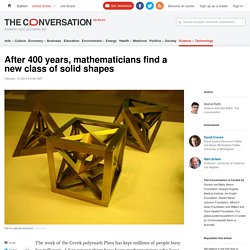
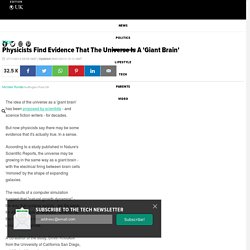
A few among them have been mathematicians who have obsessed about Platonic solids, a class of geometric forms that are highly regular and are commonly found in nature. Since Plato’s work, two other classes of equilateral convex polyhedra, as the collective of these shapes are called, have been found: Archimedean solids (including truncated icosahedron) and Kepler solids (including rhombic polyhedra). Nearly 400 years after the last class was described, researchers claim that they may have now invented a new, fourth class, which they call Goldberg polyhedra. Also, they believe that their rules show that an infinite number of such classes could exist. Physicists Find Evidence That The Universe Is A 'Giant Brain' The idea of the universe as a 'giant brain' has been proposed by scientists - and science fiction writers - for decades.
How Johannes Kepler Helped Land “Curiosity” On Mars. “He accepted the uncomfortable facts, preferred the truth to his dearest illusions.
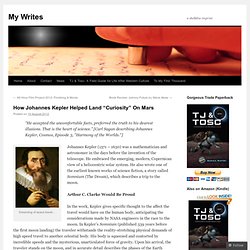
That is the heart of science.” [Carl Sagan describing Johannes Kepler, Cosmos, Episode 3, "Harmony of the Worlds. "] A New Look at the Hydrogen Wave Function. Christopher T.
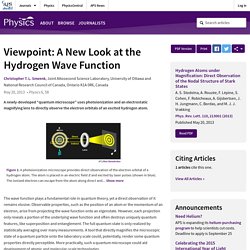
L. Smeenk, Joint Attosecond Science Laboratory, University of Ottawa and National Research Council of Canada, Ontario K1A 0R6, Canada A newly-developed “quantum microscope” uses photoionization and an electrostatic magnifying lens to directly observe the electron orbitals of an excited hydrogen atom. The wave function plays a fundamental role in quantum theory, yet a direct observation of it remains elusive.
Arctic melt season over, leaving behind more ice than recent years. After a brief time-out while its servers were protected from the flooding in Colorado, the National Snow and Ice Data Center's (NSIDC) website was back this week, just in time for its scientists to declare that the 2013 melt season had come to a close.
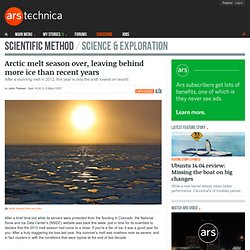
If you're a fan of ice, it was a good year for you. After a truly staggering ice loss last year, this summer's melt was nowhere near as severe, and in fact clusters in with the conditions that were typical at the end of last decade. If you've been following this for several years, you should note that the grey area, which shows two standard deviations from the average, is broader than it has been in years past.
The Vitamin Myth: Why We Think We Need Supplements. On October 10, 2011, researchers from the University of Minnesota found that women who took supplemental multivitamins died at rates higher than those who didn't.

Two days later, researchers from the Cleveland Clinic found that men who took vitamin E had an increased risk of prostate cancer. "It's been a tough week for vitamins," said Carrie Gann of ABC News. Decapitated Worms Regrow Heads, Keep Old Memories. In French Revolution-style, researchers decapitated flatworms—then did something that would give even Madam Defarge the creeps.
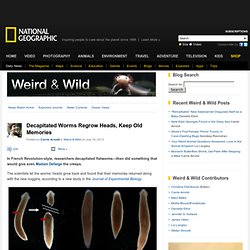
The scientists let the worms’ heads grow back and found that their memories returned along with the new noggins, according to a new study in the Journal of Experimental Biology. Researchers decapitated a flatworm (left), and then allowed its head to regrow (far right). Photograph courtesy Michael Levin and Tal Shomrat, Tufts University. Billionaire Offers $1 Million to Solve Math Problem. He dropped out of Baylor University , but Texas billionaire D.
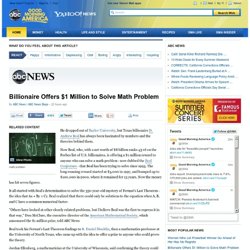
Andrew Beal has always been fascinated by numbers and the theories behind them. Now Beal, who, with a net worth of $8 billion ranks 43 rd on the Forbes list of U.S. billionaires, is offering a $1 million reward to anyone who can solve a math problem - now dubbed the Beal Conjecture - that Beal has been trying to solve since 1993. Breakthrough Propulsion Physics. Introduction Feature Artist's depiction of a hypothetical Wormhole Induction Propelled Spacecraft, based loosely on the 1994 "warp drive" paper of Miguel Alcubierre.
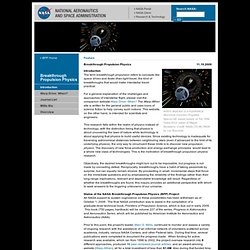
Credit: NASA CD-98-76634 by Les Bossinas. Introduction The term breakthrough propulsion refers to concepts like space drives and faster-than-light travel, the kind of breakthroughs that would make interstellar travel practical. Hawking vs Turok: Betting on the origin of the universe. The iconic scientist balked at Turok's proposal for a money wager, so they agreed on another kind of stake: bragging rights over which of them had discovered the true story of how both Creation and time began.
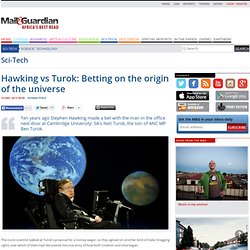
Their bet – which boils down a complex debate – was supposed to be settled by the Planck science satellite, which released its "spectacular" batch of data last month. Instead, the analysis of the data has left Turok fuming. Hawking champions the stan-dard big bang "inflation" theory, which says space and time began 13.72-billion years ago, and that Albert Einstein's laws did not apply to the first bizarre moments of creation. (Actually, last month, Planck adjusted our cosmic age to 13.8-billion, which means two-thirds of the water in your glass – the hydrogen part – is 80-million years older than you might have thought). Earth sweats as carbon levels approach threshold. And is likely to pass the symbolically important 400ppm level for the first time in the next few days. Readings at the United States government’s Earth Systems Research laboratory in Hawaii are not expected to reach their 2013 peak until mid-May, but were recorded at 399.72ppm on April 25.
The weekly mean average stood at 398.5 on Monday. Hourly daily readings above 400ppm have been recorded six times in the past week, and on occasion, at observatories in the high Arctic. But the Mauna Loa station, sited at 3400m and far away from major pollution sources in the Pacific Ocean, has been monitoring levels for more than 50 years and is considered the gold standard. A mighty wind. When a current passes between two electrodes — one thinner than the other — it creates a wind in the air between. If enough voltage is applied, the resulting wind can produce a thrust without the help of motors or fuel. This phenomenon, called electrohydrodynamic thrust — or, more colloquially, “ionic wind” — was first identified in the 1960s. Since then, ionic wind has largely been limited to science-fair projects and basement experiments; hobbyists have posted hundreds of how-to videos on building “ionocrafts” — lightweight vehicles made of balsa wood, aluminum foil and wire — that lift off and hover with increased voltage.
Despite this wealth of hobbyist information, there have been few rigorous studies of ionic wind as a viable propulsion system. Rupert Sheldrake Online - Homepage. Full AR5 draft leaked here. Using magnetism to understand superconductivity. Public release date: 4-Sep-2012 [ Print | E-mail Share ] [ Close Window ] Contact: Henrik Ronnowhenrik.ronnow@epfl.ch 41-792-517-302Ecole Polytechnique Fédérale de Lausanne Might it one day be possible to transmit electricity from an offshore wind turbine to land-based users without any loss of current?
Snapping an atom's shadow? Now that's a first. As the image above illustrates, my colleagues and I at Griffith University have been able to photograph the shadow of an atom for the first time – the culmination of five years of work by our team. The image, and attendant paper, are published today in the journal Nature Communications. So, in a nutshell, how did we get the image? The following analogy might help. On a sunny day at the beach, your shadow is a constant companion. Holding your hand up will block the bright sun, but a few rays will still penetrate the thinner parts of your fingers. Researchers discover a new kind of magnetism. Following up on earlier theoretical predictions, MIT researchers have now demonstrated experimentally the existence of a fundamentally new kind of magnetic behavior, adding to the two previously known states of magnetism.
Ferromagnetism — the simple magnetism of a bar magnet or compass needle — has been known for centuries. In a second type of magnetism, antiferromagnetism, the magnetic fields of the ions within a metal or alloy cancel each other out. In both cases, the materials become magnetic only when cooled below a certain critical temperature. The prediction and discovery of antiferromagnetism — the basis for the read heads in today’s computer hard disks — won Nobel Prizes in physics for Louis Neel in 1970 and for MIT professor emeritus Clifford Shull in 1994. “We’re showing that there is a third fundamental state for magnetism,” says MIT professor of physics Young Lee. Epic Water Tornado Spotted Near Sydney. Allianz AHHH Moments Not everything went to plan on the weekend.
Vote for your AHHH Moment below. James Tedesco injury against Manly20% Toward a New Model of the Cell. Date: December 17, 2012 Everything You Always Wanted to Know About Genes Turning vast amounts of genomic data into meaningful information about the cell is the great challenge of bioinformatics, with major implications for human biology and medicine. Breakthrough study overturns theory of 'junk DNA' in genome. Cold thermogenesis, anti-aging, and how to repair your DNA. Do we live in a computer simulation? UW researchers say idea can be tested. News releases | Research | Science December 10, 2012 A decade ago, a British philosopher put forth the notion that the universe we live in might in fact be a computer simulation run by our descendants.
While that seems far-fetched, perhaps even incomprehensible, a team of physicists at the University of Washington has come up with a potential test to see if the idea holds water. The concept that current humanity could possibly be living in a computer simulation comes from a 2003 paper published in Philosophical Quarterly by Nick Bostrom, a philosophy professor at the University of Oxford.
Scientists Prove DNA Can Be Reprogrammed by Words and Frequencies — the Power of Hyper-Communication. Physics of life: The dawn of quantum biology. Mathematical breakthrough sets out rules for more effective teleportation. Inside Insides. Bigfoot DNA Tests Prove Hairy Creature Exists, Genetic Researcher Says. Bigfoot is real. Scientist seeks surrogate mother for Neanderthal baby.
Reviving the Woolly Mammoth: Will De-Extinction Become Reality? Oldest Stone Spear Tips Found: Came About 200,000 Years Earlier Than Previously Thought : World. By Keerthi Chandrashekar (staff@latinospost.com) | First Posted: Nov 15, 2012 07:25 PM EST. Ants: What The Hell Are These Things, Anyway? Ant-Rant, Ant-Facts and Ant-Lore.
Photos: "Zombie" Ants Found With New Mind-Control Fungi. Slave rebellion is widespread in ants. Scientists Read Monkeys' Minds, See What They're Planning to Do Before They Do it. Fireflies Inspire Modification to LEDs that Makes Them 55 Percent More Efficient. New Research Blows Climate Science Wide Open. ACP - Abstract - Where do winds come from? A new theory on how water vapor condensation influences atmospheric pressure and dynamics. Stunning Map Reveals World's Earthquakes Since 1898 ǀ Plate Tectonics Map. Tree of life branches out online. Nyiragongo Crater: Journey to the Center of the World - The Big Picture.
Dazzling Map Shows More Than 150 Years of Hurricanes. Peeling Back the Hidden Pages of History With Hyperspectral Photography. 911:Energy - Wikicompany. Sixty Symbols - Physics and Astronomy videos. Ten Things Everyone Should Know About Time. 'I had a nightmare ... ' Climate change study forces sceptical scientists to change minds. Energy-related CO2 emissions in early 2012 lowest since 1992 - Today in Energy. Belgian Environmental Study Corroborates Existence and Effects of Weather Modification.
Transhumanism.