
Designing Rich (Math) Projects That Inspire. Of all the tools humans have ever created to help describe and understand our world, few are more useful than mathematics.

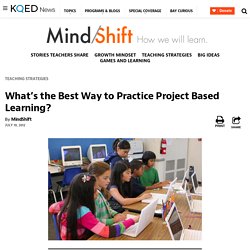
Math helps us map the world, build sturdy houses, diagnose disease—I could go on and on. Reading this blog right now is possible thanks to math! As a math teacher, this is obvious to me. But to my students, many of whom would actively tell you they hate math, it isn't. One of my biggest goals as an educator, therefore, is not just to teach students algebra and geometry—it's to change their very mindset toward math. What’s the Best Way to Practice Project Based Learning? By Peter Skillen Project Based Learning can mean different things to different people, and can be practiced in a variety of ways.
For educators who want to dive in, the good news is that a rich trove of resources are available. In order to create your own definition and practice, here are some parameters to consider. This diagram, enhanced by the critical eye of Brenda Sherry, can help you figure out what’s important to you and your students. We like to think with the frame of continua rather than dichotomies simply because things are rarely on or off, black or white, ones or zeroes. You could likely add other dimensions to consider as you build your own understandings and beliefs. Who is in control?
Who is asking the question to be investigated in the project? If the projects are collaborative in nature, you may wish to consider the amount of interdependence that students have with one another. Is the content a rich, deep problem space or is it a more narrowly focused content area? Project Based Learning vs. Problem Based Learning vs. XBL. By John Larmer, BIE Editor in Chief At the Buck Institute for Education, we’ve been keeping a list of the many types of “_____ - based learning” we have run across over the years.
Case-based learningChallenge-based learning Community-based learning Design-based learning Game-based learning Inquiry-based learning Land-based learning Place-based learning Problem-based learning Service-based learning Studio-based learning Team-based learning Work-based learning and our new fave…Zombie-based learning (look it up!) Let’s try to sort this out. The term “project learning” derives from the work of John Dewey and dates back to William Kilpatrick, who first used the term in 1918.
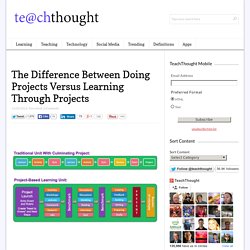
At BIE, we see Project Based Learning as a broad category, which as long as there is an extended “project” at the heart of it, could take several forms or be a combination of: Other X-BLs are so named because they use a specific context for learning, such as a particular place or type of activity. The Difference Between Doing Projects Versus Learning Through Projects. The Difference Between Doing Projects Versus Learning Through Projects by Terry Heick.
The Difference Between Projects And Project-Based Learning. The Difference Between Projects And Project-Based Learning by TeachThought Staff Projects in the classroom are as old as the classroom itself.
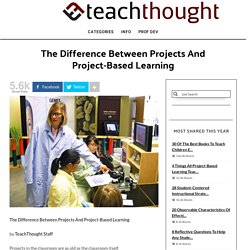
“Projects” can represent a range of tasks that can be done at home or in the classroom, by parents or groups of students, quickly or over time. Rubric. Practical PBL Series: Design an Instructional Unit in Seven Phases. As a new teacher, I once believed that teaching and learning were one and the same.
I taught, and the students learned. In creating a student-centered classroom, I began to embrace project-based learning. However, I did so in a very superficial way. I thought I had PBL nailed if my students did a presentation or poster at the end of an instructional unit. My room was full of student work. Six Strategies for Differentiated Instruction in Project-Based Learning. Project-based learning (PBL) naturally lends itself to differentiated instruction.
By design, it is student-centered, student-driven, and gives space for teachers to meet the needs of students in a variety of ways. PBL can allow for effective differentiation in assessment as well as daily management and instruction. PBL experts will tell you this, but I often hear teachers ask for real examples, specifics to help them contextualize what it "looks like" in the classroom.
We all need to try out specific ideas and strategies to get our brains working in a different context. Here are some specific differentiation strategies to use during a PBL project. 1. We all know that heterogeneous grouping works, but sometimes homogenous grouping can be an effective way to differentiate in a project. 2. Beyond Cut-and-Paste. Eliminate Topical Research Rituals The first step in fighting against simple cut-and-paste thinking is to gather all teachers together to discuss and adopt a school-wide policy outlawing the assignment of topical research projects.
"Students in this school will conduct research on questions of import that require they make answers rather than find them. We will no longer assign topical research or accept papers that are little more than a rehash of other people's ideas and thinking. " Replacing Topical Research with Questions of Import Questions of import usually require that students wrestle with difficult challenges and build their own answers rather than relying upon the thinking of others.
Example: Which of the following captains was the best at navigation? Captain James Cook Captain Matthew Flinders Captain George Vancouver Captain William Bligh The above question requires the collection and weighing of evidence to substantiate a well-considered judgment. 21st Century Skills 1. What Makes Project-Based Learning a Success?
At one high school in Texas, where every class in every grade is project based, the answer is devotion to a consistent process, belief in relationships, and commitment to relevance and rigor.
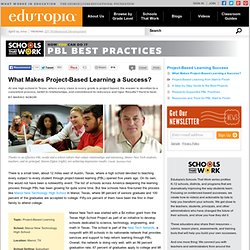
Results? Hard to beat. Thanks to an effective PBL model and a school culture that values relationships and autonomy, Manor New Tech students, teachers, and its principal, Steven Zipkes (right), are achieving impressive results. Credit: Zachary Fink. Project-Based Learning and Common Core Standards « The Whole Child Blog « Whole Child Education. The first question about Common Core State Standards, What will they look like?
, has been answered. The answer is: Very different. Free Project Based Learning resource available. Project Based Learning. BIE. Why Is Project-Based Learning Important? The old-school model of passively learning facts and reciting them out of context is no longer sufficient to prepare students to survive in today's world.
Solving highly complex problems requires that students have both fundamental skills (reading, writing, and math) and Digital Age skills (teamwork, problem solving, research gathering, time management, information synthesizing, utilizing high-tech tools). With this combination of skills students become directors and managers of their learning process, guided and mentored by a skilled teacher. A number of excellent works published in the last 10 years promotes this new set of 21st Century skills. The U.S.
Department of Labor Secretary's Commission on Achieving Necessary Skills (SCANS), the North Central Regional Education Lab's enGauge Web site, and WestEd's Learning, Technology, and Education Reform in the Knowledge Age are just a few. Want Better Project-Based Learning? Use Social and Emotional Learning. Today's guest blogger is Thom Markham, a psychologist, educator, and president of Global Redesigns, an international consulting organization focused on project-based learning, social-emotional learning, youth development, and 21st-century school design. An unfortunate legacy of the cognitive model that dominates education is the belief that everything important in life takes place from the neck up.
Using Inquiry Circles in Elementary Classrooms. Description: Master teachers Harvey Daniels and Stephanie Harvey explain how to use inquiry circle strategies to improve reading comprehension and collaboration in elementary literacy classrooms. Their DVD on... ... Master teachers Harvey Daniels and Stephanie Harvey explain how to use inquiry circle strategies to improve reading comprehension and collaboration in elementary literacy classrooms. Their DVD on inquiry circles is available at Less Tags: Video URL: Embeddable Player: Project-Based Learning. Project-Based Learning. From Groups to Teams: The Key to Powering up PBL. I don't believe that we have yet tapped the true power of project based learning. Right now, PBL is still kind of a cool way to address standards and, too often these days, is simply coverage by another name.
But its ultimate benefit is to help students think, learn, and operate in the new century by challenging them at deeper levels. That requires reversing the equation between skills and content: PBL is method for teaching students to find, process, understand, and share information, not a way to extend the industrial landscape of regurgitation and recall. In turn, that means we must get much better at using PBL for its primary purpose: Helping students be more skillful. To illustrate, I'll focus on our favorite 21st century skill, collaboration, a staple of most projects, as well as a source of problems in many projects. First, let's talk football. How to Build a Calendar for Project-Based Learning. Teachers want to know what the day-to-day looks like. I know I do. After generating great project ideas, I want to know exactly what my day-to-day looks like. There is a pitfall there. Sometimes we plan the calendar too quickly.
When this is done, projects can be unsuccessful. "The project went longer than I thought. " "I forgot a lesson, or didn't think that the students would need it. " These all stem from rushing too quickly to the calendar. Begin with the End in Mind Look at the products students are creating. In it, you can see the teacher thought about not only important essential questions and content, but also skills, like taking photographs. Open Your Filing Cabinet Please, please, please don't reinvent the wheel.