
Composers 'R' Fretboard1-9. Interactive Circle of Fifths. Interactive Circle of Fifths User's Guide. The Interactive Circle of Fifths ("the Circle" for short) is a tool designed to help musicians to: figure out the key of a piece of music easily transpose music to a different key compose new music understand key signatures, scales, and modes The concept of the circle of fifths is not a new one (see this Wikipedia article for more information), but there is more to this simple, yet profound structure than the traditional diagram can easily convey.
The Interactive Circle of Fifths goes beyond the limitations of a static diagram without sacrificing clarity and simplicity. This User's Guide will help you get the most out of the Circle, while introducing some basic music theory concepts. Petrucci Music Library: Free Public Domain Sheet Music. Welcome to The World of Holophonics™ Piano Instruction: Chopin Prelude No. 4 in E minor, Op. 28, Teacher, Shirley Kirsten. Chopin composed 24 Preludes in Op. 28 exploring 24 different keys (Major and minor) with each Prelude having its own mood and character.
In my step-by-step practicing of the E minor Prelude, I start with the Left Hand with its chordal mosaic, and listen attentively for descending chromatic movement between chords. In the foundational learning process, I want to be aware of common tones and those voice or voices within the sonorities that move. (Note that there are some progressions that are not chromatic) I also need to use a supple wrist so I don’t enter the chords too fast, or with unnecessary impact. Listening across the chords helps to avoid a vertical rendering. Next, I shape the right hand, which is especially challenging with its long notes in Largo tempo. Finally, I play hands together trying to keep a nice balance between chords and melody, listening for how the passing, chromatic and other harmonies nourish the expressive line above.
Stress in Piano Playing. Richard Beauchamp Notes of a talk prepared for a BAPAM conference in Edinburgh in 1999 - aimed at physiotherapists and doctors Some causes of Stress | Prevention of Injury | Sitting and posture | Practice technique | Building stamina | Playing technique | Minimising stress | Post injury programme | Categories of technique What, and how much, do pianists practise?

Many professional pianists spend an hour or more daily on technique as such. A technical training of this kind is required by most pianists if they wish to be serious contenders in the highly competitive world of their profession. Some pianists reach a stage where they feel that they get all the technical practice they need to keep their playing in good order through the music they are playing. Time has to be spent on note learning. JAZZ COURSES SCHEDULE : Jazz Lessons, Blues Lessons, Improvisation Lessons, Saxophone Lessons, Piano lessons, Music Theory. Bach Scholar: Links. List of musical symbols. Lines[edit] Clefs[edit] Clefs define the pitch range, or tessitura, of the staff on which it is placed. Learning and Loving Music Theory. Kelvin, You actually caught a mistake on the roman numerals!
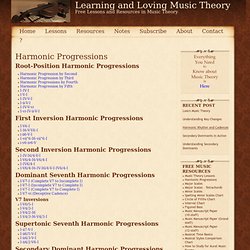
Thanks, I’ll have to fix that. Traumatic Skies by Sedate Illusion. Exercises from musictheory.net. Lesson.html from angelfire.com. Isidor Phillip - Exercises for Independence of Fingers - Book 1: Piano Technique (0073999272109): Isidor Philipp. Piano exercises and studies (books) - shared folder - free file sharing and storage. Free PDF Sheet Music - Hanon Exercises. Determining chord progressions in a song. Free Music Theory Worksheets! Musical Composition. Emily Bear Academic All-Star Salute 5-27-2010.
SheetzBox - Free Piano Sheet Music. Chord Progressions in Tonal Music. Products : Overview. How Music Works is a comprehensive suite of multimedia tutorials which explain music in clear, simple language you can relate to. Packed with 115 topics in nine tutorials, and illustrated with 360 diagrams and 750 demonstration sounds, the tutorials start with the very basics of music and advance to topics which are valuable even for professional musicians.
Whatever musical instrument or style you are interested in, these tutorials will be an essential source of information and guidance for years to come. The How Music Works tutorials are available online at www.howmusicworks.org but these tutorials are not printable and do not have the sounds. To get the full benefit of the tutorials, the ChordWizard Music Theory software is highly recommended. Teor&a - Music Theory Web. 1 guitar 2 players! ATLAS of Plucked Instruments. UkuleleCircleofFifths.jpg (1138×1068) Relative key. Circle of fifths showing major and minor keys Relative tonic chords on C and A ( Play ).
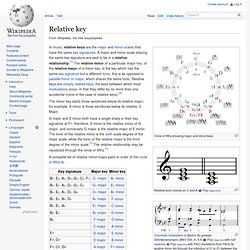
Chromatic modulation in Bach's Du grosser Schmerzensmann, BWV 300, m. 5-6 ( Play with half cadence, Play with PAC) transitions from FM to its relative minor dm through the inflection of C♮ to C♯ between the second and third chords. The minor key starts three semitones below its relative major; for example, A minor is three semitones below its relative, C Major. Roger Linn Design - New Musical Instrument Prototype. Andy McKee - Guitar - Drifting - www.candyrat.com. Scales and More. El Sistema. El Sistema is a publicly financed voluntary sector music education program in Venezuela, founded in 1975 by economist and musician José Antonio Abreu under the name of Social Action for Music.
For many years its official name was Fundación del Estado para el Sistema Nacional de las Orquestas Juveniles e Infantiles de Venezuela, (FESNOJIV), which is sometimes translated into English as "National Network of Youth and Children's Orchestras of Venezuela". It has recently changed to Fundación Musical Simón Bolívar (FMSB) but it is still widely known by the FESNOJIV acronym.[1] El Sistema is a state foundation which watches over Venezuela's 125 youth orchestras and the instrumental training programmes which make them possible. The organization has 31 symphony orchestras, and between 310,000 to 370,000 children attend its music schools around the country.[2] 70 to 90 percent of the students come from poor socio-economic backgrounds.[2] History[edit] Abreu's vision[edit] Scales and emotions. See also a post about making chords from scales.
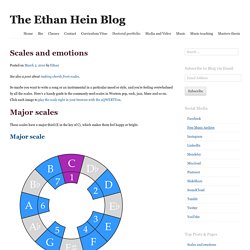
So maybe you want to write a song or an instrumental in a particular mood or style, and you’re feeling overwhelmed by all the scales. Here’s a handy guide to the commonly used scales in Western pop, rock, jazz, blues and so on. Click each image to play the scale right in your browser with the aQWERTYon. These scales have a major third (E in the key of C), which makes them feel happy or bright. Major scale. Ricci Adams' Musictheory.net.
Chord Calculator. Think you know Music ? See how much there is you didnt know! MusicalMind.org Ear Training Online. Eric Lewis rocks the jazz world. Eric Lewis plays chaos and harmony. Chopin, Frederic - Prelude in E minor Op.28 No.4 sheet music. The Sacred Geometry Of Music. The Sacred Geometry Of Music by Andrew Lorimer Music uses the laws of vibration to manifest aurally what exists at the center of everything.
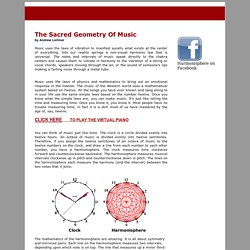
Into our reality springs a non-visual harmonic law that is universal. The notes and intervals of music speak directly to the chakra centers and causes them to vibrate in harmony to the vibration of a string or vocal chords, speakers moving through the air, or the sound of someone’s lips making a farting noise through a metal tube. Music uses the laws of physics and mathematics to bring out an emotional response in the listener. The music of the Western world uses a mathematical system based on Twelve. All the songs you have ever known and sang along to in your life use the same simple laws based on the number twelve. Clock Harmonisphere The mathematics of the harmonisphere are amazing. When we measure the same chords on the harmonisphere, the seven chords have the same mirrored combinations as the piano: With or Without You - Impromptu Guitar Performance on Vimeo.
Key Chords. Key Chords app generates guitar chord progressions automatically.

Use it free online, or get the app for Mac, Windows or iOS (iPad) - Click on a chord to preview how it sounds. - Drag and drop to arrange the chord progression - Tweak the settings to control the playback speed Or role the dice and Key Chords will automatically generate a nice sounding progression. Select a Key: Canadian Guitar Festival 2010: Finalist 1, Song 2 - 1st Place. 21 Cool 3 Notes-Per-String Exercises to Rock On! Photo by Jsome1 Playing 3 notes per string exercises is something I do on a regular basis.
I use them to warm up, to become a faster guitar player and to spice up my improvisation. 3 notes per string licks and scales are generally used for speed picking. Whenever you hear a guitar player playing these really fast terrifying licks, it’s probably a 3 notes per string lick. Emily Bear Take Five. Emily Bear Out Of Control. Emily Bear Chopin Waltz Op 64 no 2.