
New signs of language surface in mystery Voynich text - physics-math - 21 June 2013. Read full article Continue reading page |1|2 A mysterious and beautiful 15th-century text that some researchers have recently deemed to be gibberish may not be a hoax after all.
A new study suggests the text shares quantifiable features with genuine language, and so may contain a coded message. That verdict emerges from a statistical technique that puts a figure on the information content of elements in a text or code, even if their meaning is unknown. The technique could also be used to determine whether there is meaning in genomes, possible messages from aliens or even the signals between neurons in the brain. The Voynich manuscript has baffled and captivated researchers since book dealer Wilfred Voynich found it in an Italian monastery in 1912.
Word entropy Now Marcelo Montemurro of the University of Manchester in the UK and colleagues have analysed the text using a technique that pulls out the most meaningful terms. Relatedness score Word clusters More From New Scientist More from the web. Hypothese slave. The Voynich Manuscript - Wikibooks, collection of open-content t. Welcome[edit] A floral illustration on page 32.
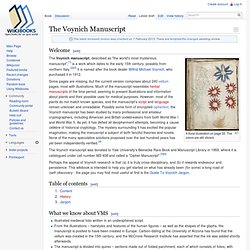
The colors are still vibrant. The Voynich manuscript, described as "the world's most mysterious manuscript",[1] is a work which dates to the early 15th century, possibly from northern Italy.[2][3] It is named after the book dealer Wilfrid Michael Voynich, who purchased it in 1912. Some pages are missing, but the current version comprises about 240 vellum pages, most with illustrations. Much of the manuscript resembles herbal manuscripts of the time period, seeming to present illustrations and information about plants and their possible uses for medical purposes. The Voynich manuscript was donated to Yale University's Beinecke Rare Book and Manuscript Library in 1969, where it is catalogued under call number MS 408 and called a "Cipher Manuscript".[5][6] Perhaps the appeal of Voynich research is that (a) it is truly cross-disciplinary, and (b) it rewards endeavour and persistence.
Table of contents[edit] What we know about VMS[edit] The Voynich manuscript, a puzzling manuscript... Voynich Manuscript. Voynich manuscript. The Voynich manuscript is an illustrated codex hand-written in an unknown writing system.
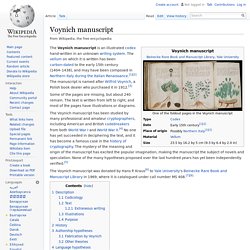
The vellum on which it is written has been carbon-dated to the early 15th century (1404–1438), and may have been composed in Northern Italy during the Italian Renaissance.[1][2] The manuscript is named after Wilfrid Voynich, a Polish book dealer who purchased it in 1912.[3] Some of the pages are missing, but about 240 remain. The text is written from left to right, and most of the pages have illustrations or diagrams. The Voynich manuscript has been studied by many professional and amateur cryptographers, including American and British codebreakers from both World War I and World War II.[4] No one has yet succeeded in deciphering the text, and it has become a famous case in the history of cryptography.
Voynich. John Baez January 30, 2005 The Voynich manuscript is the most mysterious of all texts.
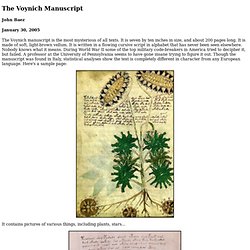
It is seven by ten inches in size, and about 200 pages long. It is made of soft, light-brown vellum. It is written in a flowing cursive script in alphabet that has never been seen elsewhere. It contains pictures of various things, including plants, stars... ... and most strangely of all, nude maidens bathing in what looks like some very elaborate plumbing: Wired 12.09: Scientific Method Man. Two years ago, an Englishman named Gordon Rugg slipped back in time.
Night after night he spread his papers on the kitchen table once his children had gone to bed. Working on faux parchment with a steel-nibbed calligraphic pen, he scribbled a strange, unidentifiable, vaguely medieval script. Transliterated into the Roman alphabet, some of the words read: "qopchedy qokedydy qokoloky qokeedy qokedy shedy. " As he wrote, he struggled to get inside the mind of the person who had first scrawled this incomprehensible text some 400 years ago.
Then came Rugg. When the news of Rugg’s breakthrough was published last winter, everyone missed the bigger story. Rugg calls it the verifier approach, and the Voynich was its first major test. MANUSCRIT VOYNICH / MS 408. Le manuscrit Voynich. Le mystère du manuscrit de Voynich Pour la Science no 323, Septembre 2004 Gordon Rugg est professeur au Département de mathématiques et d'informatique de l'Université de Keele, en Angleterre, et rédacteur en chef de la revue Expert Systems.
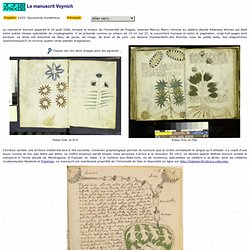
Une nouvelle analyse d'un document médiéval énigmatique suggère qu'il ne contient que des suites de mots dépourvues de sens. En 1912, Wilfrid Voynich, un libraire américain spécialiste de livres rares, fit la découverte de sa vie dans la bibliothèque de la Villa Mandragone près de Rome: un manuscrit de quelque 230 pages écrit en caractères étranges et illustré de surprenants dessins de plantes, de sphères célestes et de baigneuses.
À première vue, le manuscrit ressemblait à un manuel d'alchimiste ou d'herboriste, mais il était entièrement codé. L'oeil du bébé dieu L'essai de Newbold a été le premier d'une série d'échecs. Un code pour la tromperie Un code, mais pas de message - G. Diaporama.